That's a very good question, we tend to be extra cautious and say to use 10 gauge wire because that would be more than enough. When you get into longer trailers that will end up using a lot of wire the heavier gauge wire becomes more necessary.…
...It sounds like you are speaking of the wires for the brake magnets. If this is correct, you will need to connect one of the wires to the brake controller output wire on your trailer connector...
...a 10 gauge power wire like item # 10-1-1 from the 12 volt auxiliary terminal on the 7-Way trailer connector on the trailer to the positive terminal on the trailer battery and ground the negative terminal...
...Trailer Breakaway Kit # 3802346 as well as 10 Gauge Wire # 10-1-1, Butt Connectors # DW05745-10, and a Junction Box # e99011 (if you don't already have a 7-Way).
What made you want to add brakes to your...
Hello Rene, thanks for reaching out. It is pretty typical for RV manufacturers to use axles that are not rated for the full GVWR. They say this is because 10%-15% of the camper weight is on the hitch instead of the axles. They will put the bare…
The difference between the Class II and Class III hitches has to do with their Gross Trailer Weight (GTW), their Tongue Weight (TW), and their Hitch Receiver Size. Class II trailer hitch receivers have a 1-1/4 inch receiver and can be rated up to…
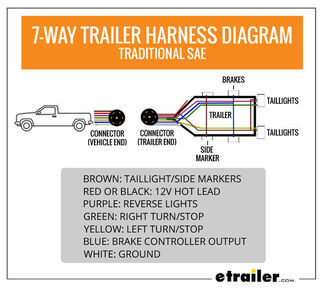
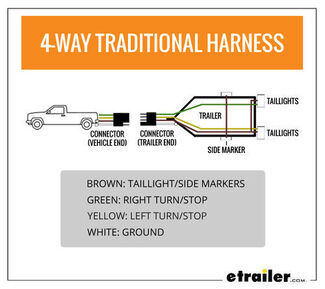
A 4-Way trailer connector has the basic lighting functions only; running lights, left turn signal and brake lights, right turn signal and brake lights, and ground. A 7-Way has these functions and a 12 volt circuit, a circuit for electric trailer…
...with junction box, then you can use jacketed 7-wire, or like just 12-14 gauge wire (both sold by the foot) if you have some laying around. You would also need butt connectors or heat shrink. Here is what I...
...lighting and then for the trailer wiring you'd want the part # 118786. Essentially you'd plug both kits into each and then install them inline with the taillight harness connectors....
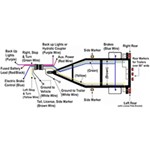
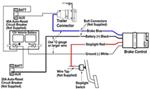
...diagrams showing the proper way to wire a vehicle and trailer side 7-way trailer connector.
If can you open up the existing 6-way connector on your trailer, take the housing apart and look...
That's a very good question, we tend to be extra cautious and say to use 10 gauge wire because that would be more than enough. When you get into longer trailers that will end up using a lot of wire the heavier gauge wire becomes more necessary.…
...It sounds like you are speaking of the wires for the brake magnets. If this is correct, you will need to connect one of the wires to the brake controller output wire on your trailer connector...
...a 10 gauge power wire like item # 10-1-1 from the 12 volt auxiliary terminal on the 7-Way trailer connector on the trailer to the positive terminal on the trailer battery and ground the negative terminal...
...Trailer Breakaway Kit # 3802346 as well as 10 Gauge Wire # 10-1-1, Butt Connectors # DW05745-10, and a Junction Box # e99011 (if you don't already have a 7-Way).
What made you want to add brakes to your...
Hello Rene, thanks for reaching out. It is pretty typical for RV manufacturers to use axles that are not rated for the full GVWR. They say this is because 10%-15% of the camper weight is on the hitch instead of the axles. They will put the bare…
The difference between the Class II and Class III hitches has to do with their Gross Trailer Weight (GTW), their Tongue Weight (TW), and their Hitch Receiver Size. Class II trailer hitch receivers have a 1-1/4 inch receiver and can be rated up to…
A 4-Way trailer connector has the basic lighting functions only; running lights, left turn signal and brake lights, right turn signal and brake lights, and ground. A 7-Way has these functions and a 12 volt circuit, a circuit for electric trailer…
...with junction box, then you can use jacketed 7-wire, or like just 12-14 gauge wire (both sold by the foot) if you have some laying around. You would also need butt connectors or heat shrink. Here is what I...
...lighting and then for the trailer wiring you'd want the part # 118786. Essentially you'd plug both kits into each and then install them inline with the taillight harness connectors....
...diagrams showing the proper way to wire a vehicle and trailer side 7-way trailer connector.
If can you open up the existing 6-way connector on your trailer, take the housing apart and look...
Wire connectors are crucial for secure and efficient electrical connections in various applications, from trailers to marine setups. They ensure a solid connection, are easy to install, and often come with features like heat shrink insulation for added durability.
Wire connectors provide a secure and reliable connection, essential for trailer wiring where vibrations and weather conditions can affect performance. They ensure that connections remain intact, preventing issues with lights and brakes.
For marine applications, look for wire connectors with heat shrink insulation and corrosion-resistant materials. These features protect against moisture and saltwater, ensuring long-lasting connections even in harsh environments.
Wire connectors are easy to install, making them ideal for DIY projects. They often come with clear instructions and require minimal tools, allowing enthusiasts to confidently tackle wiring tasks without professional help.
Yes, many wire connectors are designed to handle high-current applications. It's important to choose connectors rated for the specific current and voltage of your project to ensure safety and performance.
Heat shrink wire connectors offer added protection by sealing the connection against moisture and contaminants. This feature enhances durability and reliability, making them ideal for outdoor and marine applications.