Breakaway kits are designed to bring trailers safely to a stop by activating the electric brakes should a trailer disconnect from the tow vehicle during transit. Ideally, the safety chains will prevent a trailer from disconnecting if the coupler comes off the ball. However, if the safety chains fail, the breakaway kit acts as a last line of defense against a runaway trailer. This type of safety system is required in most states for trailers weighing more than 3,000 lbs.
The following article will describe how to:
Connection to the auxiliary power wire from the tow vehicle
needed only if the breakaway kit has a charger
Mounting the breakaway kit:
Locate a secure surface on the trailer to mount the breakaway kit battery box.
A typical position is on the inside of one of the trailer frames in the front of the trailer.
Self-tapping screws or U-bolts are usually included for mounting the battery box.
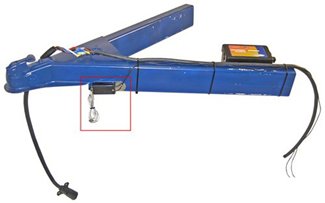
Mount the breakaway switch close to the trailer coupler so the cable can be attached to the vehicle.
Also, mount the breakaway switch close enough to the battery box so their wires can connect.
A typical position is on the outside of the trailer frame between the trailer connector and the battery box.
NOTE: The switch is held in place with only one screw.
It needs to be tight but not so tight that it cannot rotate to allow the pin to be pulled out.
Wiring a Breakaway Kit
Breakaway Kit without a Built-in Charger
Breakaway kits without battery chargers require three connections.
Remember to periodically remove the battery from the box to charge it, or replace it accordingly.
Splice one of the two wires coming out of the breakaway switch into the trailer brake wire running from the trailer connector to the brakes.
Connect the second wire coming out of the switch to the brake wire (blue) coming out of the battery box.
This connection will send power to the breakaway switch.
NOTE: Both wires on the breakaway switch are interchangeable.
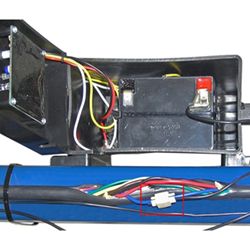
Splice the white wire coming out of the battery box into the existing ground wire (usually white) running from the trailer connector to the trailer, or screw the white wire directly to the trailer frame.
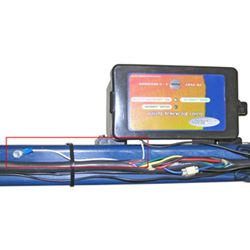
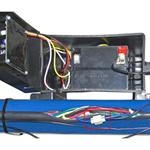
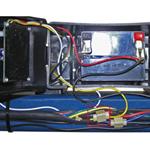
The white wire from the battery charger has been grounded to the trailer frame
The first switch wire has been spliced into the blue trailer feed wire
Hopkins Breakaway Kit with a Built-in Charger
Hopkins breakaway kits with built-in chargers require four connections.
One connection has already been made inside the battery box.
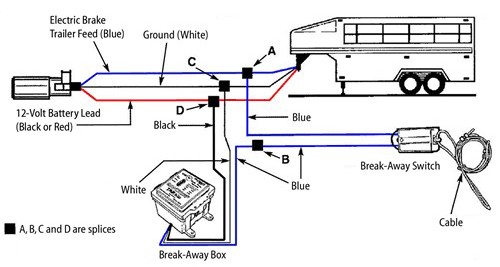
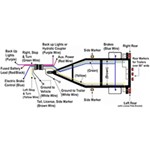
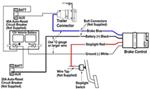
This diagram shows a typical wiring configuration for a Hopkins breakaway kit with a battery charger.
Some other manufacturers have similar configurations, but not all wire colors are the same.
Consult your breakaway kit directions before installation to verify the wiring configuration.
Splice one of the two wires coming out of the breakaway switch into the trailer brake wire running from the trailer connector to the brakes
See point A on the wiring diagram
Connect the second wire coming out of the switch to the brake wire (blue) coming out of the battery box.
See point B on the wiring diagram
This connection will send power to the breakaway switch.
NOTE: Both wires on the breakaway switch are interchangeable.
Splice the white wire coming out of the battery box into the existing ground wire (usually white) running from the trailer connector to the trailer, or screw the white wire directly to the trailer frame
See Point C on the wiring diagram
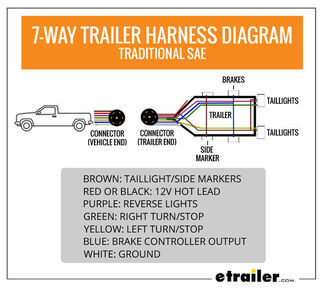
Splice or run the 12 volt hot lead (black) coming out of the battery box into the 12 volt hot lead running from the trailer connector to the trailer
See Point D on the wiring diagram
This connection will charge the battery when the vehicle is in use.
Hopkins Diagram
Wiring a Tekonsha or Tow Ready Breakaway Kit with a Built-in Charger
The Six Required Connections:
1. Splice one of the two wires coming out of the breakaway switch into the trailer brake wire running from the trailer connector to the brakes.
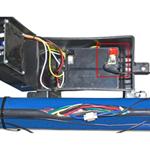
The first switch wire has been spliced into the blue trailer feed wire
2. Open the battery box and connect the second wire coming out of the switch to the positive post (red) on the battery.
This connection will send power to the breakaway switch.
NOTE: Both wires on the breakaway switch are interchangeable.
The second switch wire has been connected to the positive red post on the battery
3. Connect the red wire on the charger to the positive post (red) on the battery.
This connection charges the battery.
There should now be two wires connected to the positive post: the second switch wire and the red charger wire.
Connect the black wire on the charger to the negative post (black) on the battery.
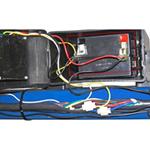
The red and black wires from the charger have been connected to the battery
4. Splice the white wire on the charger into the existing ground wire (usually white) running from the trailer connector to the trailer, or screw the white wire directly to the trailer frame.
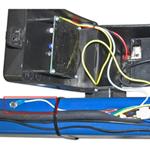
The white wire from the battery charger has been grounded to the trailer frame
5. Splice or run the 12 volt hot lead (black for Tekonsha, yellow for Tow Ready) on the charger into the 12 volt hot lead running from the trailer connector to the trailer.
This connection will charge the battery when the vehicle is in use.
The 12 volt hot lead wire from the charger has been spliced into the trailer 12 volt hot lead
Attaching the Cable to the Tow Vehicle
The breakaway switch cable needs to be secured to the vehicle bumper or frame. The cable can be attached in many different ways. The two most common methods are:
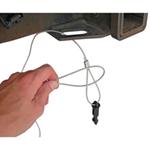
Route the pin through the safety chain loops on the hitch or bumper, then through the cable loop
-or-Route the pin through a tow hook, then through the cable loop.
Notes:
The cable should come straight out from the switch to attach to the vehicle
Any angular attachment may cause breakaway switch failure
Secure the cable on the same side of the trailer frame as you mount the breakaway switch
Do not loop the cable over the hitch ball; the cable may bounce off while the vehicle is moving
Before towing, test the breakaway kit by pulling the pin out of the switch to activate the brakes
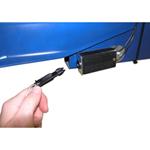
The cable pin has been pulled our of the breakaway switch, activating the trailer brakes
The cable pin is passing through the safety chain pocket and the cable loop on its way back to the switch
When you say, "Splice one of the two wires coming out of the breakaway switch into the trailer brake wire running from the trailer connector to the brakes
See point A on the wiring diagram"
Does that mean to cut the trailer brake wire in half and then connect these two cut pieces with the wire coming from the breakaway box? So that you are actually connecting three pieces of wire at POINT A, correct?
Thanks in advance,
Terry
The correct way to wire your breakaway battery, like the Hopkins Engager #20400, is to have the black wire from the battery connected to the 12V power on your trailer, and then the blue wire to your breakaway switch which, in turn, connects to the…
It sounds like you are speaking of the wires for the brake magnets. If this is correct, you will need to connect one of the wires to the brake controller output wire on your trailer connector and the other wire will need to be grounded to a clean…
Hey Bob! The Big Truck Big RV Tongue Weight Scale for Trailers - 2,000 lbs #BTBRV49FR works with standard 1-7/8", 2", and 2-5/16" ball couplers. Simply lower the trailer coupler onto the scale and read the tongue weight directly from…
Hey Moses! With that GVWR you either have the 2026 Grand Design Imagine 2670MK or the 2800BH. The correct rating for a weight distribution hitch (WDH) depends on your tongue weight. It looks like the dry tongue weight for the 2670MK is 785 lbs and…
If you still have the plunger end that goes in the break away switch, then you can simply insert the plunger back into the switch and that should cut off the power to the brakes on your trailer. If you no longer have the plunger, then you can either…
I currently have four different self-adjusting assemblies for your boat trailer with 10" x 2-1/4" electric drum brakes. You can choose from the following: -Terran Axle Electric Trailer Brakes #TX97ZJ (3,500 Axles) -etrailer Electric Trailer…
That's a very good question, we tend to be extra cautious and say to use 10 gauge wire because that would be more than enough. When you get into longer trailers that will end up using a lot of wire the heavier gauge wire becomes more necessary.…
On this page (typically below the product links) there is a helpful link section that will have the install instructions fo the Hopkins Breakaway kit part #20400 that you referenced. I also attached an install video that shows the kit installed as…
I attached a diagram showing how a breakaway switch, like part #420000, would be wired to a trailer mounted battery like the one on your Loudo dump trailer. With this type of setup you would not want to pull the breakaway switch with the trailer…
I may have a solution for you but I'm not aware of a bolt on safety chain bracket or clevis that can be used. However you can simply take a safety chain set (or your existing chains) like the 42" Long Safety Chain with 3/8" Clevis Hook…
Hi Rusty; the Dexter #84546UC3-EZ and etrailer #AKHD-5475-35-K will both fit a 3,500 lb axle but they have different bolt patterns. You already ordered the Dexter in the past so I'm assuming your wheels are 5 on 4-1/2. For the same bolt pattern…
You need a breakaway battery charger if you want to maintain the battery charge on your breakaway kit using your tow vehicle's 7-way trailer connector. The 12 volt battery on breakaway kits, like all batteries, will self-discharge over time.…
"I like the easy of navigation through the site. It only took me a couple of minutes to place my order. Thank You I will shop this sight again in the future."













Terry
4/4/2026
When you say, "Splice one of the two wires coming out of the breakaway switch into the trailer brake wire running from the trailer connector to the brakes See point A on the wiring diagram" Does that mean to cut the trailer brake wire in half and then connect these two cut pieces with the wire coming from the breakaway box? So that you are actually connecting three pieces of wire at POINT A, correct? Thanks in advance, Terry