If your trailer has wheels, odds are it’s got electric brakes. They’re the most common setup out there — simple, cost-effective, and easy to replace compared to hydraulic systems. But here’s the catch: they only work if you set them up right and know their quirks. Skip a key step, and you’ll end up wondering why your brand-new brakes feel worse than the worn-out ones you just pulled off.At etrailer, we’ve worked on every style of trailer brake imaginable — from boat haulers to fifth wheels — and we’ve seen the same mistakes again and again. This guide breaks down how electric brakes work, how to keep them working, and which ones you actually need for your trailer.
The big win with electric trailer brakes is control. Pair them with a brake controller and you can dial in exactly how much stopping power you need. Heavy equipment trailer? Crank it up. Empty utility trailer? Turn it down. Hydraulic brakes don’t give you that kind of fine-tuning.They’re also low-maintenance — especially if you choose self-adjusting trailer brakes. Once installed and properly broken in, they can run for 5–10 years without you touching them. For most folks, that’s as “set it and forget it” as trailer parts get.
How Electric Trailer Brakes Work (and Why a 7-Way Plug Isn’t Enough)
Here’s the simple version:
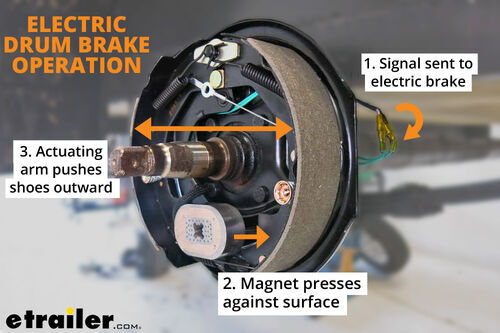
A brake controller in your tow vehicle sends power through the blue wire.
That power energizes the electromagnet inside the brake drum.
The magnet grabs the armature surface, pushes the brake shoes apart, and slows the trailer.
More Power = Stronger Magnet = More Braking Force.And no, having a 7-way plug on your truck isn’t enough. The controller takes the signal from your truck’s brake pedal and decides how much juice to send back to the trailer brakes. It’s basically the brains of the operation. Without a brake controller, your electric brakes are just expensive decorations. Nearly every new full-size truck or SUV include factory brake controllers, but always double-check.
The Right Way to Break In New Trailer Brakes
Fresh out of the box, electric brakes feel terrible. That’s normal. The friction material today is harder than the old asbestos stuff, so it won’t “grab” until you bed them in.Here’s how:
Find a safe stretch of road (40–50 mph is fine).
Use the manual override on your brake controller to slow the truck and trailer down to about 20 mph — do NOT touch your truck brakes.
Repeat 12–15 times minimum. Self-adjusting brakes may take 30–40 cycles before they’re dialed in.
Let them cool a bit between runs. You should smell them and feel heat in the hubs if you’re doing it right.
Skip this step, and your “new” brakes will feel worse than the worn-out ones you just pulled off.
Manual Adjust vs. Self-Adjusting Trailer Brakes: Which to Choose?
Manual Adjust Electric BrakesCheaper up front, but you have to crawl under and tweak the square adjuster wheel regularly. Most folks don’t, and performance suffers.
Self-Adjusting Electric BrakesCosts a little more, but they tighten themselves each time you brake. Once broken in, you don’t touch them again.
Electric Trailer Brake Mistakes and How to Avoid Them
1. Skipping the Break-In
New brakes feel weak until they’re bedded in. Do the heat cycles or don’t bother complaining — that’s how they’re designed.2. Grease Contamination
Easy Lube axles are great until someone pumps an entire tube of grease into them. One or two pumps is plenty. Too much and it blows past the seal, coats your brake shoes, and ruins them. Once grease hits a brake shoe, it’s done — you can’t clean it off.3. Worn Armature SurfaceIf the armature surface inside your hub (that flat face the brake magnet sticks to) is grooved or chewed up, new brakes won’t save you. The magnet needs a smooth surface to grab; otherwise, it’s like trying to stick a fridge magnet to a cheese grater — it barely hangs on. If that surface is scarred up, you’re not fixing anything until you swap the hub.4. Replacing Parts Instead of AssembliesYes, you can buy just shoes or magnets. But by the time you buy parts and fight with springs, you’ll spend more money and time than just replacing the whole backing plate. Replacing the whole assembly is simple — four bolts hold it on, two wires hook it up, and you’re done.
Trailer brakes coated in grease.
Replacing the entire brake is just easier.
How to Select the Right Brakes for Your Trailer
The easiest way to pick trailer brakes? Match the brake size to the axle capacity.
5,200–7,000 lb axles = 12" brakes. That’s what you’ll almost always see on fifth wheels and bigger rigs.
For these common sizes, the brand doesn’t really matter. You can mix an etrailer hub with a Dexter brake or a Lippert hub with our brakes — they all bolt up fine.But then there’s the oddball 4,400 lb axle. That’s where things get tricky.
If it’s a Dexter 4,400 lb axle, it takes a Dexter-specific brake.
If it’s a Lippert 4,400 lb axle, it takes a Lippert-specific brake.
Why? Because both companies made their 4,400 lb axles just different enough that you can’t swap parts between them. The bolt patterns and hub designs don’t line up, so you’re locked into sticking with the same brand for brakes.So here’s the rule: for 3,500 lb or 5,200–7,000 lb axles, pick the right brake size and you’re golden. But if you see “4,400 lb,” stop and check the axle tag. Dexter 4,400? You’re buying Dexter brakes. Lippert 4,400? You’re buying Lippert brakes. No mix-and-match, no shortcuts.
Drawbacks of Electric Trailer Brakes You Should Know
Electric brakes aren’t perfect. Two big caveats:
Rust in Marine UseThe 12V power is fine underwater, but the hardware isn’t. Standard e-coat finishes (think spray paint) and uncoated springs will rust quick on boat trailers. If you’re dunking your trailer often, go with dacromet-coated brakes for better corrosion resistance.
Brake Controller RequiredThis isn’t optional. Without a controller, the magnets never energize, and your brakes do absolutely nothing. A 7-way plug by itself does not control brakes.
Conclusion: Reliable Braking Without the Guesswork
Electric trailer brakes are the go-to for a reason — they’re simple, affordable, and give you the ability to fine-tune your stopping power. But they only work as well as they’re installed and broken in. Skip the bedding process, pump too much grease, or run them with a grooved hub, and you’ll be right back at square one.
For most trailers, a self-adjusting electric brake setup with the right brake controller will give you years of solid performance. If you’ve got a boat trailer, spring for the marine-grade coating. And remember — no brake controller means no brakes.
About Sam C.Here at etrailer I spend my day working on trailers, fixing RV's, and building training aids/displays to keep all of employees up to speed on how things in an RV work! I'm also responsible for training all of our Customer Service/Content teams, so it's important I'm out doing things keeping up with changes in the RV industry. In my personal time I stay in my camper up at a large fishing lake here in Missouri with my wife, and am always doing something to it. It's a 2005, and I'm cheap, so I will keep it for as long as possible!
This article was very informative as I knew nothing about the operation of the brakes on the travel trailer I’ve pulled a few times a year the past four. Thank you very much.
Jesse M.
11/17/2025
@PeteO Awesome! You are most welcome! Glad to hear you found the article helpful. Thats why we do what we do! Feel free to reach out anytime you need anything :)
Hey James, thanks for the picture of your axle tag! With that info alone we know that the Timken bearing kit part #TMK52VR that you referenced is correct for it. Did you have a bearing go out or are you looking to keep a spare set on hand?
The #AKEBRK-35L-SA Self Adjusting brake assemblies will adjust themselves as you drive after the initial installation. The front brakes will always bear a bit more of the braking work, because more of the trailer weight is normally on the most…
The Trailer Hub and Drum Assembly part #AKHD-545-35-K is the correct replacement for an AL-KO 7230. In regards to the braking assemblies, I suggest getting a new pair, the Electric Trailer Brake Kit part #AKEBRK-35-SA. This option will save you some…
Hey Bert, that's a really good question but the price can vary with an average cost being about $10 per month for the Pingmaster #PM64FR based on which plan you go with and for what duration of time. The service isn't through us and is…
Hello Gilbert, thanks for reaching out. We do have brakes and hubs for Dexter 4,400 lb axles, but the sizing for these 4.4K axles can be funky depending when they were made. The best way to confirm what you need is with the casting number on the…
You do not grease the magnet or where it touches the hub (armature surface). Grease could end up on the pads or where the pads touch the hub and that will cause all sorts of problems. Components that do need lubrication are already lubricated from…
You have to be careful if you lubricate electric trailer brakes such as #23-468. You cannot get any grease on the pads or on the inside of the drum because that will have a negative impact on brake performance. The magnet arm and the shoes pivot at a…
The Redarc Tow-Pro Liberty #RED24FR is the way to go over the Elite #RED44FR as you get the nicer functions of the Elite at a lower price. The Elite has the ability to be the more preferred proportional style of controller as well as a time-delayed…
Hey Ronald, based on the part number you mentioned the correct brake assemblies would be the etrailer brake assemblies part #AKEBRK-7-SA which are a self adjusting set that are the correct capacity for the hub/drums that you have.
Welcome back Mike! For replacement brakes you can use the etrailer Electric Trailer Brakes - Self-Adjusting #AKEBRK-35-SA. If you want replacement hardware you will also need the #BRKH10B. These are rated for 3,500 lbs and will fit the 4-bolt brake…
I currently have four different self-adjusting assemblies for your boat trailer with 10" x 2-1/4" electric drum brakes. You can choose from the following: -Terran Axle Electric Trailer Brakes #TX97ZJ (3,500 Axles) -etrailer Electric Trailer…
The left side is the driver side, right side is passenger side. On a trailer brake assembly like #23-105 the arm that the magnet is on points to the front of the trailer and the magnet always will be on the bottom. I have included a picture that…













Pete O.
11/14/2025
This article was very informative as I knew nothing about the operation of the brakes on the travel trailer I’ve pulled a few times a year the past four. Thank you very much.