The difference between the Class II and Class III hitches has to do with their Gross Trailer Weight (GTW), their Tongue Weight (TW), and their Hitch Receiver Size. Class II trailer hitch receivers have a 1-1/4 inch receiver and can be rated up to…
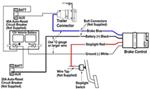
...It sounds like you are speaking of the wires for the brake magnets. If this is correct, you will need to connect one of the wires to the brake controller output wire on your trailer connector...
That's a very good question, we tend to be extra cautious and say to use 10 gauge wire because that would be more than enough. When you get into longer trailers that will end up using a lot of wire the heavier gauge wire becomes more necessary.…
Hey Ron, congratulations on the new trailer! I have a Jay Feather myself and love it. You're definitely off to a great start with a weight distribution hitch, it will make a world of difference towing that trailer with your F-150. The Weigh Safe…
...If you just need a 4-pin to 7-pin trailer wiring adapter, then you can use part # C57672. This will plug into the 4-pin trailer connector on your brother's vehicle and give him the 7-pin socket...
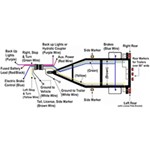
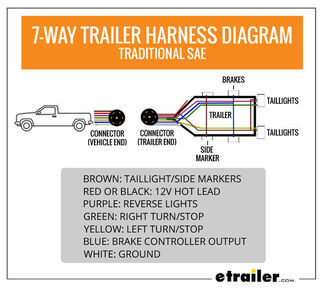
...diagrams showing the proper way to wire a vehicle and trailer side 7-way trailer connector.
If can you open up the existing 6-way connector on your trailer, take the housing apart and look...
In order to determine the torque rating for the lug nuts on your trailer you will need to know check out the chart I attached that shows all of the torque specs for all the trailer lugs available based on stud size, wheel material and wheel size.
...Yes, it will work. You'll just need to cut the Lance 6-pin connector out and rewire it into the etrailer Trailer Wiring 7-Way Upgrade Kit w/ Junction Box and RV Style Connector item # e99011.
Here...
The OEM prep package consists of 4 "pucks" in the bed of the truck that will allow you to drop in puck style hitches for easy installation and removal, that gives you a completely clear bed when not in use. The B&W Companion OEM 5th…
We do have the white Replacement Exterior Half-Moon Trailer Vent for 3" Diameter Hole #WHMAV2 which is the white version of the #HMAV2 that you referenced and also is what you sent in a picture of so it would work well for you.
...of the 7-way or 6-way round connectors which we do have adapters for. If you have a 7-way round, then you will use adapter # 47595. If you have a 6-way plug then you will use adapter # 47549 or # PK12728...
The difference between the Class II and Class III hitches has to do with their Gross Trailer Weight (GTW), their Tongue Weight (TW), and their Hitch Receiver Size. Class II trailer hitch receivers have a 1-1/4 inch receiver and can be rated up to…
...It sounds like you are speaking of the wires for the brake magnets. If this is correct, you will need to connect one of the wires to the brake controller output wire on your trailer connector...
That's a very good question, we tend to be extra cautious and say to use 10 gauge wire because that would be more than enough. When you get into longer trailers that will end up using a lot of wire the heavier gauge wire becomes more necessary.…
Hey Ron, congratulations on the new trailer! I have a Jay Feather myself and love it. You're definitely off to a great start with a weight distribution hitch, it will make a world of difference towing that trailer with your F-150. The Weigh Safe…
...If you just need a 4-pin to 7-pin trailer wiring adapter, then you can use part # C57672. This will plug into the 4-pin trailer connector on your brother's vehicle and give him the 7-pin socket...
...diagrams showing the proper way to wire a vehicle and trailer side 7-way trailer connector.
If can you open up the existing 6-way connector on your trailer, take the housing apart and look...
In order to determine the torque rating for the lug nuts on your trailer you will need to know check out the chart I attached that shows all of the torque specs for all the trailer lugs available based on stud size, wheel material and wheel size.
...Yes, it will work. You'll just need to cut the Lance 6-pin connector out and rewire it into the etrailer Trailer Wiring 7-Way Upgrade Kit w/ Junction Box and RV Style Connector item # e99011.
Here...
The OEM prep package consists of 4 "pucks" in the bed of the truck that will allow you to drop in puck style hitches for easy installation and removal, that gives you a completely clear bed when not in use. The B&W Companion OEM 5th…
We do have the white Replacement Exterior Half-Moon Trailer Vent for 3" Diameter Hole #WHMAV2 which is the white version of the #HMAV2 that you referenced and also is what you sent in a picture of so it would work well for you.
...of the 7-way or 6-way round connectors which we do have adapters for. If you have a 7-way round, then you will use adapter # 47595. If you have a 6-way plug then you will use adapter # 47549 or # PK12728...
WOW! I am impressed! I called to place my order and real person answered, spoke perfect English, albeit a slight southern accent, and my order was sent within a day, shipped quickly and I had it a few days later. I saved over a hundred dollars over local and installed it my self. I cant imagine how that they could do any better. THANKS!
Explore high-quality trailer connectors that ensure reliable connections for your towing needs. Whether you're pulling a sprayer behind a lawn tractor or connecting a vehicle to a motorhome, these connectors offer durability and ease of use, making them a must-have for any trailer enthusiast.
High-quality trailer connectors are made from durable materials with strong electrical terminals. They feature a sealed design to prevent moisture ingress and have a high spring force on the cover to protect when not in use. These connectors are easy to plug and unplug, ensuring a reliable connection every time.
Trailer connectors are designed to handle various voltage requirements, from standard 12v systems to heavier voltage needs for specific applications like hopper wagons. They ensure stable connections and minimize voltage drop, making them suitable for diverse towing setups.
A fused harness is crucial as it prevents electrical shorts and potential hazards. By integrating a fuse, the system is protected from overloads, ensuring safety and longevity of both the connector and the connected equipment. This setup is especially beneficial for high-demand applications like powering sprayers or campers.
A sealed design in trailer connectors prevents moisture and dirt from entering, which can cause corrosion and connection failures. This feature is essential for maintaining reliable performance in harsh environments, ensuring that your trailer lights and other electrical components function correctly.
Choosing the right connector depends on your specific towing needs. Consider the number of pins required, the voltage capacity, and the environmental conditions you'll face. For instance, a 4-pin connector is ideal for basic lighting, while a 5-pin or more may be needed for additional functions like brakes or auxiliary power.




 Filters