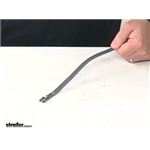
That's a very good question, we tend to be extra cautious and say to use 10 gauge wire because that would be more than enough. When you get into longer trailers that will end up using a lot of wire the heavier gauge wire becomes more necessary.…
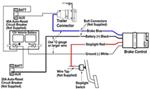
It sounds like you are speaking of the wires for the brake magnets. If this is correct, you will need to connect one of the wires to the brake controller output wire on your trailer connector and the other wire will need to be grounded to a clean…
Hey Dan. The only DC to DC charger that you might be able to get away with mounting in a battery box is the OptiMate Smart Battery Charger item #MA99JR. It has a weatherproof case but it's still restricted to inside use only. An easier and more…
Hey Michael, thanks for reaching out! The Dexter Nev-R-Adjust Electric Trailer Brakes #23-468-469 are an excellent choice, and will pair nicely with the Dexter Trailer Hub & Drum Assembly #84546UC3-EZ. This hub and drum comes pre-greased to…
Hello Rene, thanks for reaching out. It is pretty typical for RV manufacturers to use axles that are not rated for the full GVWR. They say this is because 10%-15% of the camper weight is on the hitch instead of the axles. They will put the bare…
Hi Shawn! I was able to find a little info on the Binkley 48000 SL you need to replace, and it looks like the etrailer Square Jack w/Handle - Foot Lever - Drop Leg - Spring Return - 12K Lift - 26.5" Travel #TJDDP-20000SP-F will be a pretty close…
The difference between the Class II and Class III hitches has to do with their Gross Trailer Weight (GTW), their Tongue Weight (TW), and their Hitch Receiver Size. Class II trailer hitch receivers have a 1-1/4 inch receiver and can be rated up to…
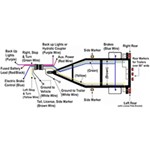
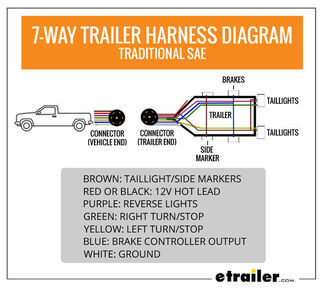
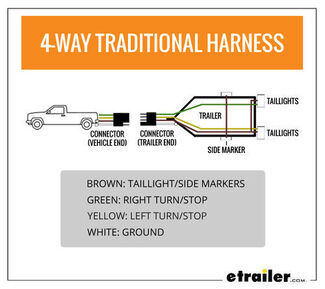
A 4-Way trailer connector has the basic lighting functions only; running lights, left turn signal and brake lights, right turn signal and brake lights, and ground. A 7-Way has these functions and a 12 volt circuit, a circuit for electric trailer…
...with junction box, then you can use jacketed 7-wire, or like just 12-14 gauge wire (both sold by the foot) if you have some laying around. You would also need butt connectors or heat shrink. Here is what I...
Hi Ben; the difference in the drum size won't make a difference as long as you have a #84 spindle with #L68149 inner and #L44649 outer bearings. The #AKHD-545-35-EZ-K is 10" x 2-1/2" while the #84546UC3-EZ is 10" x 2-1/4" and…
Typically 4-way wiring consists of 18 and 16 gauge wires. For a 4-way that has all 16 gauge wire you would want the Wesbar 4-Pole Flat Connector #W787264. The part #HM38138 uses 18 gauge for all wires but the white that uses 16 gauge.
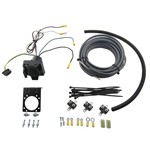
To completely rewire your 20' trailer from start to finish I recommend using the following parts: 7-Way Connector and Cable - Hopkins Molded Cable 8' Long item #H20046 Junction Box - Trailer Wiring Junction Box - 7 Color Coded Terminals item…
Durable and Reliable Jacketed Wire for Your Wiring Needs
Jacketed wire is perfect for heavy-duty applications like trailers and trucks. Its thick insulation ensures durability and longevity, making it ideal for rewiring projects or new installations. Whether you're upgrading your trailer or building a flatbed, jacketed wire provides the protection and reliability you need.
Jacketed wire offers superior protection with its thick insulation, making it ideal for trailer rewiring. It prevents chafing and damage, ensuring a long-lasting connection. This is especially useful when replacing old wiring or avoiding the hassle of chasing broken wires.
The heavy-duty jacket on these wires protects against wear and tear, making them perfect for rugged applications like trucks and trailers. This durability ensures the wiring will last, even in demanding environments, providing peace of mind for long-term use.
Yes, jacketed wire is suitable for marine applications. Its robust insulation helps protect against moisture and saltwater exposure, reducing the risk of corrosion and ensuring reliable performance for boat trailers and other marine uses.
Jacketed wire is perfect for flatbed builds due to its heavy gauge and thick jacket, which provide a clean and organized installation. It connects seamlessly to combo plugs, eliminating clutter and ensuring a neat, professional finish without a rat's nest of wires.
Absolutely, jacketed wire is designed to handle high electrical loads, making it suitable for connecting front plugs to rear lights and other high-demand applications. Its construction ensures reliable power delivery, even under heavy use.