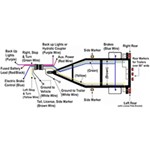
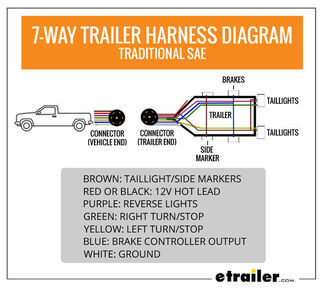
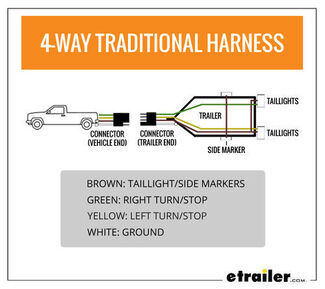
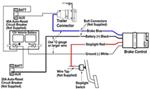
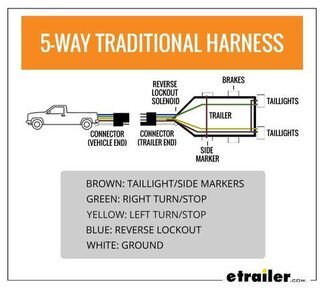
A 4-Way trailer connector has the basic lighting functions only; running lights, left turn signal and brake lights, right turn signal and brake lights, and ground. A 7-Way has these functions and a 12 volt circuit, a circuit for electric trailer…
That's a very good question, we tend to be extra cautious and say to use 10 gauge wire because that would be more than enough. When you get into longer trailers that will end up using a lot of wire the heavier gauge wire becomes more necessary.…
It sounds like you are speaking of the wires for the brake magnets. If this is correct, you will need to connect one of the wires to the brake controller output wire on your trailer connector and the other wire will need to be grounded to a clean…
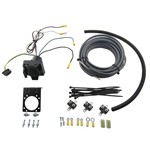
Yes, it will work. You'll just need to cut the Lance 6-pin connector out and rewire it into the etrailer Trailer Wiring 7-Way Upgrade Kit w/ Junction Box and RV Style Connector item #e99011. Here are the individual functions of that Lance 6-pin:…
Hey Robert, thanks for reaching out. The Curt Cold Weather 7-Way RV Style Connector #C23RJ uses a combination of 14-gauge and 10-gauge wire. The black 12V power wire and white ground wire are 10 gauge, while the brown, red, blue, green, and yellow…
The only difference between 7-Way Utility and 7-Way RV is the color of the wires. The pin outs are the exact same so either would work just fine with the other. If you check out the picture I attached you'll see that the functions are all the…
The difference between the Class II and Class III hitches has to do with their Gross Trailer Weight (GTW), their Tongue Weight (TW), and their Hitch Receiver Size. Class II trailer hitch receivers have a 1-1/4 inch receiver and can be rated up to…
Since wire color codes are NOT universal, we always recommend wiring by function, rather than wire color. If you look at the Trailer Wiring FAQ article I have linked you to, you can see some diagrams showing the proper way to wire a vehicle and…
Hey Mark, thanks for reaching out, and good question. That “16/18 gauge” wording throws a lot of people off. The TowSmart 16 to 18 Gauge, 4 Conductor Wire #TS57QR isn’t all one size. It’s a 4-conductor cable with mixed gauges inside, two wires are 16…
In order to determine the torque rating for the lug nuts on your trailer you will need to know check out the chart I attached that shows all of the torque specs for all the trailer lugs available based on stud size, wheel material and wheel size.
Hey Gary, thanks for reaching out. No, nothing is missing from the #C96GJ kit. Curt uses the term “T-Connector” pretty broadly for a lot of their plug-and-play harnesses, even when they are not a true tee-style splitter like you were expecting. On…
Welcome back Jordan! I have an alternative for you but we do not have any Ram 7k jacks that can be bolted on. Just welded like item #TJD-7000S and pipe mount like item #TJDP-7000S-B options. For a 7,000 lbs capacity square jack that can be bolted on,…
WOW! I am impressed! I called to place my order and real person answered, spoke perfect English, albeit a slight southern accent, and my order was sent within a day, shipped quickly and I had it a few days later. I saved over a hundred dollars over local and installed it my self. I cant imagine how that they could do any better. THANKS!
Trailer Wiring with Wiring Extensions for Easy Hookups
Add reach where you need it with wiring extensions for trailer wiring. They're handy when a camper or hitch extender pushes the plug back, making hookup easy without splicing or drilling. Pick the length that fits your setup, and consider heavy-duty construction with snug-fitting connectors; if the connection sits out in the weather, look for molded, weatherproof ends to keep water out.
Check that the plug will pass through your hitch bracket; some brackets are a tight fit. Some extensions do not include nuts and bolts for mounting the socket—verify hardware needs. Look for molded ends or sealed wire entries to help reduce water intrusion, and route cables to minimize direct spray.
Yes, a 7-way to 7-way extension can connect your factory plug to a camper lead without cutting wires or drilling. This can save a big chunk of time and keeps the factory wiring intact. Installation is typically quick when you can plug directly into the existing 7-pole connection.
Measure from your truck's connector to the camper or trailer plug with the tailgate/hitch setup in place. Add the distance of any hitch extender so the plug reaches without strain. Double-check the stated length so you don't end up with a 1' lead when you needed more. A little slack helps with routing but avoid excess that could drag.
Match the extension to your plugs: 7-way to 7-way for most truck/camper setups, 4-flat to 4-flat for light-duty trailers. If your camper uses a 6-round, use an adapter to interface with a 7-way on the truck. Confirm the plug style on both ends before you buy to avoid mismatches.


 Filters
 Trailer Wiring Parts or Accessories