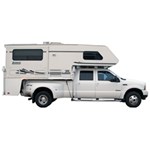
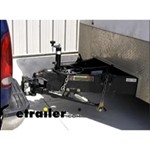
Get your slide-in on and off the truck without calling in a crowd. Brophy camper jacks handle unloads and reloads smoothly, especially when set on a flat, level surface for stability. Check your setup if you run a dually—these are generally not recommended if the fenders interfere—and make sure your camper has enough overhang or a solid lip for the jack's contact point to grab securely.
Make sure the camper has enough overhang for the jack's angle iron to reach; without overhang, modification may be needed. The tripods can sit in front of the wheels, so confirm you have a clear path to drive out. They're compact enough to work in tight spaces like around 10 ft, but check your working room. Also check welded joints are square and that handle hardware threads engage cleanly.
Yes, the cables can be replaced. Remove the old cable carefully—once it loosens it can whip, so wear gloves. Take off the drum, route the new cable through the drum and over the pulley, then secure it at the bracket and wind it neatly on the drum. Hand-guide the first wrap to keep it even.
They break down into 3 pieces for storage, but the pulley/winch assembly is welded on and is not removable. Plan your storage space around the fixed winch section.
They can be very stable when set up correctly. Use a flat surface to reduce wobble and mind the balance point. Simple stabilizers can help steady the camper during lifting. If contact feels narrow, consider adding a wider contact surface to the camper side to improve grip.
They are generally not recommended for most dually trucks. Check the clearance at the dually fenders—if the camper is the same width as the fenders, it can work; if it's only as wide as the top of the bed rails, the jacks will interfere. Measure the truck and camper widths before you commit.


 Filters