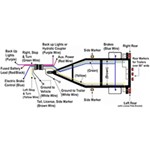
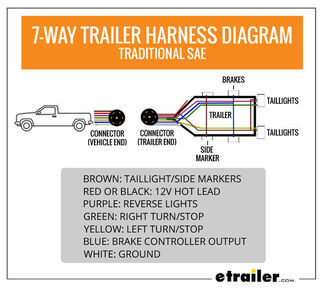
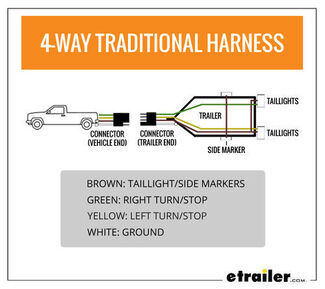
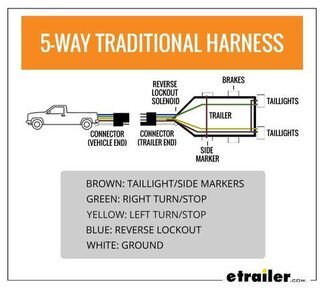
A 4-Way trailer connector has the basic lighting functions only; running lights, left turn signal and brake lights, right turn signal and brake lights, and ground. A 7-Way has these functions and a 12 volt circuit, a circuit for electric trailer…
The only difference between 7-Way Utility and 7-Way RV is the color of the wires. The pin outs are the exact same so either would work just fine with the other. If you check out the picture I attached you'll see that the functions are all the…
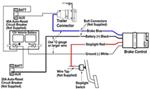
It sounds like you are speaking of the wires for the brake magnets. If this is correct, you will need to connect one of the wires to the brake controller output wire on your trailer connector and the other wire will need to be grounded to a clean…
The difference between the Class II and Class III hitches has to do with their Gross Trailer Weight (GTW), their Tongue Weight (TW), and their Hitch Receiver Size. Class II trailer hitch receivers have a 1-1/4 inch receiver and can be rated up to…
That's a very good question, we tend to be extra cautious and say to use 10 gauge wire because that would be more than enough. When you get into longer trailers that will end up using a lot of wire the heavier gauge wire becomes more necessary.…
Since wire color codes are NOT universal, we always recommend wiring by function, rather than wire color. If you look at the Trailer Wiring FAQ article I have linked you to, you can see some diagrams showing the proper way to wire a vehicle and…
Typically 4-way wiring consists of 18 and 16 gauge wires. For a 4-way that has all 16 gauge wire you would want the Wesbar 4-Pole Flat Connector #W787264. The part #HM38138 uses 18 gauge for all wires but the white that uses 16 gauge.
Hey Nate, We do not have a 3/4" spindle nut or washer, the smallest option is the 7/8" spindle nut #165931and a 1" washer #SW1000. I cannot find anything smaller. Are you sure the threads on you're spindle are 3/4"? If they…
Lance does have a proprietary plug, but many customers see a standard 6-way or 7-way round and notice it doesn't fit their factory 7-way as well. I've attached an article to help if you have one of the 7-way or 6-way round connectors which we…
In order to determine the torque rating for the lug nuts on your trailer you will need to know check out the chart I attached that shows all of the torque specs for all the trailer lugs available based on stud size, wheel material and wheel size.
Hey Ron, congratulations on the new trailer! I have a Jay Feather myself and love it. You're definitely off to a great start with a weight distribution hitch, it will make a world of difference towing that trailer with your F-150. The Weigh Safe…
Hey Ed. It has to do with the voltage dropping from the 7-way connector on your trailer to the brake assemblies. The thicker 10 item #10-2-1 or 12 gauge wire item #12-2-1 carries the brake signal without a voltage drop over longer distances. For a…
A 4-Way trailer connector has the basic lighting functions only; running lights, left turn signal and brake lights, right turn signal and brake lights, and ground. A 7-Way has these functions and a 12 volt circuit, a circuit for electric trailer…
The only difference between 7-Way Utility and 7-Way RV is the color of the wires. The pin outs are the exact same so either would work just fine with the other. If you check out the picture I attached you'll see that the functions are all the…
It sounds like you are speaking of the wires for the brake magnets. If this is correct, you will need to connect one of the wires to the brake controller output wire on your trailer connector and the other wire will need to be grounded to a clean…
The difference between the Class II and Class III hitches has to do with their Gross Trailer Weight (GTW), their Tongue Weight (TW), and their Hitch Receiver Size. Class II trailer hitch receivers have a 1-1/4 inch receiver and can be rated up to…
That's a very good question, we tend to be extra cautious and say to use 10 gauge wire because that would be more than enough. When you get into longer trailers that will end up using a lot of wire the heavier gauge wire becomes more necessary.…
Since wire color codes are NOT universal, we always recommend wiring by function, rather than wire color. If you look at the Trailer Wiring FAQ article I have linked you to, you can see some diagrams showing the proper way to wire a vehicle and…
Typically 4-way wiring consists of 18 and 16 gauge wires. For a 4-way that has all 16 gauge wire you would want the Wesbar 4-Pole Flat Connector #W787264. The part #HM38138 uses 18 gauge for all wires but the white that uses 16 gauge.
Hey Nate, We do not have a 3/4" spindle nut or washer, the smallest option is the 7/8" spindle nut #165931and a 1" washer #SW1000. I cannot find anything smaller. Are you sure the threads on you're spindle are 3/4"? If they…
Lance does have a proprietary plug, but many customers see a standard 6-way or 7-way round and notice it doesn't fit their factory 7-way as well. I've attached an article to help if you have one of the 7-way or 6-way round connectors which we…
In order to determine the torque rating for the lug nuts on your trailer you will need to know check out the chart I attached that shows all of the torque specs for all the trailer lugs available based on stud size, wheel material and wheel size.
Hey Ron, congratulations on the new trailer! I have a Jay Feather myself and love it. You're definitely off to a great start with a weight distribution hitch, it will make a world of difference towing that trailer with your F-150. The Weigh Safe…
Hey Ed. It has to do with the voltage dropping from the 7-way connector on your trailer to the brake assemblies. The thicker 10 item #10-2-1 or 12 gauge wire item #12-2-1 carries the brake signal without a voltage drop over longer distances. For a…
WOW! I am impressed! I called to place my order and real person answered, spoke perfect English, albeit a slight southern accent, and my order was sent within a day, shipped quickly and I had it a few days later. I saved over a hundred dollars over local and installed it my self. I cant imagine how that they could do any better. THANKS!
Trailer wiring is essential for ensuring your trailer's lights and brakes function properly. Whether you're rewiring a boat trailer or setting up a new RV connection, choosing the right wiring kit can make installation a breeze. Consider compatibility with your vehicle, ease of installation, and durability in various weather conditions.
Selecting the right kit depends on your vehicle's existing wiring setup and the type of trailer you have. For vehicles not prewired, a complete kit with connectors and adapters is ideal. Ensure compatibility with your trailer's lighting and brake systems, and consider kits with easy-to-follow instructions or video guides for a smoother installation.
Installation can be tricky if your vehicle isn't prewired, requiring connections under the hood and dash. Some kits may have mounting issues or require additional tools like heat shrink connectors. It's crucial to follow instructions carefully and use dielectric grease to protect connections from moisture and corrosion.
Durability is key, especially in harsh weather. Use dielectric grease on connections to prevent corrosion, and consider heat shrink connectors for added protection. Regularly inspect the wiring for wear and tear, and ensure all connections are secure to prevent separation or damage.
If the wiring doesn't fit, you may need an adapter or converter, especially if your vehicle and trailer have different plug types. Check the specifications of both your vehicle and trailer to ensure compatibility, and consider purchasing a universal adapter for flexibility.
Using quality components ensures reliable performance and longevity. Inferior parts can lead to connection failures, shorts, or corrosion, especially in challenging environments like saltwater exposure. Investing in high-quality wiring and connectors can save time and money in the long run.