Once you've decided to purchase a recreational RV, one of the toughest choices is deciding what kind of rig you want to tow. Specifically, the big choice comes down to fifth wheels vs travel trailers. Although they may seem similar on the surface—both are towed behind your vehicle rather than driven—there are unique benefits and drawbacks to each.Back when I was considering full-time RV living, I shopped both options extensively, comparing prices, layouts, and the benefits and drawbacks of each. I walked through countless trailers and changed my mind a few (dozen) times, but I learned a lot from my research along the way. There are a lot of factors that go into choosing the right rig, and your goals for your trailer absolutely play a huge part.Let's talk about some of the main differences between fifth wheels and travel trailers, and then you'll see why this decision is so personally specific.
Why Go With a Fifth Wheel Over a Travel Trailer?
I came to the conclusion that if I was going to live full time in an RV, it was going to be a fifth wheel. I loved the roomy, apartment-like feeling of a fifth wheel that I could spread out in.Below are the top 4 reasons to choose a fifth wheel as your camper.
1. More Stability, Less Total Length
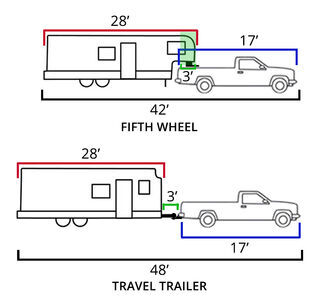
Fifth wheels are more stable than travel trailers because they are positioned over a truck's axle, rather than being pulled behind it. This allows for a better towing experience, since you have a greater turning radius and are less likely to have sway issues.The positioning of fifth wheels also permits them to be larger and more spacious than travel trailers without sacrificing stability. Despite their generally larger size, your overall length (front of truck to back of trailer) will actually be shorter with a fifth wheel. This is because a fifth wheel sits over your truck bed, while a travel trailer is pulled behind it. A 28-ft travel trailer is going to result in an overall longer tow vehicle/camper setup than a 28-ft fifth wheel.This is good news as far as maneuverability goes. A shorter overall length means it's easier to park, turn, squeeze into tight campsites, and get around on the road.
Image Credit: Big Truck, Big RV
2. Storage Above & Below
As mentioned, fifth wheels are just generally larger than conventional trailers, and this means they're able to offer more storage space. (When you're camping in a trailer, every inch of space counts!) This goes for storage space both inside and below the camper. You can take advantage of a fifth wheel's extra-high kitchen cabinets, tall shelving, and huge storage compartments beneath the rig.That's not to say travel trailers don't offer storage space, but if you plan on spending significant amounts of time in your trailer or taking a lot of stuff along for the ride, you'll definitely appreciate the ability to store more gear and supplies.
Image Credit: Big Truck, Big RV
3. Larger Living Spaces
Since I planned on living full-time in my camper, I was drawn to the spacious, homey feel of fifth wheels—they're basically apartments on wheels. If you have a big family or plan on spending a lot of time in your camper, it's worth considering a fifth wheel for the extra space.Why are fifth wheels bigger? The fact that they sit over your truck's axle means they can be heavier without becoming unstable to tow. Slideouts are especially common on fifth wheels, and they open up huge possibilities in terms of space. Even if you have a 30' travel trailer and a 30' fifth wheel, you'll still most likely have more room overall with the fifth wheel by the time you open all the slideouts. At most, you can expect one or two slide-outs on a travel trailer. Most fifth wheels have at least two, if not three or four, slide-outs. That's a lot of extra space!With a fifth wheel, you also get to take advantage of that overhang cab that sits over your truck bed. It may not look like much from the outside, but these cabs create a sizable upstairs living space that is usually used for a bedroom or living room. (My personal favorite floor plan were campers that used this space as a designated living area, complete with 2-3 sofas, a TV, and sometimes even a fireplace.)If you're traveling with your partner or kids, this separate space can be especially beneficial. Yes, camping together is about sharing quality time...but that upstairs separation lets you spread out a bit when you need a break.
Image Credit: Big Truck, Big RV
4. Washer/Dryer Hookups
Yes, some fifth wheels include washer/dryer hookups! This was a huge plus for me. Since I wanted to live in my trailer full-time, the prospect of having my own washer and dryer was invaluable.Keep in mind that your "laundry room" in a fifth wheel generally consists of a section of closet space designated for a (small) washer and dryer. We're not talking about a Pinterest-worthy laundry room here. But having a small laundry area is better than having none at all, and it's extremely rare to find a travel trailer with washer/dryer hookups, so this is a point for the fiver camp.
Why Go With a Travel Trailer Over a Fifth Wheel?
Fifth wheels have their perks, but that's not to say there aren't also good reasons to go with a travel trailer. I would personally choose a travel trailer for camping trips over a fifth wheel if I didn't plan on living in it full time.Check out the top 4 sweet perks of a travel trailer below!
Image Credit: Big Truck, Big RV
1. Price
This is a big one. You can get a travel trailer for a fraction of the price of a fifth wheel. Plus, even the largest conventional trailer hitches and ball mounts are less expensive than fifth-wheel hitches.The average price for a new travel trailer is about $10k-$40k, whereas the average price for a new fifth wheel is around $25k-$90k. If you go for a used travel trailer, you can save even more money.
For full-time RV living, I'd still go with a fifth wheel provided I had the budget. However, for non-full-time camping trips, I'd rather save with a travel trailer.
2. Less to Heat/Cool
Less space may not always seem like a good thing, but when it comes to heating and cooling your camper, you'll appreciate the more intimate dimensions of a travel trailer.If all you need is a place to sleep after your outdoor adventures, a cozy little camper is one of the most efficient options.
Image Credit: Keep Your Daydream
3. More Tow Vehicle Options
There's no getting around it: you need a truck to tow a fifth wheel. Preferably a really big one.Not so with a travel trailer. You can tow many conventional travel trailers with an SUV or even a full-sized van. So if you already have a capable vehicle, there's no need to invest in a pricey new truck (unless you want to, of course).If you do decide to tow with a truck, since a travel trailer hitch sits behind (not inside) the truck, you can enjoy full use of your truck bed while towing. Fifth wheels don't allow you to throw extra gear, bikes, ATVs, etc. in the back of your truck. But you can haul it all while towing your travel trailer (provided, of course, you're within your truck's weight limits!).
Image Credit: Keep Your Daydream
4. Better for Off-Roading
Due to the structural differences in the hitch setup, a travel trailer is by far the better way to go if you plan on going off-road to boondock. Fifth wheels provide a better ride on the relatively level, paved road, but that same positioning is a disaster waiting to happen off-road.Travel trailers are pulled behind your vehicle, so there's a certain amount of pivoting allowed, which you'll need for steep angles and rough terrain. A fifth wheel is much less forgiving. Steep angles can strain your hitch to the breaking point. Not to mention, there's only so much clearance between your truck and fifth wheel—driving at a wonky angle can send one crashing into the other.Then there's the height issue—that extra fifth wheel height is great for storage and spaciousness, but not so much for avoiding low-hanging elements of nature like pesky tree branches. Can you off-road with a fifth wheel? Sure. But it's much safer and easier with a travel trailer.
Ultimately, everyone is looking for different things in a trailer. If you're going to be taking your family of four camping on a regular basis, you may appreciate the spaciousness of a fifth wheel. If it's just you and your partner, you may not mind snuggling up in a travel trailer that you tow with your SUV.
The important thing to keep in mind when shopping is to do your research and maintain an open mind. Walk through both trailer types to get a feel for what will best suit your circumstances and lifestyle.Still have questions?Give our experts a call at 800-298-8924, or contact us online. We're happy to assist any way we can!
About the AuthorAs a content writer for etrailer, I might spend my morning loading and unloading a bike on five different bike racks to figure out which is easiest to use. I might be in the parking lot, taking pictures of an impressive RV battery setup our techs came across in the shop and discussing the benefits of the setup with the owner. I might spend an afternoon in a manufacturer training classes for some hands-on experience with new products, and then sit down to assemble all this information into a coherent article.At etrailer, one of our core values is that we are always learning, and I learn something new every day. I start each morning with the goal in mind of taking all of this information and figuring out the best way to answer the questions people ask us (and the ones they don’t know to ask yet), and helping people get the solutions they need to make their lives easier, safer, and more fun. I’m a DIYer at heart, so it brings me great joy to help a fellow DIYer find what they’re looking for, whether that’s a product, an answer, or a community.
The thing that causes the noise you are experiencing is actually the hitch you have and not the Roto Flex. The biggest factor in how much noise you'll experience when towing a fifth wheel trailer is the hitch itself since it has moving parts and…
The difference between the Class II and Class III hitches has to do with their Gross Trailer Weight (GTW), their Tongue Weight (TW), and their Hitch Receiver Size. Class II trailer hitch receivers have a 1-1/4 inch receiver and can be rated up to…
In order to determine the torque rating for the lug nuts on your trailer you will need to know check out the chart I attached that shows all of the torque specs for all the trailer lugs available based on stud size, wheel material and wheel size.
A 4-Way trailer connector has the basic lighting functions only; running lights, left turn signal and brake lights, right turn signal and brake lights, and ground. A 7-Way has these functions and a 12 volt circuit, a circuit for electric trailer…
Yes, it will work. You'll just need to cut the Lance 6-pin connector out and rewire it into the etrailer Trailer Wiring 7-Way Upgrade Kit w/ Junction Box and RV Style Connector item #e99011. Here are the individual functions of that Lance 6-pin:…
Hey Bryan, that's a good question. The pricing can definitely be misleading, but I wouldn't use it to judge the quality of the tire. A lot of that comes down to promotions, inventory, and whether you're looking at a tire by itself or…
Hey Andrew! Yes, Furrion does have a Chill Cube model with a heat pump. This was actually just released for aftermarket sale. You will need a complete system to make the switch, new R32 units aren't backwards compatible with old R410A systems.…
Hi Paul, you’re definitely on the right track here, and I can help you narrow this down with confidence. With your tandem 3,500 lb Dexter axles and 33 inch spacing, both the Dexter EZ Flex part #K71-652-00 and the Lippert Road Armor part #LC53CK are…
It sounds like you are speaking of the wires for the brake magnets. If this is correct, you will need to connect one of the wires to the brake controller output wire on your trailer connector and the other wire will need to be grounded to a clean…
Hey Jonathon thank you so much for all of that additional information! To haul your bikes behind your class C Sprinter motorhome, while flat towing your Mini, I recommend the Hollywood Racks RV Rider Bike Rack item #HLY64FR and the Roadmaster Dual…
Hello Sam; that is a great question! I reached out to Furrion and you will be able to use the Furrion Chill Cube #FR69TD (white) or #FR49TD (black) with your furnace. However, the remote is not capable of operating the furnace at this time. Also, we…
From what I can find the Norcold N306.3 fridge has a 2.7 cu ft capacity and is 20-1/8" wide and 26" tall. The most similar option we can offer is the 3.2 cu ft Everchill RV Mini Refrigerator #324-000111. The #324-000111 measures…