
bing tracking image

Testing Trailer Brake Magnets for Proper Function

There are 4 different tests that can be done to check the brake magnets on your trailer. The first test you should do is to use a multimeter to check the amperage of your trailer braking system. The trailer brake magnets will draw amperage from the brake controller based on the output voltage sent by the brake controller. Performing this test will let you know if the magnets are functioning properly or if further testing is required.If further testing is indicated, you can test the individual brake magnets for proper amperage. Test each magnet for a short and test the magnets for resistance. Below we have outlined each of these tests for you.

Testing with Trailer Connected to the Vehicle

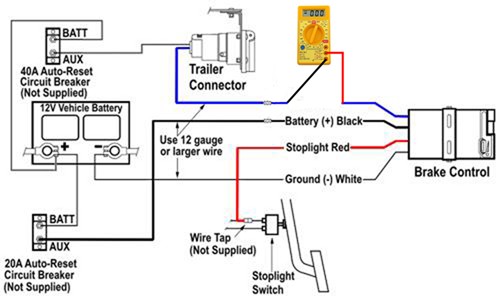
To test trailer brake magnets you will need a multimeter that reads amps and ohms. A good brake controller, like the Tekonsha P3, has test functions built in. To test with a multimeter, first you will connect the ammeter inline with the blue wire exiting the back of the brake controller or use the brake controller's diagnostic readings.Check the amperage. If the amperage is greater than the specified amount (see specifications below), replace the magnet or magnets. If the reading is less than the specified amount, the leads are bad and the magnet or magnets should be replaced.
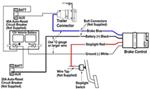
Illustration of Connecting ammeter to blue wire between brake controller and trailer connector

Electromagnet Specifications

10 and 12 Inch Brake DrumsMax Amps at 12-13 Volts
2 Brakes7.5-8.2
4 Brakes15.0-16.3
6 Brakes22.6-24.5
7 inch Diameter Brake DrumMax Amps at 12-13 Volts
2 Brakes6.3-6.8
4 Brakes12.6-13.7
6 Brakes19.0-20.6

Testing Individual Brake Magnets

Testing individual brake magnets for proper function can be accomplished by severing the magnet wires and connecting the ammeter between the positive terminal of a 12-volt battery and one of the magnet wires; it does not matter which one. Then connect the other magnet wire to the negative battery terminal. Check the amperage. If the amperage is greater than the specified amount (see specifications below), replace the magnet. If the reading is less than the specified amount, the leads are bad and the magnet should be replaced.

Individual Brake Magnet Amperage Specifications

10 and 12 Inch Brake Magnets7 Inch Brake Magnets
3.2-4.0 Max amps at 12-13 volts3.0-3.2 Max amps at 12-13 volts
Connecting Ammeter between positive terminal on 12-volt battery to one of the magnetic wires

Testing Individual Brake Magnet for a Short

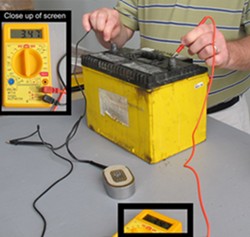
To determine if a brake magnet has an internal short, touch the base of the brake magnet to the negative post of a 12-volt battery. Then, connect one of the brake magnet wires to the negative lead of a multimeter and the positive lead of the multimeter to the positive post of the battery. If any amperage is detected, the magnet is shorted and will need to be replaced.
Touching base of brake magnet to negative post on 12-volt battery image

Testing Brake Magnet Resistance

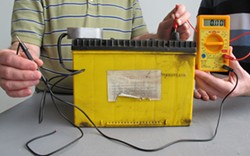
Further testing can be done with an ohmmeter. Using the ohmmeter function on the multimeter, check the resistance between the brake magnet wires. If the resistance is not within the specified range (see specifications below), then the magnet will need to be replaced.

Brake Magnet Resistance Specifications

10 and 12 Inch Brake Magnets7 Inch Brake Magnets
3.0-3.8 Ohms3.8-4.0 Ohms
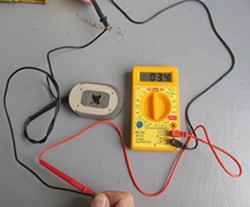
Testing with an ohmmeter image
Updated By: Dani S.Last Updated: 3/15/2021
Dallas S. profile picture

Dallas S.

9/12/2025

I have a 6 month old flatbed trailer with 4 20” brakes. A rodent chewed one brake wire at the wheel. I fixed the wire and now when connected to my 2022 Ford F450 with factory brake controller, it shows trailer disconnected when manually activated. Then it says there is a wiring default. All other trailer light working fine. I inspected all the wiring for any signs of damage and it all looks like new with no damage. I measured the the resistance at both brakes individually and the both showed 3.4 ohms each. Then I measured the entire brake system resistance at the connector and it showed 4 ohms. I have a stacker trailer with 3 axels and 12” brakes. The resistance at the connector reads 9 ohms. I connected that trailer to the truck to verify the problem isn’t within the truck and it worked fine. Is the 4 ohms for the total system correct or does this indicate a bad magnet or wire somewhere?

Pete profile picture

Pete

5/21/2025

I tested each magnet last night. 4 brake trailer. I am only getting 2.7 ohms at each magnet. I’ve replaced the brake wire, the brake controller and now tested the magnets. I am only getting 2.7 ohms at all 4 magnets. What am I missing as I am getting intermittent brake overload. One magnet was a little lack of response when testing with the meter. So I am possibly thinking short in that magnet. Please help?????

Robin H. profile picture
Etrailer Expert

Robin H.

5/21/2025

@Pete it could be a bad ground, grounding each individually might help if you haven't done that. Might also be the wire gauge you have running to the brake assemblies. I would at least use 10 gauge # 10-1-1. A short in the magnet is also possible.
Pete profile picture

Pete

5/21/2025

@RobinH new ground also from junction box to brake. It is also a 10” brake drum, dual axle. I measured the resistance on all magnets and 2.7 ohms which I have read it is low. For 4 wheel brake. I have rewired brakes, ground, added a junction box, and swapped out brake controller. The only wire I didn’t swap is the thru axle wire. Which I tested and it was good. Brakes work intermittently then states overload. I also hooked another trailer up to the truck to rule that out. The other trailer works flawlessly. I thought the magnet would be bad but the ohms on all 4 are consistent so I am at a loss. And other suggestions?
Robin H. profile picture
Etrailer Expert

Robin H.

5/22/2025

@Pete you can try replacing the magnets, could still run an individual ground for each one. Outside of that if they aren't functioning properly I'd take it to a local shop.
See All (5) Replies to Pete ∨
Paul profile picture

Paul

4/9/2024

Hello, I have been trying to test my 2003 GMC 1500 5500 lb towing vehicle with 5500 lb travel trailer elec brakes. I have noticed during wheel bearing inspection that one one the four trailer Brake drums did not have any marks from the elec magnet. Thus making me think that one magnet was not making contact with drum. This would be the front right side. I have a Tekonsha Prodigy P3 controller. When I jack up the front axle to test the brakes by putting a 1x4 from truck seat With key on trailer plugged into truck both trailer wheels turn, even with break- away key removed wheels will rotate. So I suspected a ground problem.and replaced two ground lugs and cleaned the connection to frame. Now the wheels of the trailer lock up while removing the break away key and while pulling manual over ride lever on controller. But when I place the 1x4 from truck seat to foot brake pedal the wheels on trailer do not lock up. May the foot pedal with not apply until I'm on the road, I don't know. Any ideas? Thanks, Paul

Sherman profile picture

Sherman

4/27/2024

@Paul The brake controller senses vehicle deceleration to apply the brakes. If the vehicle is not moving it will not apply the brakes. It sounds like you system is working correctly after you fixed it.
Jeremy profile picture

Jeremy

9/22/2023

I am not electrician, but on a trailer with four 10" brakes, if min amperage at each magnet is 3.2 amps, how are you going to get the stated min combined 15 amps at the tongue? It seems to me that min combined at the tongue should be 12.8 (3.2*4) amps or each individual magnet min amps should be 3.75 (15/4).

Mike L. profile picture
Etrailer Expert

Mike L.

9/25/2023

@Jeremy Can you explain what you mean by 'at the tongue'? Do you mean at the trailer connector?
Jeremy profile picture

Jeremy

9/25/2023

@MikeL I just mean wherever the four magnet wires come together into one. It could be at a junction box at the tongue, at the brake pin on the connector, or a loose wire in your hand. The location is irrelevant. My point is that 3.2 amps * 4 magnets = 12.8 amps, not 15 as the article states. Someone reading the article could be wasting their time tearing their trailer wiring apart trying to achieve 15 amps when the article plainly states that only 12.8 amps is possible if you do the math yourself instead of assuming that whoever wrote the article did the math correctly. Either the min amps per magnet listed is incorrect or the min combined amps listed is. Feel free to email me directly if I haven't explained this clearly enough.
Mike L. profile picture
Etrailer Expert

Mike L.

9/25/2023

@Jeremy The 3.2 amp figure represents the low end with 4 amps being the maximum. This is the acceptable range, so 15 amps for 4 10 or 12 inch brake assemblies would be in that acceptable range.
See All (5) Replies to Jeremy ∨
Marcus M. profile picture

Marcus M.

9/21/2023

Can you use a multimeter, that's equipped a DC AMP clamp?

Mike L. profile picture
Etrailer Expert

Mike L.

9/21/2023

@MarcusM You sure can.
Andy W. profile picture

Andy W.

11/10/2023

@MarcusM Only some really expensive clamp-on Ampe meters will read DC--they need a power source of their own. Most amp clamps read only AC amps. As I said there are some that do, but for most meters the answer is no.