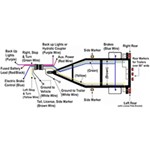
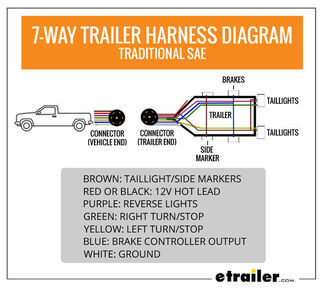
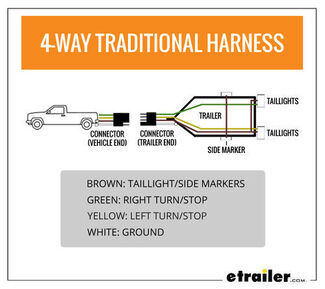
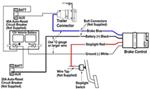
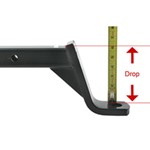
A 4-Way trailer connector has the basic lighting functions only; running lights, left turn signal and brake lights, right turn signal and brake lights, and ground. A 7-Way has these functions and a 12 volt circuit, a circuit for electric trailer…
That's a very good question, we tend to be extra cautious and say to use 10 gauge wire because that would be more than enough. When you get into longer trailers that will end up using a lot of wire the heavier gauge wire becomes more necessary.…
It sounds like you are speaking of the wires for the brake magnets. If this is correct, you will need to connect one of the wires to the brake controller output wire on your trailer connector and the other wire will need to be grounded to a clean…
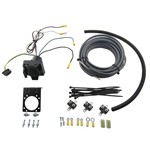
Yes, it will work. You'll just need to cut the Lance 6-pin connector out and rewire it into the etrailer Trailer Wiring 7-Way Upgrade Kit w/ Junction Box and RV Style Connector item #e99011. Here are the individual functions of that Lance 6-pin:…
Hey Robert, thanks for reaching out. The Curt Cold Weather 7-Way RV Style Connector #C23RJ uses a combination of 14-gauge and 10-gauge wire. The black 12V power wire and white ground wire are 10 gauge, while the brown, red, blue, green, and yellow…
The only difference between 7-Way Utility and 7-Way RV is the color of the wires. The pin outs are the exact same so either would work just fine with the other. If you check out the picture I attached you'll see that the functions are all the…
The difference between the Class II and Class III hitches has to do with their Gross Trailer Weight (GTW), their Tongue Weight (TW), and their Hitch Receiver Size. Class II trailer hitch receivers have a 1-1/4 inch receiver and can be rated up to…
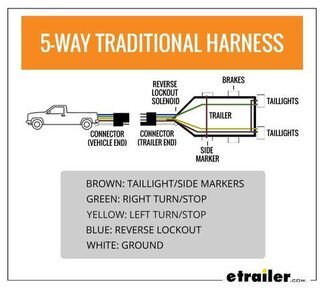
Since wire color codes are NOT universal, we always recommend wiring by function, rather than wire color. If you look at the Trailer Wiring FAQ article I have linked you to, you can see some diagrams showing the proper way to wire a vehicle and…
Hey Mark, thanks for reaching out, and good question. That “16/18 gauge” wording throws a lot of people off. The TowSmart 16 to 18 Gauge, 4 Conductor Wire #TS57QR isn’t all one size. It’s a 4-conductor cable with mixed gauges inside, two wires are 16…
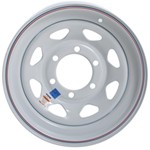
In order to determine the torque rating for the lug nuts on your trailer you will need to know check out the chart I attached that shows all of the torque specs for all the trailer lugs available based on stud size, wheel material and wheel size.
Hey Gary, thanks for reaching out. No, nothing is missing from the #C96GJ kit. Curt uses the term “T-Connector” pretty broadly for a lot of their plug-and-play harnesses, even when they are not a true tee-style splitter like you were expecting. On…
On a 7-Way connector the suggested minimum wire gauge for the White (ground) wire, the Red or Black (power) wire, and the Blue (brake power) wire is 12 gauge. The minimum wire gauge for the remaining Green (right turn/brake) wire, the Yellow (left…
Your internet site is very well organized and easy to use...My order was shipped very promptly and included everything I ordered...All in all this was a simple procedure for what can be a complicated order. I would use your company again or recommend you to others. Your selection was broad and your prices fair.
Robert
Bloomington, IL
Trailer Wiring with 4 Round connectors
Choose 4 round trailer wiring when you want a compact plug for towing lights or small 12v accessories. Since 4 round wiring isn't universally standardized, wire the vehicle and trailer as mirror images and use the common color code—white ground, yellow left turn/brake, green right turn/brake, brown taillights—for a clean, reliable hookup.
Common layout: facing the vehicle socket with the cover raised—top left: yellow left turn/brake; top right: green right turn/brake; bottom left: white ground; bottom right: brown taillight. The trailer side is a mirror image. There is not an industry standard, so test each circuit before finalizing.
Yes, it works well for tow lighting and light-duty accessories. It's been used between a motorhome and a towed car, and for items like a 12v sprayer or remote controls. Add a fused line when running to the battery and route the harness to avoid rubbing that could short the circuit.
Ensure set screws tighten fully so the inner part doesn't move. Check that the cover closes firmly and the plug inserts and removes smoothly. If powering accessories, include an inline fuse and secure the harness to prevent rubbing. Some choose a metal-body connector when replacing a plastic unit.
Often, but not always. Some 4-round parts use slightly different pin sizes, so verify your plug and socket match. Wiring patterns can also vary, which can cause issues. Use a circuit tester and confirm the vehicle and trailer are wired as mirror images before plugging in.


 Filters