Thanks for reaching out Herbert. I do have access to a schematic for our stabilizer jacks, but unfortunately, I'm not able to forward that document directly. I also wanted to clarify the photo you referenced. That photo is not showing one of our…
Hi Scott, thanks for reaching out. A great replacement for the 3,500-lb Lippert jack on your Jayco 32BHDS is the etrailer Electric Trailer Jack – A-Frame – 18" Lift – 3,500 lbs #e23ZV. It’s a bolt-on swap with the same capacity, upgraded…
I have a few different options for you depending on the route you would like to take. However, regardless of which route you pursue you will need to take some measurements of your outer jack tube length and weld stop spacing. If you are handy and the…
There are a few things that go into making sure you choose the correct replacement landing gear. First you need to be sure that the landing gear is rated properly. If you check out the weight rating on your current landing gear just make sure the…
Hey Steve! After doing some research, I can confirm that there isn't a plug-and-play brake controller available for your 2026 BMW X5. Installing one will require a splice-in wiring harness, like the one included with the Redarc Tow-Pro Liberty…
Congrats on the new motorhome Edward! SnapPad doesn't have the 2026 Allego Red 38 KA in their system so I don't know what size your jack feet are. However, we have a few options that will work with the HWH leveling systems. What you'll…
Hey Doug, welcome back! The Leveling Scissor Jack - 24" Lift - 5,000 lbs item #JSC-24-IND and the Scissor Stabilizer Jacks - 18-3/4" Lift item #TJSCHD-24 are going to be made of the same 14 gauge steel. The difference in capacity has to do…
Aside from the weight capacity of the jacks and their speed, they also have different mounting bracket locations. If you don't mind potentially having someone do some cutting and welding on your trailer then either one will work great for you. If…
We do have motors that you can add to your landing gear. For example, the Landing Gear Set #RVLG-8000 can be operated with the manual crank #RVLG-HDL but you can also add the motor #LC142178 and switch #LG-145236 for effortless operation on your end.…
Hi Ray! The MORryde GooseTech 5th Wheel to Gooseneck Pin Box for 11.5K to 14K Trailers #MR74MV can definitely be used in a short bed 3/4 ton pickup, like your 2024 Ram 2500. Just be aware that not all trailers have a tapered nose and you may not get…
No you're right on track, a tongue jack like the Stromberg Carlson Electric A-Frame Tongue Jack #JET-2500 that you mention is not designed to support the entire weight of your trailer, only a portion of the weight. When it comes to choosing an…
Hey Sharon, in order to use the MORryde I-Beam Mounted Stabilizer for 5th Wheels and Travel Trailers #MR96RV on a camper like your 2025 Forest River Heritage Glenn 308RL you'd have to remove a portion of that underbelly cover which I'd assume…
I received this order yesterday. Thanks for the outstanding service. I appreciate it! Thanks, Alex
Alex
Blowing Rock, NC
Camper Jacks for Stable, Quiet Setup
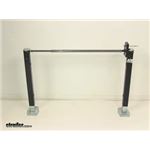
Get solid, low-shake support for your trailer with camper jacks built for easy setup. Options include bolt-on or weld-on installs, electric models with automatic stop and an internal circuit breaker, or manual jacks you can turn by hand or with a drill/driver, plus spring-loaded feet and grease fittings for easy upkeep. Some legs operate independently to match uneven ground for stabilizing—not for leveling—and compact designs can improve tailgate clearance.
Some electric jacks include an automatic stop to help prevent over raising and gear damage. Verify this feature in the specs before buying. Also check the type of circuit protection—some use an internal circuit breaker instead of a fuse.
Choose a compact jack body and plan the mounting spot to maximize clearance. Measuring from the mounting plate to the top of the jack on your setup helps predict tailgate swing. If washers don't sit flat, opening the mounting holes slightly can help the hardware seat correctly.
Look for stabilizer jacks with legs that operate independently; they can be lowered to match uneven ground. These are not leveling jacks, so don't try to correct major unlevel terrain with them. Set your rig first, then deploy the stabilizers to firm things up.
Yes, good stabilizers can noticeably reduce motion, even near heavy appliances, though they may not eliminate all movement. Position a stabilizer under the area that needs support to feel the biggest difference. Heavier-duty ratings can help with firmness, but set realistic expectations.


 Filters