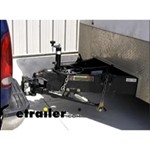
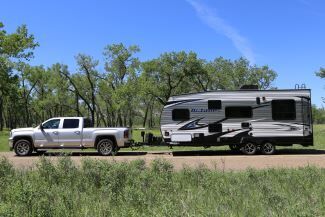
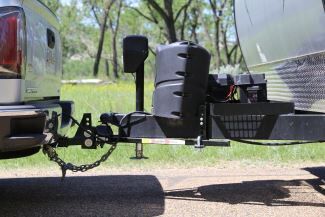
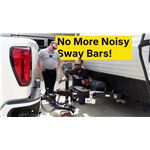
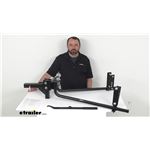
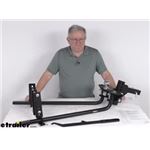
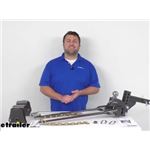
Featuring dual-cam sway control, this weight-distribution system includes an adjustable shank and flexible, powder coated steel, round spring bars to create a level ride for both your trailer and your tow vehicle. Fits 2" trailer hitches.
Features:
Evenly distributes weight over axles of tow vehicle and trailer for stability and control
Creates a more level ride for both tow vehicle and trailer
Automatically self-adjusting, self-centering sway control works in a variety of situations
Straight-line movement - cams lock in position to hold trailer steady despite crosswinds
Cornering - cams automatically unlock and slide to allow full-radius turns
Sudden swerving - cams seek a straight-line angle to help stabilize trailer
Sway control bolts onto A-frame trailer tongue and attaches to lift brackets via chains
No U-bolts or platforms to interfere with frame-mounted items such as gas tanks, toolboxes or generators
Round spring bars are hot rolled and tapered for superior strength and flexibility
Bars flex appropriately over uneven terrain for a controlled, even ride
Sway-control cams provide attachment point for spring bars
Head assembly and adjustable shank included
Forged, raised ball platform eliminates need for raised hitch ball
Solid steel shank is powder coated for rust protection
Adjustable spring-bar tension - just switch links in lift chains to fine-tune
Easy-to-use blocks for simple, fast adjustment of the ball mount angle
Uniquely shaped washer is positioned between blocks on head to give desired tilt
System includes sway-control cams, head assembly, adjustable shank, lift brackets, spring bars, lift chains, pin and clip, and all necessary hardware
Hitch ball sold separately - requires 1-1/4" diameter shank
Made in the USA
Specs:
Tongue weight: 600 lbs - 1,200 lbs
Gross towing weight: 12,000 lbs
Fits: 2" x 2" trailer hitch receivers rated for use with weight-distribution systems
Lift-bracket positioning: mount about 30" back from hitch ball
Requires approximately 5-1/2" of space along trailer frame
Optional mounts (sold separately) that take up less space on trailer frame are available
Will not fit trailer frames wider than 2-1/2"
Shank length: 14" from center of hitch pin hole to center of ball hole
Total height adjustment along shank: 5-1/4"
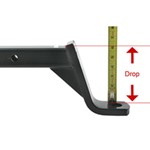
Maximum rise: 6-1/2" from top of hitch receiver opening
Maximum drop: 1-1/4" from top of hitch receiver opening
Limited lifetime warranty
Included w/ RP66088
Required - Sold Separately
Optional Add-Ons
Adjustable Shank
System Head
Sway-Control Cams
Spring Bars
Hitch Ball w/ 1-1/4" Diameter Shank
n/a
Note: Dual-cam sway control cannot be use with surge-type trailer brakes and is designed for 2" x 2" hitches only.
Create a stable ride for your tow vehicle and trailer with a weight-distribution hitch. Adding spring bars to your towing system applies leverage, which transfers the load that is pushing down on the rear of your vehicle to all the axles on both your tow vehicle and your trailer, resulting in an even distribution of weight throughout. The result is a smooth, level ride, as well as the ability to tow the maximum capacity of your hitch.
Selecting a Weight-Distribution System
The tongue weight rating is the most important factor in determining which size weight-distribution system you should use. If the bars of the system you choose are rated too high for your setup, they will create a rigid ride, which can result in a bouncing trailer. If, on the other hand, the bars are not rated high enough, the system will be unable to properly distribute the weight, rendering it virtually useless.
To determine the proper weight rating for a weight-distribution system, you must first determine your trailer's tongue weight. Then add to that the weight of the cargo behind the rear axle of your tow vehicle. These two measurements make up the tongue weight rating for a weight-distribution system.
Unique Features of Reese Strait-Line Weight Distribution
The easy-to-use, block-style washer on the Reese system makes adjusting the tilt of the weight-distribution head a snap. This uniquely shaped washer can be rotated and positioned between blocks on the weight-distribution head for simple, secure positioning. And the numbered sides provide reference points should you need to adjust your system between different tow vehicles. This is a huge improvement over the standard pin-and-washer method, which involves piling washers - one on top of another - onto a difficult-to-access pin to obtain the desired tilt.
The round spring bars of this system slide up into the weight-distribution head and secure with pins for quick, easy installation. With a tapered design and hot rolled steel construction, these bars offer superior flex, ensuring a smooth, controlled ride for both your tow vehicle and your trailer. In addition, these specially designed bars have rounded, hooked ends, making them the only kind of spring bars that can function with Reese's active-style, dual-cam sway control.
Dual-Cam Sway Control
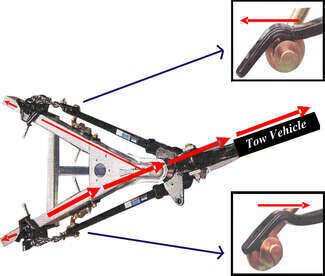
Reese's dual-cam sway-control system stops trailer sway before it begins. This is a significant improvement over traditional friction-style controls, which help to correct sway only after it has already begun. This specially designed system uses unique sliding devices called "cams" to suspend the spring bars of your weight-distribution system. One end of a cam bolts onto your trailer's frame, and the other end attaches to the lift bracket via the lift chain. The rounded, hooked ends of the spring bars then sit in these cams. The controlled placement of the spring bars keeps your system secure while still allowing enough movement for free, easy interaction between your trailer and your tow vehicle.
During basic, straight-line towing, the cams lock in place and hold the trailer steady by applying constant, consistent pressure to both sides. This keeps the trailer from swaying in crosswinds. When you go into a turn, the cams unlock and slide to allow a controlled, full-radius maneuver. If you swerve suddenly, the cams will give to accommodate the movement while still working to obtain a straight angle, thereby maintaining control of the trailer.
66088 Reese Strait-Line Round Bar Weight Distribution Hitch with Hitch Bar
Customers compare RP66088 to these similar products
Strait-Line Weight Distribution System w Sway Control - Round Bar - 12,000 lbs GTW, 1,200 lbs TW - RP66088
Average Customer Rating: 5.0 out of 5 stars (3 Customer Reviews)
- RP66088
by: patrick E.08/07/2012
Is this review helpful?
I have currently ordered one of these and I have a fleetwood 24'bounder motor home with a 16' 7000lb electric brake trailer carring my 2006 Ford mustang convertible with 6150watt generator and winch . I had a 30+ travel trailer pulled by my 2004 chev avalanche and had one of these system which I let go with the trailer not knowing I would need one for my mustang carrier and it worked great never had a problem so when I get it installed on motor home I will send pictures of the whole thing .....50884
Excellent Service - knowledgeable staff. Answered all of my questions,. I shopped around, they had lowest price for my particular hitch. And delivered on time as promised. Ordered on a Thursday, received the following Wednesday. However, I have not had time to open and install my hitch setup yet, assuming all parts are there, if they are not, I will update my review. Would definitely recommend to a friend. Thank you.43112
The Reese Round Bar Strait-Line Hitch with Shank, item # 66088, lift up brackets will not fit channel frames wider than 2-1/4 inches. As long as your C-Channel frame is no wider than 2-1/4 inches you should not have any problems with the installation.
Along with this system you will need a properly sized and rated hitch ball with a 1-1/4 inch shank. I have listed a couple that may work for you below.
Hitch Ball with 2-5/16 inch Diameter and Medium Shank, 12,000 lbs GTW - Chrome, item # 1 view full answer...
The angle of the chains will present a problem, with the chains angled forward to such a degree it will put forward pressure on the spring bars and the weight distribution head.
There is a solution though. You can use the Bolt On Weight Distribution Chain Hanger Kit, item # RP58305, in place of the Tip up chain hanger brackets. Once installed the chains are attached by raising the trailer tongue and rear of vehicle with the trailer jack. Tubular frames cannot be wider than 2-1/4 inches with t view full answer...
Since your tongue weight is starting out over 600 pounds the Reese Round Bar Strait-Line Hitch with Shank 1,200 lbs. TW / 12,000 lbs. GTW, item # 66088, will be an excellent choice. Even if fully loaded the trailer tongue weight gets to the maximum recommended tongue weight of 15 percent of the total trailer weight, loaded and ready to travel you should not go over the maximum 1200 pound tongue weight of the Reese Round Bar Strait-Line Hitch.
Along with the weight distribution system you will view full answer...
The Reese Round Bar Strait-Line Hitch with Shank 1,200 lbs. TW / 12,000 lbs. GTW, item # 66088, would be a good choice for the tongue weight and gross trailer weight loaded and ready to tow that you have mentioned. Installation instructions and a video installation of a similar system are linked below.
You will need to check your vehicle owner manual or with Chevrolet to make sure that your vehicle towing capacities are within the limits of your setup. view full answer...
You are correct, the 24 foot Coachman travel trailer you are considering will require weight distribution for use with your vehicle, and for safety sway control is a good idea. The dual cam sway control you have referenced is the best sway control available, and keeps sway from starting rather than reacting to it like some other systems. You will need to check your trailer weight fully loaded and ready to tow, to be sure you are within the capacity of the hitch and vehicle. Your vehicle towing c view full answer...
The chains in the Reese Round Bar Strait-Line Hitch with Shank 1,200 lbs. TW / 12,000 lbs. GTW, item # RP66088, are designed to be used with weight distribution systems up to 12,000 pounds gross trailer weight and 1,200 pounds tongue weight.
These chains can be purchased separately in the Draw-Tite Replacement Weight Distribution Chain Kit, item # 3216.
The snap up brackets can also be purchased separately in the Replacement Weight Distribution Hook-Up Brackets kit (2) with Lift Bar, item view full answer...
When selecting a weight distribution system, you want to use one that is close to or falls within the range of the trailers tongue weight when it is loaded. Tongue weight is about 10 to 15 percent of the gross trailer weight when the trailer is loaded.
I would recommend the Reese Strait-Line Weight Distribution System, part # RP66088, to be used with trailer loads that have a tongue weight capacity between 600 and 1,200 lbs, and would be a good fit for your 2007 Outback Trailer. Part # RP660 view full answer...
A Class V trailer hitch will have a 2-1/2 inch receiver opening. Most likely on a 2011 Chevy Avalanche you have a Class III or IV rated hitch with a 2 inch receiver opening. This is important because we want to get you the right weight distribution system.
If the trailer weighs in at 7,000 pounds, the typical tongue weight will be between 700 and 1,050 pounds (10 to 15 percent). But, you also have to add to that the weight of anything loaded behind the rear axle of the tow vehicle.
I belie view full answer...
In order to find the correct weight distribution system, you will need to know: 1) the tongue weight of the trailer when loaded and ready to tow and then add 2) the weight of anything loaded behind the rear axle of the tow vehicle.
Once you add these together to get the total tongue weight, you will want a system that has a tongue weight capacity range that puts your total tongue weight in the middle. So for a 600 to 1,200 pound system, a tongue weight of 900 pounds would be ideal. If you ha view full answer...
I did some research on your 2003 Cadillac Escalade EXT and it has a Gross Vehicle Weight Rating of 7,000 lbs. Weight distribution systems are recommended if the trailer that you are pulling is more than 50 percent of the vehicles weight. Even though your vehicle has self leveling air shocks, a weight distribution would take stress off of those shocks and distribute the load among all axles.
For your situation, I would definitely recommend a weight distribution system. To be sure you choose t view full answer...
The brackets that hold on the dual-cam sway control on weight distribution kit # RP66088 use 1/2 inch bolts to hold them to the trailer frame as indicated in the instructions that I have linked for you. I have also included the instruction for the rest of the weight distribution system. view full answer...
The key to choosing the best weight distribution system for you is knowing the tongue weight of your trailer when it is fully loaded and ready to tow. Keep in mind that anything loaded behind the rear axle of your 1999 Dodge Ram 1500 will contribute to the tongue weight as well. I would recommend choosing a system that has a tongue weight capacity range that encompasses the tongue weight of your trailer with its heaviest load.
If the tongue weight of your fully loaded trailer and anything lo view full answer...
You do need to secure the snap up brackets to the trailer frame. The chains use the snap up bracket as a support and if the bracket was not secured to the trailer frame, then the bracket could move or fall off any time the tension is released from the chains, such as a big dip or bump in the road.
Even if the bracket moves, which would be possible even under a load, the effectiveness of the weight distribution system would be compromised. You would continually have to check and measure to ma view full answer...
From the picture it is a little difficult to tell what angle the A-frame is. But I do believe that I have a solution for you if the A-frame part is a standard 50 degrees or close to it AND as long as it is not a hydraulic coupler. What you could do is use chain hangers, # RP58305, and bolt them through the sides of the frame rather than use brackets that clamp on.
This is because you have such a tall frame, the chain hangers would be needed to prevent the bars from contacting the trailer. If view full answer...
As a first step, I would recommend determining the fully loaded and ready to tow tongue weight of your trailer. The weight of anything stowed in the bed of your truck behind the rear axle will need to be considered as tongue weight. I will link you to an FAQ article that lists several ways of doing this. Knowing the fully loaded and ready to tow tongue weight of your trailer is essential, in order to choose the proper system for your trailer. Weight distribution systems are typically rated for a view full answer...
Reese does not offer 1,000 lb capacity spring bars. The Reese Strait-Line System you referenced, part # RP66088 is recommended for trailers having tongue weights ranging from 600-1,200 lbs, which would work absolutely great with a trailer that has a 1,000 lb tongue weight.
Since the system is designed to work well within a range of tongue weights, even if a 1,000 lb spring bar was available, there would be no need to go with a different spring bar, since your tongue weight is solidly within t view full answer...
To determine if a 2009 Chevrolet Silverado 1500 with a 5.3L V8 can tow your 2002 Coachmen travel trailer, you will need to find the towing capacity of the truck and weight of your trailer when it is loaded and ready to tow.
I did some research on the 2009 Chevy Silverado 1500 with a 5.3L V8 and found that the towing capacity can range from 9,700 lbs to 10,700 lbs based on how it is equipped. If you are purchasing the truck from a private party, the towing capacity should be listed in the own view full answer...
Ideally, you would want the chains to be straight up and down. A slight angle is permissible. What I recommend is to change the chain hanger type being used. There are 2 options. First we have a type that bolts to the side of the trailer frame, # RP58305.
The other type is a skinny bracket that fits around the frame (up to 6-1/2 inches tall and 2-3/4 inches wide), # RP58306. With either set up you would need to use the trailer jack to jack up the trail and vehicle to achieve the required amou view full answer...
If your old system does not have enough weight capacity to handle the new trailer you are planning to purchase, or if you are having problems with your old system when towing then I would consider a new system. If you are within the weight limit of your Pro Series System and it is functioning properly then you should be able to use it on the new trailer.
The Strait-Line weight distribution system you have selected is the newest out there and works very well. It is easier to hook up and is exc view full answer...
At etrailer.com we provide the best information available about the products we sell. We take the quality of our information seriously so that you can get the right part the first time. Let us know if anything is missing or if you have any questions.