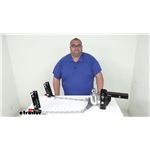
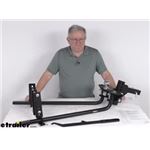
Reese Weight Distribution - RP66083
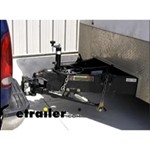
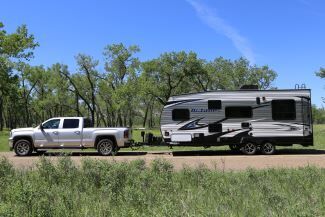
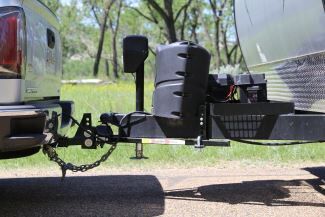
Featuring dual-cam sway control, this weight-distribution system includes an adjustable shank and flexible, powder coated steel, trunnion spring bars to create a level ride for both your trailer and your tow vehicle. Fits 2" trailer hitches.
Features:
- Evenly distributes weight over axles of tow vehicle and trailer for stability and control
- Creates a more level ride for both tow vehicle and trailer
- Automatically self-adjusting, self-centering sway control works in a variety of situations
- Straight-line movement - cams lock in position to hold trailer steady despite crosswinds
- Cornering - cams automatically unlock and slide to allow full-radius turns
- Sudden swerving - cams seek a straight-line angle to help stabilize trailer
- Sway control bolts onto A-frame trailer tongue and attaches to lift brackets via chains
- No U-bolts or platforms to interfere with frame-mounted items such as gas tanks, toolboxes or generators
- Trunnion spring bars are hot rolled and tapered for superior strength and flexibility
- Bars flex appropriately over uneven terrain for a controlled, even ride
- Sway-control cams provide attachment point for spring bars
- Head assembly and adjustable shank included
- Forged, raised ball platform eliminates need for raised hitch ball
- Solid steel shank is powder coated for rust protection
- Adjustable spring-bar tension - just switch links in lift chains to fine-tune
- Desired tilt is easily achieved with serrated-washer design - no more piling on washer after washer
- System includes sway-control cams, head assembly, adjustable shank, lift brackets, spring bars, lift chains, pin and clip, and all necessary hardware
- Hitch ball sold separately - requires 1-1/4" diameter shank
- Made in the USA
Specs:
- Tongue weight: 400 lbs - 800 lbs
- Gross towing weight: 10,000 lbs
- Fits: 2" x 2" trailer hitch receivers rated for use with weight-distribution systems
- Lift-bracket positioning: mount about 30" back from hitch ball
- Requires approximately 5-1/2" of space along trailer frame
- Optional mounts (sold separately) that take up less space on trailer frame are available
- Will not fit trailer frames wider than 2-1/2"
- Shank length: 14" from center of hitch pin hole to center of ball hole
- Total height adjustment along shank: 5-1/4"
- Maximum rise: 6-1/2" from top of hitch receiver opening
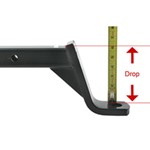
- Maximum drop: 1-1/4" from top of hitch receiver opening
- Limited lifetime warranty
| Included w/ RP66083 | Required - Sold Separately | Optional Add-Ons |
|---|
- Adjustable Shank
- System Head
- Sway-Control Cams
- Spring Bars
| - Hitch Ball w/ 1-1/4" Diameter Shank
| n/a |
Note: Dual-cam sway control cannot be use with surge-type trailer brakes and is designed for Class III and Class IV hitches only.

Create a stable ride for your tow vehicle and trailer with a weight-distribution hitch. Adding spring bars to your towing system applies leverage, which transfers the load that is pushing down on the rear of your vehicle to all the axles on both your tow vehicle and your trailer, resulting in an even distribution of weight throughout. The result is a smooth, level ride, as well as the ability to tow the maximum capacity of your hitch.
Selecting a Weight-Distribution System
The tongue weight rating is the most important factor in determining which size weight-distribution system you should use. If the bars of the system you choose are rated too high for your setup, they will create a rigid ride, which can result in a bouncing trailer. If, on the other hand, the bars are not rated high enough, the system will be unable to properly distribute the weight, rendering it virtually useless.
To determine the proper weight rating for a weight-distribution system, you must first determine your trailer's tongue weight. Then add to that the weight of the cargo behind the rear axle of your tow vehicle. These two measurements make up the tongue weight rating for a weight-distribution system.

Unique Features of Reese Strait-Line Weight Distribution
The easy-to-use, serrated washers on the Reese Strait-Line system make adjusting the tilt of the weight-distribution head a snap. This is a huge improvement over the standard pin-and-washer method, which involves piling washers - one on top of another - onto a difficult-to-access pin. The serrated-washer system lets you easily loosen, adjust and tighten a single washer and nut on either side of the head for simple, secure positioning.
The trunnion spring bars of the Strait-Line system slide into the weight-distribution head for quick, easy installation. With a tapered design and hot rolled steel construction, these bars offer superior flex, ensuring a smooth, controlled ride for both your tow vehicle and your trailer. These specially designed bars have rounded, hooked ends, making them the only kind of spring bars that can function with Reese's active-style, dual-cam sway control.

Dual-Cam Sway Control
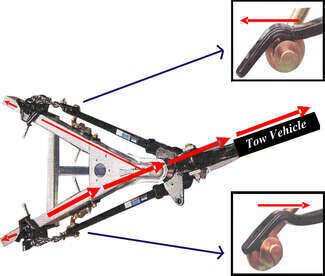
Reese's dual-cam sway-control system stops trailer sway before it begins. This is a significant improvement over traditional friction-style controls, which help to correct sway only after it has already begun. This specially designed system uses unique sliding devices called "cams" to suspend the spring bars of your weight-distribution system. One end of a cam bolts onto your trailer's frame, and the other end attaches to the lift bracket via the lift chain. The rounded, hooked ends of the spring bars then sit in these cams. The controlled placement of the spring bars keeps your system secure while still allowing enough movement for free, easy interaction between your trailer and your tow vehicle.

During basic, straight-line towing, the cams lock in place and hold the trailer steady by applying constant, consistent pressure to both sides. This keeps the trailer from swaying in crosswinds. When you go into a turn, the cams unlock and slide to allow a controlled, full-radius maneuver. If you swerve suddenly, the cams will give to accommodate the movement while still working to obtain a straight angle, thereby maintaining control of the trailer.
66541 and 26002 Reese Strait-Line Trunnion Bar Weight Distribution Hitch with Hitch Bar
Customers compare RP66083 to these similar products
Customers Who Purchased This Weight Distribution Also Bought...
Replacement parts available for this product
Ask the Experts about this Reese Weight Distribution
Do you have a question about this Weight Distribution?
- Recommend A Weight Distribution System With Sway Control For 2008 Gulfstream Ultra-Lite 21 LE
- I did some research and found that the dry weight of your 2008 Gulfstream Ultra-Lite 21 LE Trailer is approximately 3,200 lbs when not loaded. When choosing a weight distribution system, the tongue weight of your trailer will determine the proper weight distribution system. Tongue weight is usually about 10-15 percent of Gross Trailer Weight loaded and ready to tow. So I multiplied 3,200 lbs by 15 percent and came up with 480.
If you find that you will have a lighter loaded trailer, I would
view full answer...
- Recommendation For a Weight Distribution System on a 2002 Mercedes ML320 Towing a 4,260-Lb Trailer
- A weight distribution system is a good idea any time you are towing a trailer that is at least 50 percent of the tow vehicle weight. You will want to check the hitch on your 2002 Mercedes ML320 to make sure it will accept a weight distribution system.
To choose a weight distribution system you will need a system that has a tongue weight capacity range that encompasses the trailer tongue weight loaded and ready to tow, plus the weight of any gear in the tow vehicle, behind the rear axle. Since
view full answer...
- Weight Distribution System for 30 Foot Aerolite Travel Trailer with 808 lb Dry Tongue Weight
- The effective range of the W/D system you choose should encompass the fully loaded and ready to tow tongue weight of your trailer, which includes anything stored behind the rear axle in the cargo area of the tow vehicle (as you stated). You are also right on the money with needing to include the weight of the propane tanks and batteries. Given this, the RP66083 would have insufficient capacity to handle the tongue weight of your trailer.
For your 30 foot Aerolite, I would recommend the Reese
view full answer...
- List of Replacement Parts for # RP66083 Dual Cam Sway Control System
- The individual parts that make up the # RP66083 are as follows:
Weight Distribution Head for Trunnion Bars, part # RP58167
800 lb Capacity Trunnion Bar, part # RP22225 (sold individually)
Weight Distribution Shank, part # RP54970
Dual Cam Sway Control, part # RP26002
Chain Kit, part # 3216
Chain Hanger Bracket, part # RP6637
Due to the fact that the weight distribution head unit, the shank and the trunnion heads of the spring bars are cast, I would recommend replacing those regardless
view full answer...
- Weight Distribution and Sway Control for a 29 ft Sprindale Trailer Towed by a 2012 Ford Expedition
- The key to purchasing the correct weight distribution system and sway control is choosing a system that is compatible with the tongue weight of your trailer. So it is important to know the tongue weight of your trailer when it is fully loaded and ready to tow. With that being said, I have attached an article on determining trailer tongue weight for you to review.
If the tongue weight of your trailer is greater or less than the tongue weight range on your weight distribution system, then the
view full answer...
- Weight Distribution for a 2005 Chevy Tahoe and Dutchmen Aerolite 195QB Travel Trailer
- When choosing a weight distribution system you will need to go by the tongue weight of the trailer when loaded and ready to tow plus the weight of anything loaded behind the rear axle of the tow vehicle.I did some research and found that on a 2012 Dutchmen Aerolite 195QB the gross trailer weight is approximately 5,400 pounds. Tongue weight is typically 10 to 15 percent of gross trailer weight so we are looking at 540 to 810 pounds.
If nothing is loaded behind the rear axle on the Tahoe then y
view full answer...
- Weight Distribution and Brake Controller for a 2004 Chevy Suburban and Fun Finder Travel Trailer
- You have come to the right place because some of the information you were given is not 100 percent accurate. First, tongue weight and gross trailer weight are very important factors when choosing weight distribution. But the most important number is the loaded tongue weight. You calculate this by taking the tongue weight of the trailer, when loaded and ready to tow, and then add to it the weight of anything loaded behind the rear axle of the tow vehicle. I have included a link to an FAQ article
view full answer...
- Weight Distribution and Sway Control for a 2011 Ford F-150 and 24 Foot Car Hauler Trailer
- Based on everything that you need a system to do going with an Equal-i-zer system will be the best bet. You are correct about the dual-cam system being closer to the ground and not as easy to remove to tow with the motor home.
The Equal-i-zer systems do use metal on metal contact to prevent sway. With any sway control system there is going to be some noise but it is not constant noise unless it is constantly working to prevent sway. The dual-cam system would offer the best sway control but th
view full answer...
- Weight Distribution With Sway Control Recommendations For 2004 Nissan Titan SE and Trailer
- The Reese Strait-Line Weight Distribution System with Sway Control # RP66083 will work with your 2004 Nissan Titan SE and trailer as it has a tongue weight capacity of 400-800 lbs. If your trailer stays at 635 lbs of tongue weight, you will have no problem. I have provided a link to the installation instructions for this WDS as well as a link to our FAQ page on weight distribution.
When figuring your GTW, always ensure that the weight includes all cargo that will be loaded. When figuring tong
view full answer...
- What is the Towing Capacity of a 2005 Ford Expedition Eddie Bauer Edition
- The best place to look for the towing capacities of a vehicle is in the owners manual. The manual will give you what the vehicle is capable of. Usually on the hitch there is a sticker with the hitches capacities. Which ever is lower, the vehicle or the hitch, is the capacity you need to go by.
Based on a manual I found online through Ford, the tow capacity of the vehicle is as follows:
With a 5.4 liter engine, standard tow package, 2-wheel drive the gross trailer weight capacity is 6,000 p
view full answer...
- Reese Dual Cam WD Hitch Upgrade Recommendation
- For your 2012 Chevrolet Avalanche with a loaded truck and trailer and a tongue weight of 880 pounds as opposed to 610 pounds of the original estimation I would definitely recommend upgrading to the 1,200 pound capacity trunnion bars for your weight distribution system.
The replacement trunnion bars that are rated up to 1,200 pounds are part # RP66009. These trunnion bars are sold individually so you would need to get 2 to replace your current trunnion bars on your weight distribution system
view full answer...