If you have ever been standing in your camper wondering why the lights work but the outlets do not, or the other way around, you have run straight into the most common RV electrical question we hear at etrailer. Converter vs. inverter. What is the difference?
We help neighbors sort through RV electrical issues every day, from dead batteries to inverter installs that were never going to work the way they expected. The confusion almost always comes from not knowing which component does what.This FAQ breaks it down in plain English using real world RV examples, so you know what is normal, what is not, and where upgrades actually make sense.
What Is the Difference Between an RV Converter and an Inverter?
The difference comes down to which direction the power is flowing.
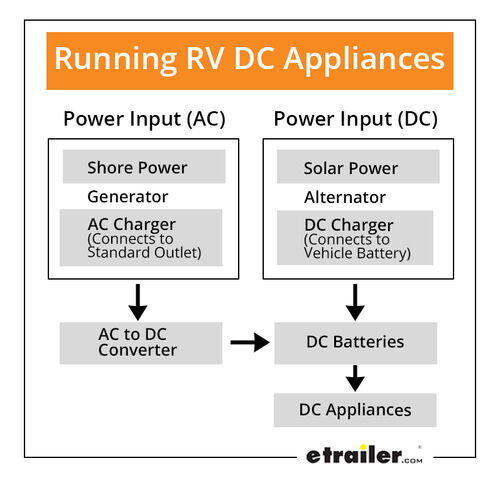
A converter takes 110 volt AC power from shore power or a generator and converts it into 12 volt DC power. That 12 volt power runs your RV’s essential systems and charges the battery bank.
An inverter does the opposite. It takes 12 volt DC battery power and converts it into 110 volt AC power. This allows you to use household outlets and appliances when you are not plugged in.
A quick rule of thumb helps here.
If you are plugged into shore power, the converter is working.
If you are camping off grid and running outlets, the inverter is doing the work.
Do All RVs Have a Converter and an Inverter?
No, and this is where a lot of people get tripped up.Every RV has a converter because every RV relies on batteries that need to be charged.Very few RVs come with an inverter from the factory. If your camper has one, it was almost always added later as an aftermarket upgrade. That is why many RVs have working lights and water pumps but no power at the outlets unless they are plugged in.
That setup is completely normal.
What Runs on 12 Volt vs. 110 Volt Power in an RV?
Once you understand this split, RV electrical systems make a lot more sense.
12 volt DC systems powered by the converter and batteries:
Interior and exterior lights
Water pump
Slide outs
Power awnings
USB charging ports
Bathroom vent fans
Control panels and wall switches
Many newer 12 volt refrigerators
110 volt AC systems powered by shore power or an inverter:
Household style outlets
Coffee makers
Microwaves
Air conditioners
Washer and dryer units
Electric space heaters
Hair dryers
Residential appliances
If it plugs into a standard wall outlet at home, it is almost always running on 110 volt power in your RV too.
Why Will a 1,000 Watt RV Inverter Not Run a Coffee Maker or Microwave?
Because inverter size matters more than breaker size.
Most RV appliances require more wattage than a 1,000 watt inverter can supply, even if they seem small.
Typical power requirements look like this:
Coffee makers usually need 1,500 to 1,800 watts
Microwaves usually need 1,600 to 1,800 watts
RV air conditioners can draw close to 2,000 watts
If an appliance requires more power than the inverter is rated for, it simply will not run. No wiring change or breaker swap fixes that. This is one of the most common misunderstandings we see when people start shopping for inverters.
How Much Does an RV Inverter System Cost?
Inverter systems are not cheap, and the inverter itself is only part of the total cost.
A realistic breakdown looks like this:
Inverter cost usually falls between 600 and 1,800 dollars
Wiring, fuses, and sub panels typically add 300 to 500 dollars
A properly sized battery bank often costs 2,000 to 4,000 dollars
Battery capacity is where most systems fall short. Inverters draw hard from batteries, and undersizing the battery bank leads to short runtimes and disappointing performance.
Will Solar Panels and an Inverter Save Me Money?
No, and that expectation is important to set up front.
Solar
and inverter systems are about camping freedom, not saving money. They allow you to camp quietly without hookups, generators, fuel runs, or campground restrictions.
A portable generator
is usually cheaper up front and often costs around 1,000 dollars. Many RVers still choose solar and inverters because they value silence and flexibility more than upfront cost.
Can I Replace an RV Converter or Power Panel Myself?
It is possible, but this is where experience matters.
RV power panels handle 110 volt AC power, which can be dangerous if wired incorrectly. Replacing a panel also means disconnecting, labeling, and reinstalling every circuit. One mistake can damage equipment fast.
Because of liability concerns, many manufacturers limit installation support. If you are comfortable with electrical work, it can be done. If not, professional installation is usually the safer choice. If you would rather have a qualified installer handle it for you, you can use our installer locator
to find an RV installer near you.
How Do I Make Sure I Buy the Correct RV Power Panel Replacement?
Always start with the white sticker on your existing power panel. It lists the exact model number and electrical specifications. An example image here would be helpful.
Cross reference parts may work electrically, but they rarely match physical dimensions. That often means cutting or modifying cabinets, which most neighbors are not planning to do. Matching the original part number is the safest approach.
Common RV power brands include Progressive Dynamics, WFCO, and Powermax. These are the brands we most often see when helping neighbors diagnose RV electrical issues.
RV coverter panel labels will list the model and specs.
Bottom Line: Know the Job Before You Buy the Part
Most RV power problems are not broken parts, they are misunderstandings. Converters run your 12 volt systems and charge the batteries. Inverters run outlets when you are not plugged in.
This is something we see constantly at etrailer when people are troubleshooting electrical issues or planning upgrades. Once that clicks, the rest usually falls into place, and you avoid spending money where you do not need to.
About Sam C.Here at etrailer I spend my day working on trailers, fixing RV's, and building training aids/displays to keep all of employees up to speed on how things in an RV work! I'm also responsible for training all of our Customer Service/Content teams, so it's important I'm out doing things keeping up with changes in the RV industry. In my personal time I stay in my camper up at a large fishing lake here in Missouri with my wife, and am always doing something to it. It's a 2005, and I'm cheap, so I will keep it for as long as possible!
Yes, when using your turn signals the monitor of your Furrion Vision S Wireless RV Backup Camera System w/ 3 Cameras - 5" Screen #FCE48TASL-05 will switch to the corresponding side marker camera. You will need to ensure that you have "LCD…
Fan-Tastic vents offers an upgrade kit for their roof vents that allows you to upgrade to a motorized fan setup with the part #FV807359. If you had a different brand of RV vent though we wouldn't have an upgrade solution and you'd have to go…
I checked with Furrion and the 7 inch and 5 inch monitor version of the Furrion observation system #FOS05TASF use part #FR79SR. The smaller 4.3 inch size use the part #LC776462. The ball of the #FR79SR is 0.85" or 21.59mm and the ball of the…
The difference between the Class II and Class III hitches has to do with their Gross Trailer Weight (GTW), their Tongue Weight (TW), and their Hitch Receiver Size. Class II trailer hitch receivers have a 1-1/4 inch receiver and can be rated up to…
In order to determine the torque rating for the lug nuts on your trailer you will need to know check out the chart I attached that shows all of the torque specs for all the trailer lugs available based on stud size, wheel material and wheel size.
Hi Paul, you’re definitely on the right track here, and I can help you narrow this down with confidence. With your tandem 3,500 lb Dexter axles and 33 inch spacing, both the Dexter EZ Flex part #K71-652-00 and the Lippert Road Armor part #LC53CK are…
Hey Bryan, that's a good question. The pricing can definitely be misleading, but I wouldn't use it to judge the quality of the tire. A lot of that comes down to promotions, inventory, and whether you're looking at a tire by itself or…
Yes, it will work. You'll just need to cut the Lance 6-pin connector out and rewire it into the etrailer Trailer Wiring 7-Way Upgrade Kit w/ Junction Box and RV Style Connector item #e99011. Here are the individual functions of that Lance 6-pin:…
A 4-Way trailer connector has the basic lighting functions only; running lights, left turn signal and brake lights, right turn signal and brake lights, and ground. A 7-Way has these functions and a 12 volt circuit, a circuit for electric trailer…
The OEM prep package consists of 4 "pucks" in the bed of the truck that will allow you to drop in puck style hitches for easy installation and removal, that gives you a completely clear bed when not in use. The B&W Companion OEM 5th…
Hey Andrew! Yes, Furrion does have a Chill Cube model with a heat pump. This was actually just released for aftermarket sale. You will need a complete system to make the switch, new R32 units aren't backwards compatible with old R410A systems.…
The 5.30-12 tires, being wider, are going to make more contact with the road. This means that the noise, and heat build up will be higher than a 4.80-12 tire but the rolling resistance will actually be less because the tire is larger diameter. The…