How to Reduce Trailer Sway on Single Axle Car Hauler Trailer
Updated 09/17/2018 | Published 09/16/2018
Question:
I Have a car transport trailer currently single axle with leaf spring suspension and drum brakes operated by a cable. I am looking at adding a second axle. The reason is stability. When I drive above 45mph I can see the trailer snaking and can feel stability severely affected and do not consider it safe despite being within the swl of the trailer and the tyres. So the purpose is merely to add stability. So Ive been looking at the axleless type, which bolt on each side independently. So wondering what implications there are to consider with this?
asked by: Tony
Expert Reply:
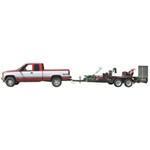
By "snaking" I presume you are referring to trailer sway, with the car hauler's rear end moving side to side above the 45 mph speed you mentioned. Trailer sway like this usually has one cause: too low tongue weight (TW). Car hauler trailers, especially when they are towing different vehicles all the time, can be hard to get just right. Different cars and even slightly different placement of the same car on the trailer can result in varying TW that in some cases may be too low. When the trailer rear-end has too much weight, it can start the "pendulum" effect of swaying back and forth.
Before you go through the process (and expense) of adding a second axle and modifying your suspension, you might try to increase the TW of the loaded trailer by moving the loaded vehicle further forward. If this is not feasible and/or if this does not fully correct the sway issue then moving a fixture like a tool box, gas cans or other moveable weight on the trailer to the front may help too.
Ideally a loaded trailer's TW will be in the range of 10 to 15 percent of its gross weight. It is easy to find the correct spot for any given vehicle by measuring the actual TW using a scale # C51701. This makes it easy to find the best position for any given vehicle being transported so that your TW is high enough.


Product Page this Question was Asked From
Dexter Trailer Axle w/ Electric Brakes - 5 on 4-1/2 Bolt Pattern - 89" Long - 3,500 lbs


- Trailer Axles
- Leaf Spring Suspension
- Standard Grade
- Electric Brakes
- 3500 lbs
- 5 on 4-1/2 Inch
- 74 Inch Spring Center
- 89 Inch Hub Face
- No Drop or Lift
- Dexter
more information >
Featured Help Information
Miscellaneous Media

Continue Researching
- Shop: Front Mount Hitch
- Shop: Curt Front Mount Trailer Hitch Receiver - Custom Fit - 2"
- Video: Best 2014 Ford F-150 Front Mount Hitch Options
- Shop: Trailer Hitch
- Shop: Curt Front Mount Trailer Hitch Receiver - Custom Fit - 2"
- Shop: TorkLift SuperTruss Hitch Extension for SuperHitch Trailer Hitch Receivers - 48" Long
- Search Results: atwood jack parts
- Q&A: What is the Difference Between a Class II and a Class III Hitch?
- Article: Trailer Wiring Diagrams
- Video: Firestone Ride-Rite Air Bags with Easy Mount Compressor Feature Breakdown
- Shop: Universal Installation Kit for Trailer Brake Controller - 7-Way RV and 4-Way Flat - 10 Gauge Wires
- Search Results: trailer hitch
- Q&A: Lug Nut Torque Chart for Trailer Wheels
- Search Results: trailer wiring
- Shop: Curt Powered Tail Light Converter with 4-Pole Flat Trailer Connector
- Shop: Trailer Wiring
- Article: Brake Controller 7- and 4-Way Installation Kit (ETBC7)
- Search Results: trailer tires and wheels
- Shop: Suspension Enhancement
- Video: Curt T-Connector Vehicle Wiring Harness Review C56040
- Q&A: What is the Difference Between a 4-Way and 7-Way Trailer Connector
- Shop: etrailer Trailer Hitch Receiver - Custom Fit - Matte Black Finish - Class III - 2"
- Article: How to Measure for Trailer Hitch Drop
- Search Results: trailer hitch ball mount
- Q&A: Recommended Bike Rack and Dual Hitch Adapter for Carrying E-Bikes While Flat Towing
- Shop: etrailer Anti-Rattle Hitch Collar for 2" Hitch Receivers
- Shop: Brake Controller
- Article: How to Choose the Right Trailer Hitch Class
- Article: Wiring Trailer Lights with a 7-Way Plug (It's Easier Than You Think)
- Search Results: trailer jack

on Trailer Axles