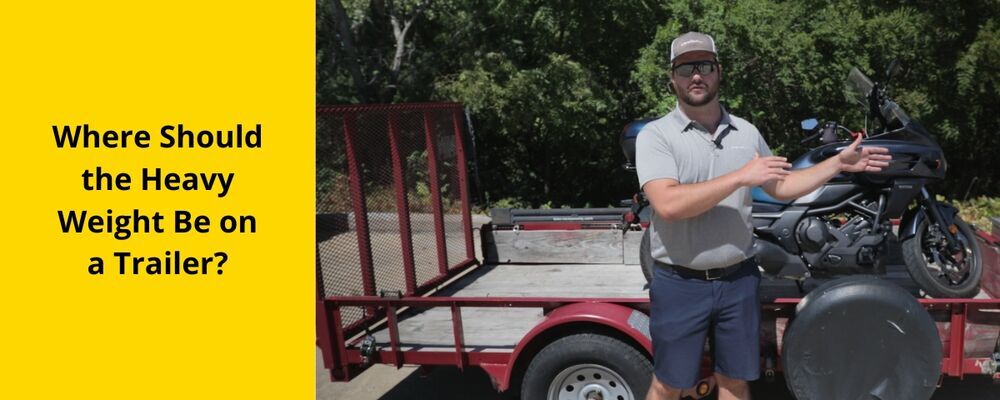
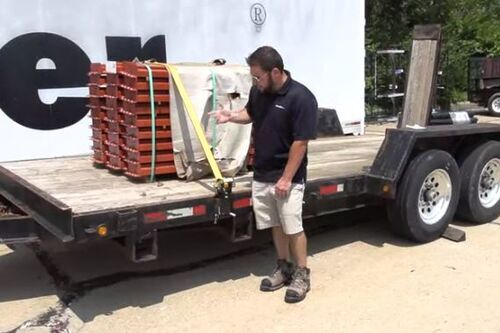
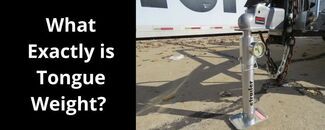
If you're researching where to put the heavy weight on your trailer, you probably already know that proper loading is a huge part of safe towing. All the suspension upgrades or weight distribution systems in the world won't fix an improperly loaded trailer. In general, trailers should be loaded with heavier gear toward the front and evenly from side to side.
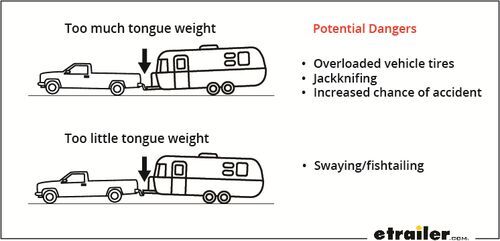
When a trailer is loaded too lightly at the front, the back may act like a pendulum, causing swaying or fishtailing at high speeds.
This can result in dangerous situations such as jackknifing or flipping. By placing the heavy weight up front, you increase the tongue weight and help keep your trailer in line with your tow vehicle.
That said, there's actually a specific weight percentage that should be at the front of your trailer: it's called tongue weight, and it's crucial to safe towing.
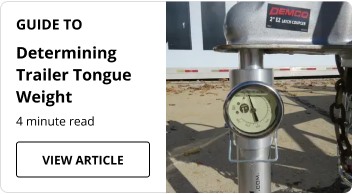
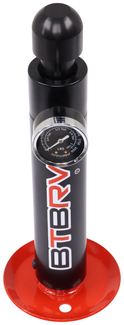
There are a lot of generic rules of thumb out there, such as the one that says you should place about 60% of the total weight toward the front of the trailer, ahead of the axle(s), with the remaining 40% in the back. This is a good starting point, but the real key to proper trailer loading is tongue weight. Tongue weight is the constant downward force a trailer tongue applies to the ball of a hitch.Proper tongue weight is 10% to 15% of your loaded trailer weight. (For 5th-wheel and gooseneck trailers, this is called pin weight, and you'll want this number to be from 15% to 25%.) This means you need to 1) find your loaded trailer weight, and 2) make sure 10% to 15% of its weight is up front and pressing down on your hitch ball. You can measure tongue weight by either using a tongue weight scale, a bathroom scale, or a commercial scale depending on your trailer. Read more about each of those methods here.
Tips for Loading Your Trailer
Here are some additional guidelines to follow when loading your trailer:
Distribute Weight Evenly Side to Side: Along with putting the heaviest items near the front, distribute weight evenly from side to side. An unbalanced load can cause the trailer to lean, which affects tire wear and handling.
Tie Down Heavy Items: Secure heavy items in place so they don’t shift while driving. Shifting weight can lead to trailer sway or cause items to become damaged.
(Learn more about choosing the right tie-downs here.
Avoid Overloading: Know your trailer's Gross Vehicle Weight Rating (GVWR) and your vehicle’s towing capacity. Overloading your trailer or vehicle can lead to poor handling, tire blowouts, and potentially damage to your vehicle’s drivetrain or transmission. This article helps you determine how much trailer you can tow, breaks down GVWR and other weight ratings, and shows you how to find them on your trailer.
Final Thoughts
You're towing heavy stuff—making sure it's properly loaded will go a long way in keeping you and others safe on the road. If you have any questions about loading your trailer, hit us up in the comments!
Hello Nathaniel, thanks for reaching out. So the etrailer jacks are going to be a great choice from a durability and affordability standpoint. The jacks offer all of the features you would want like a work light, sealed switches and a manual crank…
You never know what you might end up towing in the future so having more rise or drop is beneficial. To determine the exact rise or drop needed to tow any trailer level you can follow the help article I have linked for you.
Hey Tim, thanks for reaching out! The Trimax Puck Lock for Trailer Door Hasps #TMX96RR has an overall diameter of 2-7/8", and the opening is 1-3/4" wide x 3/4" tall. It's also 3/4" deep. I've attached some photos for you…
The B&W Tow and Stow ball mount #BWTS10049B will have some great features. You can stow the mounting platform that has the 3 hitch balls (1-7/8, 2, and 2-5/16 inch) underneath your vehicle. This is nice because you will eliminate the possibility…
There isn't a specific height from the trailer floor recommended to mount the E-Track. My gut feeling is that if 3 feet is too low and 4 feet is too high then 3-1/2 feet might be perfect. Another option is to mount E-track pieces vertically along…
The 1-5/16" Hellwig Adjustable Big Wig Rear Anti-Sway Bars are designed for 2WD #HE97MR or 4WD #HE94FR versions of your 2021 Ford F-250. These are both designed for trucks which have a stock ride height. Hellwig does offer their 2" Lift…
The Roadmaster Rear Anti-Sway Bar #RM93VR is a confirmed fit for a 2022 Ford F-350, but if you had a suspension lift instead of just a body lift you will most likely need to also need to get longer end links. For this you would need to call…
The CIPA Custom Towing Mirrors #CM10800 that you recently installed on your Sierra feature a basic floating design that allows for manual adjustment. I spoke with my contact at CIPA to see if he could provide any tips for this process. He did state…
The K-Source Snap & Zap Custom Towing Mirrors #KS80800, which are a confirmed fit for your 2004 GMC Sierra, will do an excellent job to help your towing experience easier. This has been confirmed by many different customers. I encourage you to…
Yes, you can correct the vibration in the K-Source, #KS80800, towing mirrors. if you push in on the bottom of the mirror all the way, you will then be able to see a Phillips head bolt in the gap that is exposed at the top of the mirror. Tightening…
The Longview Custom Slide-On Towing Mirror #CTM1500 that you referenced will fit the stock mirrors on the 2003 Chevrolet Silverado 1500 that look like the mirror in the linked photo. This towing mirror has no electrical connections at all, since it…

 Product Experts Available Now!
Call 1-800-940-8924