Let me ask you a question: do you know how much weight your vehicle is ACTUALLY capable of towing? How would you even figure that out? Simple, you need to find your vehicle’s towing capacity. Knowing your towing capacity is absolutely crucial for safe and effective towing. However, towing capacity is also an easy value to misunderstand, especially since most vehicle manufacturers misrepresent it in the owner’s manual. Thing is, towing capacity doesn’t have to be complicated. It can actually be pretty simple to figure out, so long as you know which numbers to look for.
Towing Capacity Explained
To put it simply, towing capacity is the amount of weight a vehicle can safely tow behind it, without the risk of significant damage. If you try to haul anything without understanding towing capacity, you run the risk of overloading your trailer. All towing puts wear and tear on your vehicle, but hauling an overloaded trailer puts you at risk of causing serious damage to both your tow rig and your trailer.
Vehicle manufacturers will usually give you a single number that’s supposed to tell you your absolute max towing capacity, but that number’s basically make believe. Most listed towing capacities assume that your vehicle isn’t carrying any cargo or passengers, and doesn’t have any accessories or modifications. This poses a real problem, because nobody in the real world tows with a setup like that.Towing capacity isn’t just determined by what’s behind your vehicle, it’s also influenced by what’s inside your vehicle. In other words, the amount of weight in/on your towing vehicle will greatly change your towing capacity. Some common examples of things that can influence your towing capacity are:
The combined weight of the driver and passengers
How much cargo is already in your vehicle
Whether or not you’ve optimized your towing setup with the right gear
How your payload is arranged in the trailer/whether or not the load shifts around while you’re driving (this can alter your tongue weight and change how your vehicle handles on the road)
Whether you’ve made modifications to your vehicle that might reduce the towing capacity, like adding certain aftermarket accessories or lifts
Taking all of this into account, it’s easy to see why the listed towing capacity doesn’t mean all that much. If you want to know your ACTUAL towing capacity, you’re gonna have to do a little trailer math.
How is towing capacity calculated?
For starters, you’ll need to know your GCWR (Gross Combined Weight Rating), which tells you the absolute max amount of weight your vehicle can support inside, plus the total weight it can tow behind. You’ll also need to know the curb weight of your vehicle, which is how much it weighs when it’s completely empty, except for any fluids necessary for driving (your gas, power steering fluid, etc.). Both of these numbers can usually be found on a sticker on the inside of your driver’s side door, but you can also check your owner’s manual. Vehicle manufacturers use these two numbers to determine that make-believe towing capacity they list in the owner’s manual.
Remember, this number only tells you part of the story. It’s pretty unlikely that you’ll ever tow with an empty cab and no aftermarket accessories. It’s also important to remember, this number is an ABSOLUTE maximum weight capacity for vehicles with perfect towing conditions. Even if your vehicle was perfectly optimized for towing (i.e., little to no extra weight in/on the vehicle, plus all the right towing accessories and enhancements), it’d still be a bad idea to force your rig to tow that much. Towing is pretty hard on a vehicle, and repeatedly pushing your engine for max performance can wear it out really fast. It’s just never a good idea.Now if you’re like most people and you have extra weight in your vehicle, that’s something you’ll need to factor into your towing capacity too. Your GCWR only gives you so much room to work with, so the more weight you pack into/ onto your tow vehicle, the less you’ll be able to haul behind it. Taking this into consideration, you’ll want to add up the weight of all the passengers and cargo inside your tow vehicle, plus whatever accessories are attached to your vehicle (we’ll call this combined number the payload) and factor that into your towing capacity.
This number is your ACTUAL max towing capacity, since it takes your real life towing setup into account. Still though, this number should only ever be your maximum load capacity, not your usual goal weight. If you overload your trailer and overwork your vehicle, it won’t stay roadworthy nearly as long as it should. Because of this, you should always keep your towing weight at least 10% less than your towing capacity if you're going short distances. If you plan on towing long distances, then that buffer should be increased to 15-20%. Having that buffer makes it way less likely that you’ll overburden your vehicle, and it helps account for any load shifting/ imbalance that might happen while you're towing. It also helps account for any vehicle modifications (like lifts) that might reduce your towing capacity even further.How can I make the most of my towing capacity?Contrary to what some misinformed towing forum contributors would have you believe, you’ll never be able to increase your towing capacity, and trying to push your vehicle to haul more than the max limit is SERIOUSLY unsafe. However, if you make the right upgrades to your vehicle, your tow rig will be able to haul as close to that max capacity as possible.It all has to do with vehicle modification and aftermarket accessories. Most of these modifications revolve around making your engine ultra efficient, or reinforcing the parts of your vehicle that take a lot of abuse when you tow.
Here are some of the specific mods you can make to give your tow vehicle a helping hand, and reduce the stress of towing:
Use the right hitch for your load size and towing setup
Or take the simple route and offload some cargo out of your tow vehicle.
If you have the time and money to make these additions to your towing setup, you can turn a really good tow vehicle into an excellent one. And if you’re looking for more in depth information on topics like performance tuners or trailer hitches, check out our informational articles linked below!
It’s important to always be cautious when you’re towing, and never exceed your towing capacity. Overloading your trailer is dangerous for your vehicle, your passengers, and everybody else on the road. Treat your tow rig right, and it will thank you in the long run.
About Izzy B.My journey with etrailer has had a number of twists and turns. I first started here in 2019 as a Summer Intern with our Content Department. I ended up enjoying the experience so much, that I came back to work at etrailer during several academic breaks throughout my college years. After some time away, I returned last Spring to work at our main warehouse, first as a Picker, and eventually on our Audit Team. Then, at the start of 2024, I was offered the chance to come aboard etrailer's Marketing Department, as a Writer for the Shopping Guide Team. Now, I help our neighbors by creating informational content to aid their shopping experience, ensuring they find the info, products, and solutions they need to get their own journeys underway!
The difference between the Class II and Class III hitches has to do with their Gross Trailer Weight (GTW), their Tongue Weight (TW), and their Hitch Receiver Size. Class II trailer hitch receivers have a 1-1/4 inch receiver and can be rated up to…
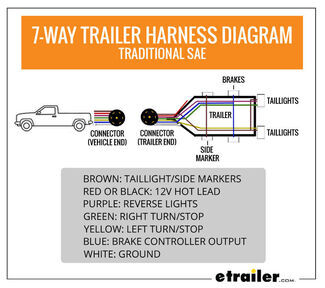
A 4-Way trailer connector has the basic lighting functions only; running lights, left turn signal and brake lights, right turn signal and brake lights, and ground. A 7-Way has these functions and a 12 volt circuit, a circuit for electric trailer…
In order to determine the torque rating for the lug nuts on your trailer you will need to know check out the chart I attached that shows all of the torque specs for all the trailer lugs available based on stud size, wheel material and wheel size.
Hey Jonathon thank you so much for all of that additional information! To haul your bikes behind your class C Sprinter motorhome, while flat towing your Mini, I recommend the Hollywood Racks RV Rider Bike Rack item #HLY64FR and the Roadmaster Dual…
Hi Paul, you’re definitely on the right track here, and I can help you narrow this down with confidence. With your tandem 3,500 lb Dexter axles and 33 inch spacing, both the Dexter EZ Flex part #K71-652-00 and the Lippert Road Armor part #LC53CK are…
According to Blue Ox, it'll take an experienced installer about 4 to 5 hours to complete the installation of their #BX1128 Base Plate Kit on a 2016 Jeep Grand Cherokee. The install isn't what I'd call super-difficult, but the installation…
The OEM prep package consists of 4 "pucks" in the bed of the truck that will allow you to drop in puck style hitches for easy installation and removal, that gives you a completely clear bed when not in use. The B&W Companion OEM 5th…
There sure is K.C.. For a shorter weight distribution shank that fits a 2-1/2" hitch, I recommend the Equal-i-zer item #EQ90-02-4700. This shank measures 12" long x 9-1/2" tall. It provides up to a 3" drop and has a 16,000 lbs…
Hi Ryan; the Weigh Safe Hitch w/ Built-In Scale for 2.5" Hitch #WS56ZR is designed in the US but manufactured in China. The Weigh Safe ball mounts with the built-in scale are pretty unique so we don't have a USA made option with the same…
Hey Jason! I'm guessing you have the 12" long shank right now which is the standard. For a longer shank that fits a 2-1/2" receiver you can use the Equal-i-zer Weight Dist Shank - 2-1/2" Hitch - 16" Long - 7" Rise,…
Hi James! With your GVWR being 7,600 pounds, your loaded tongue weight should be around 760 pounds. With that said, I recommend going with the Weigh Safe True Tow Weight Distribution Hitch - 2" Shank - 6" Drop - 8.5K GTW, 850 lbs TW…
The main difference between the Curt Trailer Hitch Receiver part #C13416 and the EcoHitch Hidden Trailer Hitch Receiver part #EH97FR is that the EcoHitch has a completely hidden cross tube whereas the Curt cross tube will be visible from the rear of…