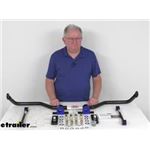
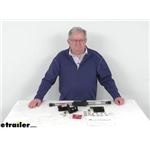
Hey Steve, welcome back! The difference between these two Hellwig Adjustable Big Wig Rear Anti-Sway Bars is the fitment. The #HE94FR is designed for 4WD models and the #HE97MR is designed for 2WD models. Since your 2019 F-250 is 4WD you need the…
Hey Thomas, the Blue Ox Avail tow bar part #BX7420 would be a really great option. It's very easy to use and has longer arms which allows the towed vehicle to track a little better behind the tow vehicle. Now if you wanted a braking system that…
Hey Eric, I can't find anything under 34-140, but maybe you meant 31-140 which is the silver Safe-T-Plus Steering Stabilizer #ST39VR. This is for Class B, C Motorhomes, Leisure Travel & Custom Vans, Pickup Truck, SUV, and Van Tow Vehicles,…
Hey Tom, yes the 2014 Ford Edge with the V6 engine is a great vehicle for flat towing. It's perfectly safe to do so as long as you follow the outlined instructions on how that are in the owners manual. The first thing you'll need to flat tow…
Hey Kent! For your 2024 F-350 Tremor you need the following: -Hellwig Front Anti-Sway Bar - 1-5/16" Diameter #HE36GR -Hellwig Adjustable Rear Anti-Sway Bar - 1-1/4" Diameter #HE44FR Are you adding these for towing or something else?
Hey Rich, yes you can definitely use the PowerMax Wireless 50A RV Power Center and Distribution Panel #PM77VR in your cargo trailer setup. You'd run the AC input to this and you'd have DC power circuits for anything that's DC powered in…
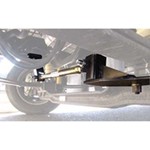
Roadmasters priority when it comes to their sway bars is top notch quality and the easiest install for the customer. This typically cuts the install time down enough that you end up saving money if you pay to have the bars installed or decide to do…
Hello Todd, thanks for reaching out. We do have rear sway bars for the 2022 Ford F-350. Here is what I recommend: - Hellwig Adjustable Big Wig Rear Anti-Sway Bar - 1-5/16" Diameter #HE97MR (for 2wd models) - Hellwig Adjustable Big Wig Rear…
The Roadmaster Exact Center Steering Stabilizer w/ Custom Brackets #RM47MR typically comes centered and you would only need to make adjustments after installation and testing to see if it continues to pull. If you adjusted it all the way out to where…
Hi Debbie! We do change part numbers when they are too close to other part numbers we have, and that looks to be the case here. The Safe-T-Plus Steering Stabilizer - White #ST49VR is the same thing as the Safe-T-Plus 41-180 and the Safe-T-Plus…
Good question, Rick. The #ST28MR blue and #ST88MR white steering stabilizer are tuned for different F-53 weight ranges. The blue version is for 24,000 lb + GVWR, while the white one fits 16,000–22,000 lb chassis. What’s your coach’s GVWR or model…
Hey John. We have three steering stabilizers that fit your 2021 Coachman Concord 300ts class C motorhome that was built on a 2020 E-450 chassis. I have listed them below in the order I recommend them: 1. Safe-T-Plus Steering Stabilizer with Mounting…
Hey Steve, welcome back! The difference between these two Hellwig Adjustable Big Wig Rear Anti-Sway Bars is the fitment. The #HE94FR is designed for 4WD models and the #HE97MR is designed for 2WD models. Since your 2019 F-250 is 4WD you need the…
Hey Thomas, the Blue Ox Avail tow bar part #BX7420 would be a really great option. It's very easy to use and has longer arms which allows the towed vehicle to track a little better behind the tow vehicle. Now if you wanted a braking system that…
Hey Eric, I can't find anything under 34-140, but maybe you meant 31-140 which is the silver Safe-T-Plus Steering Stabilizer #ST39VR. This is for Class B, C Motorhomes, Leisure Travel & Custom Vans, Pickup Truck, SUV, and Van Tow Vehicles,…
Hey Tom, yes the 2014 Ford Edge with the V6 engine is a great vehicle for flat towing. It's perfectly safe to do so as long as you follow the outlined instructions on how that are in the owners manual. The first thing you'll need to flat tow…
Hey Kent! For your 2024 F-350 Tremor you need the following: -Hellwig Front Anti-Sway Bar - 1-5/16" Diameter #HE36GR -Hellwig Adjustable Rear Anti-Sway Bar - 1-1/4" Diameter #HE44FR Are you adding these for towing or something else?
Hey Rich, yes you can definitely use the PowerMax Wireless 50A RV Power Center and Distribution Panel #PM77VR in your cargo trailer setup. You'd run the AC input to this and you'd have DC power circuits for anything that's DC powered in…
Roadmasters priority when it comes to their sway bars is top notch quality and the easiest install for the customer. This typically cuts the install time down enough that you end up saving money if you pay to have the bars installed or decide to do…
Hello Todd, thanks for reaching out. We do have rear sway bars for the 2022 Ford F-350. Here is what I recommend: - Hellwig Adjustable Big Wig Rear Anti-Sway Bar - 1-5/16" Diameter #HE97MR (for 2wd models) - Hellwig Adjustable Big Wig Rear…
The Roadmaster Exact Center Steering Stabilizer w/ Custom Brackets #RM47MR typically comes centered and you would only need to make adjustments after installation and testing to see if it continues to pull. If you adjusted it all the way out to where…
Hi Debbie! We do change part numbers when they are too close to other part numbers we have, and that looks to be the case here. The Safe-T-Plus Steering Stabilizer - White #ST49VR is the same thing as the Safe-T-Plus 41-180 and the Safe-T-Plus…
Good question, Rick. The #ST28MR blue and #ST88MR white steering stabilizer are tuned for different F-53 weight ranges. The blue version is for 24,000 lb + GVWR, while the white one fits 16,000–22,000 lb chassis. What’s your coach’s GVWR or model…
Hey John. We have three steering stabilizers that fit your 2021 Coachman Concord 300ts class C motorhome that was built on a 2020 E-450 chassis. I have listed them below in the order I recommend them: 1. Safe-T-Plus Steering Stabilizer with Mounting…
Very helpful/friendly Customer Service. Competitive Pricing. Shipping was Fast.
John
Mankato, MN
Rear Anti-Sway Bars for steadier handling
Settle down body roll and side push when towing or carrying a camper. rear anti-sway bars can make handling feel more stable in crosswinds, turns, and with heavy loads. Match your setup for stock height or lifted, and if you run helper springs or air bags, minor bracket adjustments may be needed.
Yes, they can work together. Minor adjustments to air bag lower brackets may be needed, and you may need to trim excess bolt length on one side. After installation, check the end link angle and clearances around brackets, hitch hardware, and exhaust. If something looks tight, reposition the bracket per the instructions to prevent contact.
Install can be straightforward, sometimes about an hour for a clean fit. Have a standard 1/2" drive tool set, a low speed high torque drill if frame holes are required, and a 250 plus ftlbs torque wrench. Check link-hole choices and arm length per the instructions for the ride you want. Removal of an old bar can be trickier where access is tight; plan patience there.
It can, but you must match the bar to your drivetrain and rear ride height. Some kits are for stock height only, while others are for a specific amount of rear lift—verify your rear lift, not just the advertised front lift. Also confirm 2WD vs 4WD, as kits can differ. With the correct kit the rear bar should sit level.
Yes, upgrading the rear first typically makes the biggest difference. It helps resist push from passing trucks and gusty winds and improves stability with loads or a camper. If you want more control after that, add a front bar. Verify bar diameter and design against your current setup and confirm it's listed for your vehicle's configuration.


 Filters