bing tracking image

REDARC BCDC Charging Process Explained
Image provided by REDARC

REDARC's BCDC Charging Process Explained

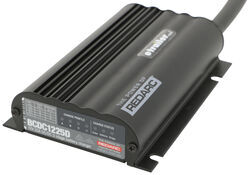
*This article is property of and was originally featured on REDARC. It has been repurposed with permission for use by etrailer.REDARC's BCDC product line features technology designed to charge batteries to 100% regardless of their type or size.By providing a unique charging profile to each specific battery type, a REDARC in-vehicle battery charger is able to achieve and maintain an optimal charge in an auxiliary battery at all times.The BCDC automatically senses once the vehicle has started charging the main battery. When the start battery reaches 13.2 volts (26.4 volts on a 24-volt system), the BCDC will then commence charging the auxiliary battery.

Three Stage Charging Process

  • Boost Stage
  • Absorption Stage
  • Float Stage
Charging Process
Image provided by REDARC
The three-stage charging process starts with the ‘boost’ stage, providing maximum current until the battery reaches its predetermined ‘absorption’ voltage. The BCDC will then remain in the absorption stage, holding its set voltage until the unit is 100% charged.The BCDC then switches to the ‘float’ stage, where it retains the 100% charge. Once the secondary battery voltage falls below 12.7 volts (12 volt) or 25.4 volts (24 volt) due to a large load, the BCDC will recommence the boost stage.During these charging stages (including float) the BCDC is able to supply loads (up to maximum current output) without necessarily switching back to the boost stage. This protects the battery from overcharging.The microprocessor constantly monitors the main vehicle battery input charge levels, automatically switching off the BCDC should the main battery fall below 12.7 volts (12 volt) or 25.4 volts (24 volt), so it will not flatten the start battery.

Two Stage Charging Process (Lithium)

  • Constant Current
  • Constant Voltage
The BCDC charger works a little differently when used with lithium batteries. When turned on, the charger will move to the Constant Current stage. This stage maintains a constant current until the battery voltage reaches its set point. The current may vary during operation in order to maintain safe operating temperature, or to limit the difference between input and voltage.The Charger will then move to Constant Voltage stage. This stage maintains 14.5V on the battery output, keeping the battery topped up. When a load is applied to the battery, causing it to lose charge, it will move back into the Constant Current stage.
Lithium Batteries
Image provided by REDARC
Related Products
Keith L. profile picture

Keith L.

3/8/2025

Great article. I have a 100AH lead acid auxiliary battery. The only load is a 45ltr Dometic fridge. I have never seen anything except "Boost'.I am running a Redarc Alpha 25. How can I troubleshoot this, please?

Jon G. profile picture

Jon G.

3/8/2025

@KeithL Are the battery types between your trailer and tow vehicle the same?
Keith L. profile picture

Keith L.

3/9/2025

@JonG Yes. Both are lead acid and under bonnet.
Jon G. profile picture

Jon G.

3/10/2025

@KeithL Thanks for the extra info! I went ahead and reached out to my contact at Redarc for this one, and this is what they got back to me with: Please let me know the customer vehicle application, and ask the customer if they have attached the “Ignition Trigger” wired. Pages 7, 16 & 25 of the attached manual address this. Late model vehicles from mid 2000’ and up generally have these Smart Alternators that drop voltage while the vehicle is driving and can cause the BCDC Alpha to stop charging if an “Ignition Trigger” is not wired-up. Also, since the auxiliary battery type is lead-acid, the profile for charging needs to be set to “B” – page 28. The RedVision App. can be utilized to ease programing – page 29. Please check out the above and let me know if that solves the issue.
See All (7) Replies to Keith L. ∨
Chris profile picture

Chris

12/3/2024

This article does not explain the charging process in enough detail. For example, what is the "predetermined absorption voltage"? How does the charger maintain full charge when the battery is being used by a fridge for example? Float stage does not provide enough power to maintain a full battery when a fridge is drawing power.


Jameson C. profile picture
Etrailer Expert

Jameson C.

12/3/2024

@Chris The predetermined voltage rate is going to be based on the battery type which you can choose. If the battery is in use it will cause the charger to switch down to a more aggressive charge setting depending on when it senses and the draw and how much amperage is getting drawn.
Tom E. profile picture

Tom E.

6/17/2022

The article does answer the question of what a DC to DC charger is and how they work. Good article.