What we check every spring before we tell a neighbor they’re ready to tow.Every spring we hear some version of this:“The trailer’s been sitting all winter. The tires look fine… but I don’t want a blowout on the first trip.”That’s a good instinct.Because here’s what we see every year: Tires that look fine fail, not because they were junk, but because they aged quietly while the trailer was parked.Cold weather. Sitting under weight. UV exposure. Then suddenly 65 mph and highway heat.
That’s when problems show up.Here’s how we walk through it in the shop before we send a neighbor down the road.
Before tread. Before pressure. Before anything.Over time: Check the DOT date code on the sidewall.The last four digits tell you the week and year the tire was made.Example:1421 = 14th week of 2021Here’s the guideline we use:
Under 5 years old - Usually fine if overall condition is good
5–6 years - Look very closely at sidewalls and wear
7+ years - We strongly recommend replacement before highway travel
Rubber dries out from the inside over time. You don’t notice it sitting in the driveway. You notice it at 65 mph.We’ve seen 9- and 10-year-old tires with great tread depth separate at speed because the internal structure had simply aged out. Tread doesn’t tell the whole story. Age does.
Date code stamp on sidewall of a trailer tire
Step 2: Measure the Tread (Don’t Just Guess)
Trailer tires don’t usually wear out from mileage. But when tread gets low, two things happen:
They run hotter
They lose wet traction
Heat is the enemy with trailer tires.Here’s how we check tread properly.Option 1: Tread Depth GaugeThey’re inexpensive and accurate. Insert the probe into the deepest groove and check the number.Option 2: Quarter TestInsert a quarter into the groove with Washington’s head down.
If you can see the top of his head - tread is getting low
If his head is mostly covered - you likely still have usable depth
For trailer tires, we typically recommend replacement at 4/32" or less, especially for highway towing.If you’re right at that line and planning a longer trip, we usually recommend replacing them before you go.Blowouts rarely happen at 20 mph. They happen at speed, under load, when heat builds.
Step 3: Inspect the Sidewalls Closely
This is where winter damage usually shows up first.Use a flashlight. Check both the outside and the inside sidewalls.Normal:
If you see a bulge, that’s internal separation. We won’t recommend towing on that. Period.Sidewalls flex constantly at highway speed. Any structural weakness there is amplified by heat.
Step 4: Inflate to the Correct PSI (This Is the Big One)
If there’s one thing that prevents most trailer tire failures, it’s this.Trailer tires should be inflated to the maximum cold PSI listed on the tire sidewall.Not the trailer sticker.Not “close enough.”Not a few pounds under because it’s warm outside.If the tire says:“Max Load at 65 PSI”That means 65 PSI cold. Trailer tires are designed to carry their rated load at that pressure. Running lower increases sidewall flex. Sidewall flex builds heat. Heat weakens the internal belts.Set pressure when the tires are cold.Let them sit overnight.Re-check in the morning.We do this with every trailer that comes through in the spring. Because underinflation is still the number one cause of trailer tire failure we see.
Inflate the tires to the maxium cold PSI listed.
Step 5: Look at the Wear Pattern
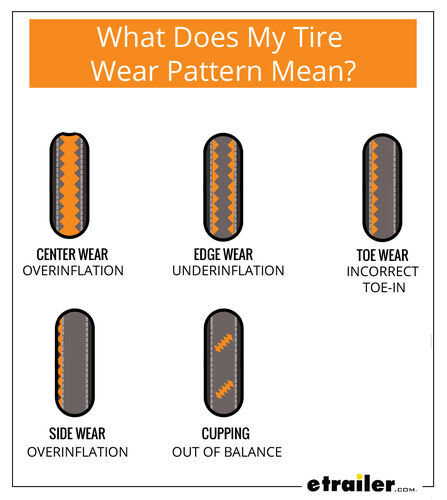
Tires tell a story. If wear is even across the tread, that’s what we want to see.If it’s not, here’s what those patterns usually mean:Inside edge wear
Often caused by overloading
Can indicate a bent axle or camber issue
When an axle bends slightly under weight, it changes how the tire contacts the road. Over time, that inside edge scrubs away first.Outside edge wear
Common with chronic underinflation
Sometimes alignment-related
Low pressure allows the outer edges to carry more load. That extra flex builds heat and wears those shoulders down faster.Cupping (scalloped dips around the tread)
Suspension wear
Worn equalizers or bushings
Loose shackles
Bearing play
Cupping happens when the tire bounces slightly instead of rolling smoothly. That usually points to something loose or worn in the suspension system.Sometimes the tire isn’t the problem. It’s just the part that’s showing you something else is.If we see uneven wear, we don’t immediately recommend new tires. We inspect springs, shackles, equalizers, and bearings first.Replacing tires without fixing the root issue usually means you’ll see the same wear pattern again next season.
Step 6: Make Sure All Tires Match
Before the first tow of the season, confirm:
Same size
Same load range
Same type (all radial or all bias)
Similar age
Mixing bias and radial tires changes how the trailer flexes and tracks at speed. Mixing load ranges can overload one tire before the others. A properly matched set runs cooler, tracks straighter, and wears more evenly.Consistency keeps things predictable.
Step 7: Quick Bearing Check
Before sending a neighbor out, we always do this.Jack up one side.Grab the tire at the top and bottom.Rock it gently.If you feel noticeable movement, the bearings may need adjustment or service.Then give the tire a slow spin by hand. It should rotate smoothly and quietly. If you feel grinding, resistance, or noticeable wobble, something isn’t right.Loose bearings generate heat at the hub. Rough bearings generate even more. Hub heat transfers into the wheel. That heat moves into the tire.And again, heat shortens tire life fast.
Before Your First Real Trip
Here’s what we typically suggest:
Inflate to max cold PSI
Let it sit overnight and re-check
Drive 5–10 miles
Carefully check hub temperature (warm is normal, hot is not)
Look for consistency between wheels
Check the spare - pressure, age, and condition. A spare only helps if it’s ready.
You’re not looking for perfection. You’re looking for anything that feels different. You want to know it’s ready, not hope it is.
Not Sure What You’re Seeing?
That’s normal.If you’ve gone through this checklist and you’re still unsure whether your tires are safe, we walk through that decision here: When Should You Replace a Trailer Tire?Or send us:
A photo of the sidewall
The DOT code
What you’re towing
How far you’re traveling
We’ve helped a lot of neighbors work through this over the years.
If they’re safe, we’ll tell you.If they’re not, we’ll help you choose something that fits how you actually use your trailer.Because the goal isn’t just avoiding a blowout.It’s making sure your first trip of the season feels boring, in the best way possible.
About Nicki B.I’ve always loved learning and teaching. Every day I get the chance to help a neighbor pick up something new, whether it’s understanding how to tow with more confidence, setting up camp a little easier, or just finding the right gear for their next trip. For me, the real joy comes from turning those little “aha” moments into solutions that make life safer, smoother, and more fun.Outside of work, you’ll usually find me outdoors. I love fishing, camping, and hiking the trails with my family and our golden retriever (who insists on carrying the biggest stick he can find). I spent years as a Cubmaster and scout leader, and now I get to put those skills to good use running our team campouts. My favorite part is making up fun games and activities that get everyone laughing.When I’m not outside, I’m probably curled up with a book or unwinding with some old Top Gear reruns. At the end of the day, I just like finding ways to make things a little easier and more enjoyable, on the road, at camp, or at home.
In order to determine the torque rating for the lug nuts on your trailer you will need to know check out the chart I attached that shows all of the torque specs for all the trailer lugs available based on stud size, wheel material and wheel size.
Hey Bryan, that's a good question. The pricing can definitely be misleading, but I wouldn't use it to judge the quality of the tire. A lot of that comes down to promotions, inventory, and whether you're looking at a tire by itself or…
The difference between the Class II and Class III hitches has to do with their Gross Trailer Weight (GTW), their Tongue Weight (TW), and their Hitch Receiver Size. Class II trailer hitch receivers have a 1-1/4 inch receiver and can be rated up to…
The 5.30-12 tires, being wider, are going to make more contact with the road. This means that the noise, and heat build up will be higher than a 4.80-12 tire but the rolling resistance will actually be less because the tire is larger diameter. The…
A 4-Way trailer connector has the basic lighting functions only; running lights, left turn signal and brake lights, right turn signal and brake lights, and ground. A 7-Way has these functions and a 12 volt circuit, a circuit for electric trailer…
It sounds like you are speaking of the wires for the brake magnets. If this is correct, you will need to connect one of the wires to the brake controller output wire on your trailer connector and the other wire will need to be grounded to a clean…
The difference between an load range C and load range D tire in the same size is the capacity and psi rating. The two tires will still have the same dimensions and fit on the same wheel. The D rated tire has a higher capacity. For a ST175/80D13 like…
The two sizes you mentioned are pretty similar and fit many of the same 15 inch wheels. The 205/75-15 fits rim widths of 5 inch to 6 inch whereas the 225/75-15 fits widths that are 5 inch to 6-1/2 inch. The 205 is 27.1 inches tall and the 225 is 28.4…
Hi Paul, you’re definitely on the right track here, and I can help you narrow this down with confidence. With your tandem 3,500 lb Dexter axles and 33 inch spacing, both the Dexter EZ Flex part #K71-652-00 and the Lippert Road Armor part #LC53CK are…
The #84 spindle is just a common way to identify the spindle dimensions typically used for 3,500 lb axles. So instead of listing out the parts, people can just say they have #84 spindles and it's easier to know what fits it. The CE Smith Trailer…
According to Blue Ox, it'll take an experienced installer about 4 to 5 hours to complete the installation of their #BX1128 Base Plate Kit on a 2016 Jeep Grand Cherokee. The install isn't what I'd call super-difficult, but the installation…
Even though I cannot comment specifically on the grease you used because I am not familiar with it, I can tell you the best grease for trailer bearings is a a grease with a rating of GC-LB, which just means it is made to withstand very high…