


To see if this custom-fit item will work for you please tell us what vehicle you'll use it with.



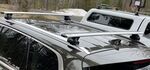
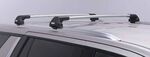
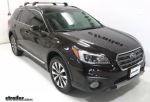
The flush design keeps the crossbars tight to the roofline, giving your setup a clean, from-the-factory look. Nothing sticks out past the feet, so the rack stays sleek and low-profile. The WingBar Edge blends right in, keeping things tidy whether you’re hitting the highway or parking in the garage.
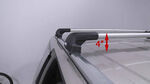
Wind noise can make even short drives annoying. These aerodynamic aluminum crossbars are shaped to reduce drag and vibration while driving. The split rubber strips in the top channels close automatically around your mounts to seal out wind and keep things quiet. The result is a smoother ride without that constant whistling.
This rack is ready for whatever gear your weekend brings. The aero-style bars work with both channel-mount and clamp-on accessories, so you can easily attach bike racks, kayak carriers, or cargo boxes when you need them. You don’t have to limit yourself to one type of setup—the system’s flexibility makes switching between gear simple.
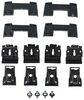
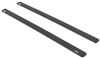
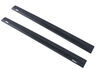
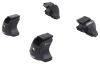
Everything you need comes in one package—2 WingBar Edge crossbars, 4 Edge Flush Rail feet, and a custom fit kit designed for your roof rails. The pieces fit together cleanly for secure mounting without extra parts or cutting strips. It’s straightforward and built for stability under load.
Constructed from strong aluminum, these bars handle up to 165 lbs while staying lightweight and corrosion-resistant. For added peace of mind, you can use Thule One-Key System locks (sold separately) to secure both the rack and your channel-mounted gear. It’s a sturdy platform built for real use on every trip.
 Alternate Instructions
Videos are provided as a guide only. Refer to manufacturer installation instructions and specs for complete information.
Hello, neighbor, this is Curt with etrailer, and today we're gonna be taking a look at the Thule WingBar Edge roof rack and see how it works with our 2024 Mazda CX-50. Now, if after watching this video, you decide that this is the roof rack for you and you go ahead and get it, put it on you, use it a few times, go ahead and share with us what you think about it in the comments below. We would love to share your experience with our other neighbors so they can make the best decision for themselves. Now, a roof rack can be an excellent way to carry some of that extra cargo with you on your next adventure. There are other ways to do it, of course. You could always use the hitch along with hitch carriers and hitch baskets.
However, that does leave a big footprint behind the vehicle, can make it difficult to park. And not only that, it does, you know, being that low to the ground, seem to be a little more accessible to things like thieves and other kinds of damage. A roof rack is a great way to kind of get those extra things up and outta the way. They won't be dragging behind your vehicle or anything like that. Up here on the roof is an excellent place to carry it as well because there's always some things that you're gonna have with you on those longer trips.
Maybe they're either too big to fit in the car with you and the other passengers, or it might be something you just don't want in there. Like maybe you're going camping and you keep your tent up there, among some other things that may or may not be smelling all that great on the trip home. So a roof rack can hold things like roof boxes, roof cargo baskets, kayak carriers, ski and snowboard carriers, awnings, all sorts of things that could go up on your roof. Now, the Thule WingBar Edge is a flush roof rack, and what that means is that the crossbars don't actually overhang the towers. They all come to and end right here.
And from a stylistic standpoint, I do agree that these kind of look better. They look a little more factory. They look a little more streamlined than the overhanging bars. However, what you're going to end up sacrificing is usable bar space. Generally speaking, because you don't have as much accessible bar space on a flush rack like this, you can usually only put one accessory up here, usually a roof box or something like that.
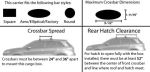
And you're also gonna be forced to mount it toward the middle, as opposed to an overhang, which generally gives you a little bit extra to work with and you can often put accessories side by side. But with all that being said, this isn't excellent system. It is a an aero bar, which means the bar is an elliptical shape. It's wider in the front, narrow in the back, with the blade shape. That's gonna help reduce a lot of that road noise that you end up getting out of round bars and square bars. It's also going to have an available track to it that's gonna allow you to use your T-slide accessories as well, such as an awning or some of those kayak and snowboard carriers that are out there on the market. You can, of course, also use the clamp-mounted systems. And on this vehicle, we are gonna take a few measurements eventually, but you've got plenty of space under the bar here to get just about any clamp-mounted accessory up there as well. Now, it does have a 165 pound weight rating. However, you always want to double-check in your owner's manual, double-check your vehicle and see what the weight capacity for your roof is. Whatever number is lower, that's how much you can carry up on your roof. But with all that being said, let's get up there, take a few measurements, and see how this is fitting on our CX-50. So, taking a look at what we have up here. Now, I did mention that you've got kind of less space than you would up here for as far as usable bar space compared to an overhang, but if you want to check your accessories, you just wanna make sure that having about 32 3/4 inches of bar space is gonna be enough for them. The rails on the CX-50 do taper. They're closer together in the back than they are up in the front. But if you're really only doing the one, the back bar is gonna be more important. But if you wanted to know, you've got almost 34 inches of bar space up here on your front bar. The other important thing to look at is going to be our spread. So if I'm going from the seam on our weather strip to the seam over here, we are at a 30 inch crossbar spread almost dead on the nose. And to me, that's perfect. If I have the ability to put my bars wherever I need 'em to, 30 inches is generally where I want to be because just about every rooftop accessory out there requires somewhere between 26 and like 34 inches of bar space. So getting it right at that 30 mark puts it right in between. I'm not really afraid of anything coming up here and not really fitting all that well. One of the things that you do want to keep in mind though, it does actually add some height to the vehicle. So if you've got a low garage opening or anything like that, just be mindful. This is gonna add four inches of height to your vehicle. And if we're gonna take a look at how much bar space we have underneath, you're looking at about 2 1/2 inches of bar space between the roof and the bottom of the bar, which as I said just a moment ago, is plenty of room really for any of your clamp-mounted accessories to go up and on here. Now, the fit of the WingBar Edge on the CX-50 to me on these rails is excellent. The fit kit that you get with it, with these clamps in this rubber foot pad, are gonna be specific to the vehicle, and I'm really impressed by how they fit. The rubber foot pad actually kind of contours to this rail top perfectly. And the clamps have it on here in a way that it's really, really solid. And installation on the WingBar Edge is actually pretty simple as well. So follow along, I'm gonna show you exactly how we got our crossbars up on our CX-50. So, to begin our installation, let's make sure we've got the right tools with us. One, Thule is gonna provide you with this pre-torqued tool here. This is what you're gonna need for pretty much all of the assembly of our crossbar system. We're also gonna have a measuring tape handy as well as a flathead screwdriver. Now the first thing that we're going to do is attach our tower to our crossbar. We've got one end attached already. Do be careful because these towers are gonna be driver or passenger's side-specific. This wider end here should be facing the rear of the vehicle. Just like on our crossbar, the thinner end of the crossbar faces the rear of the vehicle. So this will be our driver's side portion. We're gonna go ahead and insert it here. Now, as I do that, you'll notice that there is a square cutout here in the bar. That's where this little square tab is going to go. So the idea is you depress it and slide it on, just like that, until it clicks into place and it's locked in. Now you could still adjust your crossbar length, but it's attached onto our tower at this point. And the next thing we're going to do is go ahead and finish our assembly of that tower. So we're gonna turn our crossbar upside down. Now one of the great things about Thule is that they do a great job of labeling all their different parts. So there's not a lot of confusion as far as when you get it put on there. So, for instance, this first portion we're gonna insert is stamped with an A, our rubber foot pad is stamped with a B, and our final clamp is gonna be with a C. So we're gonna put our inner clamp on first. And in order to do that, remember we're working with it upside down here, we're just going to go ahead and thread this bolt here through the opening. And we're gonna make sure that these two little arms here are kind of resting up on top, just like so. So with that on, we're gonna go ahead and grab our rubber foot pad. Now as we put this on, you'll see that there are tabs here and some correlating holes for those to go into. But when we do this, we do wanna make sure that this clamp is toward the outside. So we're just gonna go ahead and slip that on, press down on it on all the holes, and just get it nice and snug. And then lastly, we're gonna be putting on our outer clamp. Now, to do this, first thing you wanna do is the A clamp actually has this tab on it. You're gonna wanna just kind of slip that through there and then we'll get that bolt put through as well. Once I have that on, I'm gonna go ahead and get it turned over. Now, you can see where that bolt is coming out. I'm gonna finally take this kind of a different shape. This is a nut that's gonna go on here and screw on. I'm not gonna screw it all the way down because this is what's going to adjust and tighten down both our clamps onto our rails and our crossbar length onto our towers. So the final step of the install is going to be putting on our weather stripping. This is gonna come in one piece. So you're gonna wanna go ahead and separate those. And once we do that, we're gonna go ahead and get it installed here. Now, on the back part, the part facing the rear of the vehicle, that's where this more plain section of strip is going to go. So we're just gonna feed it into this tab, and just a little bit at at a time, just kind of press it along its way all the way to the end. Now the next portion is gonna be this section with the arrows. The arrows, by the way, should be pointed toward the front of the vehicle, if that helps you out at all. So we're just gonna go ahead and install this the same way on the opposite end. So once we have that in place, we've got everything assembled and we're ready to get it up on the roof. So as we put it on, just keep in mind that, again, the point part where the arrows are pointing or the wider portion of the bar is gonna face the front of the vehicle. So it is helpful if you have a friend to help you out with this, but it's not that heavy. So if you could do it gently in a way that you just kind of settle it in right over there, I'm gonna do the same thing on this side. Just kind of open our clamp up and get it resting on there. And as far as where on here you're going to put them, well, there are no fixed mounting points up here. So you're really kind of free to put these wherever you want. However, I do have a suggestion that perhaps because of the way that this tapers toward the front and slopes down, also as it gets to the front of the vehicle, they kind of bend outward like this. So I really don't want to install it too close to the front up here. I find that a really good place to install these is right where our door seams are for the most part. And that still gives us a really good crossbar spread up here. But it also gets us to a point where things are a little bit more relatively flat than they would be if, you know, maybe I install a bar way up here. So I'm getting this bolt kinda lined up with my door seams. I am gonna check the other side to make sure it's lined up that way as well. And because I do wanna guarantee that these bars are parallel to each other, I'm gonna make sure that the measurement from one tower to the back one is the same on both the driver and the passenger's side. So I'm gonna go ahead and get those measurements and adjustments right now. So, after measuring our crossbar spread and making sure that's equal on both sides, at this point, now we're gonna make sure that our crossbar is kind of evenly distributed across both of our towers. You'll find a little letter scale here on the inside of the tower. It's gonna be A through the letter U. And if you get it kind of matched up, because we left this loose, we could still maneuver our crossbar back and forth a little bit. And just make sure that you're on the same letter on both sides. That way it makes sure that not too much of the crossbar, say, is loaded here onto our passenger end and there's not much over here. We really like, you know, the crossbar to be as evenly distributed across here as possible. So in our case, on the front bar, we've got the letter M here and we've got the letter M over on the other side as well. So we know that we have an even crossbar. Okay, so we've got everything, even our bar is even, we've double-checked our crossbar spread, that's even on both sides. Now, it's time to tighten our clamps down onto the vehicle itself. So we're gonna take our Thule tool, and what we're going to do is just use that kind of special-looking nut that we add there and we're just gonna tighten it down kind of slowly. Now, I don't want to tighten it down completely on one side and then go to the other 'cause that can cause it to shift a little bit. So I'm basically tightening it down to getting it to, you know, relatively snug. I'm gonna go over on the other side and do the same thing, and we're gonna kind of incrementally go back and forth and get it tightened down evenly on both sides. So once you've got it down tight and snug enough, we could go ahead and go all the way. Now, what's gonna happen is I mentioned that this is a pre-torqued tool. So when you get it tight enough, you're gonna hear a loud click or a pop, (tool popping) just like that. That indicates that our clamps are tightened down completely, our crossbars tightened down completely, and we can go ahead and replace our tower covers, which again, these are side-specific, so the wider end of it is toward the back. We're just gonna slip that into place there. And this is where our flatheads gonna come in handy. When you purchase these crossbars just outta the box, you know, from the manufacturer, from us, it's not gonna come with metal lock cores. It's just gonna come with these tabs that you can open and close with a flathead. It would be my suggestion for the security of your crossbars and the cargo, however, to go ahead and to get a set of locking metal cams and keys. They are part of Thule's One-Key System, which means that you can actually get them keyed-alike to all your other Thule accessories. So if you have a Thule roof box or a kayak carrier or a Thule bike rack, you can get those keyed-alike so that you only have one set of keys for all of your Thule products. But once you get it on there and it's locks in, your installation is going to be complete. You'll be ready to load these up and head onto your next adventure. So there was a look at the features and installation of our Thule WingBar Edge on our 2024 Mazda CX-50. I'm Curt with etrailer, thanks for stopping by.
Ratings & Reviews

For XXX bucks I thought it would include the keys. Not plastic plugs. Instructions say it should have key. They even talk about how to store the key. My advice to anyone is buy it directly from dealer.
I received all the required parts in excellent condition. The installation went very smoothly as planned on my 2022 Subaru WRX!
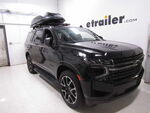
We bought a new vehicle that we already had several Thule accessories for. Purchased the fit kit for our Tahoe along with the Flush Rail feet and they fit perfectly.
Initially I was worried that I good not get a good Roof Rack configuration to match my 2022 Kia Telluride. When I asked etrailer for some assistance on the configuration, Jon was quick to reply with an excellent solution. He definitely knew the products. Unfortunately, my initial shipment was damaged but Gwen and team quickly got me replacements in the mail. I have received and installed all components and couldn't be more satisfied.

Do you have a question about this Roof Rack?
Info for this part was:
At etrailer we provide the best information available about the products we sell. We take the quality of our information seriously so that you can get the right part the first time. Let us know if anything is missing or if you have any questions.

















Thank you! Your comment has been submitted successfully. You should be able to view your question/comment here within a few days.
Error submitting comment. Please try again momentarily.