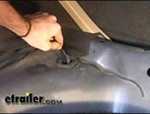
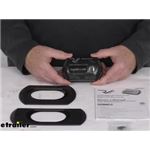
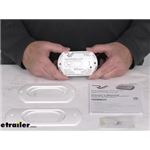
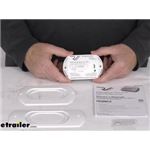
You can use the RV Propane Gas Detector #RS64FR (white) or #RS44FR (black) to replace your current Atwood 31013 propane gas detector. This will also use a 12v, 2-wire installation like your current detector.
The RV Propane Gas Detector part #RS64FR is what I recommend using to replace the the Atwood RV Propane Gas Detector part 31013 (Discontinued). The mounting plate for this new detector will cover up any holes you had for the previous so it will be a…
Hey Dennis, I can assure you that the Kenda Karrier KR53 ST235/80R16 Radial Trailer Tire with 16" Black Mod Wheel #KE22EV that you referenced does come pre-mounted. There isn't a chance these would show up and would need to have the tires…
We do have a couple of options to replace your Atwood 36636, and you can use either, with the only difference being the color: - RV Propane Gas and Carbon Monoxide Detector - Black #RS54FR or White #RS34FR Either will work perfectly as replacements…
For a replacement you could use the RV Propane Gas Detector #RS64FR (white) or #RS44FR (black). These are made in the USA with imported parts. If you want the version that also detects CO we have the #RS34FR or #RS54FR as well.
Based on the picture you provided the Atwood RV Propane Gas Detector - 12 Volt - White #AT36720 would be an exact replacement for your current Atwood RV Propane Gas Detector.
We do have a propane gas detector you can use to replace your Atwood model 31013. The Atwood 31013 is no longer available, so it will not be a direct replacement. We have the: -RV Propane Gas and Carbon Monoxide Detector #RS34FR for white, or the:…
The Atwood RV Carbon Monoxide and Propane Gas Detector #AT36681 is going to be the closest replacement to your ProTECHtor GS961LP-RV. It requires a 3-9/16" long x 3-7/16" wide x 1" deep cutout hole and will alert you to both unsafe…
Hello Tom, Welcome to etrailer, I'm glad you found us! I see you were looking at the ICON locks, EXCELLENT choice! I was pretty impressed when they came here to etrailer with power tools and other locks just to show us how well their locks are…
I wasn't able to find the Atwood 36720 RV Propane Gas Detector you mention, however I was still able to find the RV Propane Gas Detector #RS64FR in white, or #RS44FR in black to work as a replacement for your Protechtor Series 2001 LP Gas…
Hey Craig, thanks for reaching out. If your 2025 Rockwood 2318FT came with the SJ-2500 stabilizer jacks, I agree with you. They're functional, but they're pretty light-duty. My favorite upgrade is the etrailer Scissor Stabilizer Jack…
RV gas detectors are essential for ensuring safety on the road, detecting propane and carbon monoxide leaks. When choosing a detector, consider ease of installation, compatibility with your RV's existing setup, and the brightness of status indicators. A good detector should fit seamlessly, provide reliable alerts, and be easy to replace when needed.
Installing an RV gas detector is generally straightforward. Most models come with mounting plates and require minimal drilling. They often connect to existing 12V wiring with wire nuts, making the process quick and simple. Some models even cover existing cutouts perfectly, ensuring a clean look.
Consider the brightness of the detector's status LED, as some models have very bright lights that can illuminate the RV at night. If you prefer a more subdued light, look for models with less intense LEDs or consider placing the detector in a less obtrusive location.
Yes, some detectors are recommended for specific RV brands like Airstream or Atwood replacements. These models often fit perfectly into existing cutouts and come with mounting options to cover a range of hole sizes, ensuring a seamless replacement.
Most RV gas detectors have a lifespan of around 7 years. It's crucial to replace them once they reach their 'End of Life' to ensure continued safety. Regular self-tests can also indicate if the detector is functioning properly or if a replacement is needed.
Common issues include false alarms, often due to wiring problems or expired detectors. Ensuring proper installation and replacing detectors at the end of their lifespan can mitigate these issues. Some users also find the LED brightness too intense, which can be addressed by choosing models with dimmer lights.


 Filters