I do have an option for you but we do not carry the exact replacement you are looking for. For your trailer, I recommend using the Dexter Equalizers part #13-140-3. These equalizers are almost an exact replacement for the ones you currently have. All…
The difference between the Class II and Class III hitches has to do with their Gross Trailer Weight (GTW), their Tongue Weight (TW), and their Hitch Receiver Size. Class II trailer hitch receivers have a 1-1/4 inch receiver and can be rated up to…
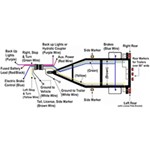
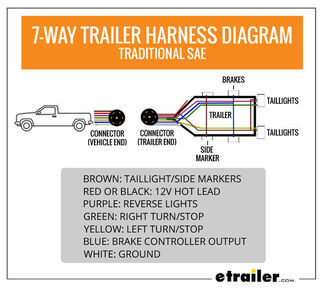
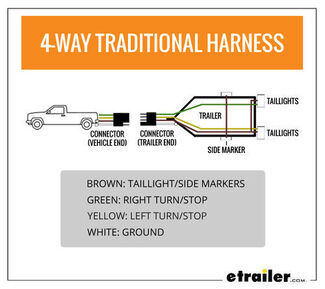
A 4-Way trailer connector has the basic lighting functions only; running lights, left turn signal and brake lights, right turn signal and brake lights, and ground. A 7-Way has these functions and a 12 volt circuit, a circuit for electric trailer…
The OEM prep package consists of 4 "pucks" in the bed of the truck that will allow you to drop in puck style hitches for easy installation and removal, that gives you a completely clear bed when not in use. The B&W Companion OEM 5th…
In order to determine the torque rating for the lug nuts on your trailer you will need to know check out the chart I attached that shows all of the torque specs for all the trailer lugs available based on stud size, wheel material and wheel size.
According to Blue Ox, it'll take an experienced installer about 4 to 5 hours to complete the installation of their #BX1128 Base Plate Kit on a 2016 Jeep Grand Cherokee. The install isn't what I'd call super-difficult, but the installation…
Thanks for the picture! I checked with Progressive Dynamics the replacement power converter you need for your Parallax Series 7300 Model 7345 is the Replacement Converter for Parallax/Magnetek or WFCO RV Power Centers - 45 Amp item #PD4645V.
You will have to go with a sliding hitch to allow the trailer to make tight turns. For a trailer 8 feet wide the only bed length that's going to allow 90 degree turns without a slider is a stationary hitch. That being said you have two options.…
Both the Roadmaster and Blue Ox tow bars are great options. But if it was my decision to make I would go with the Blue Ox Avail part #BX7420 as we have found that the Blue Ox tow bars are a little easier to connect and disconnect from. Also this tow…
If you just need a 4-pin to 7-pin trailer wiring adapter, then you can use part #C57672. This will plug into the 4-pin trailer connector on your brother's vehicle and give him the 7-pin socket for the trailer. Keep in mind, this will only give…
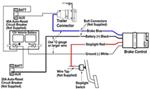
The trailer brakes work on a separate circuit than the lights. You have a couple of options to control the electric brakes on the trailer. One option is to use an air over electric brake control, #HA100400C. This unit connects to the air brakes on…
Hello Andy! Yes, I would be happy to put together a flat tow package for your 2019 GMC Canyon. Here is what I recommend: - Roadmaster Direct-Connect Base Plate Kit - Removable Arms #RM-523182-5 - Roadmaster Nighthawk All-Terrain Tow Bar w/ LED Lights…
Car radiators are essential for keeping your engine cool and running smoothly. When shopping, consider the radiator's material, size, and compatibility with your vehicle. Aluminum radiators are popular for their lightweight and efficient heat dissipation. Ensure the radiator fits your car model and driving conditions, whether it's daily commuting or high-performance racing.
Aluminum radiators are favored for their lightweight and excellent heat dissipation, making them ideal for performance vehicles. Copper-brass radiators offer superior heat transfer but are heavier, often used in classic cars. Consider your vehicle's needs and driving style when choosing the material.
Check the radiator's dimensions and mounting points against your vehicle's specifications. Compatibility is crucial, so refer to your car's manual or consult with a specialist to ensure a perfect fit. Some radiators are designed for specific models, making installation straightforward.
Cooling capacity determines how effectively a radiator can manage engine heat. For high-performance or heavy-duty vehicles, a radiator with higher cooling capacity is essential to prevent overheating. Consider your driving conditions and engine power when evaluating cooling needs.
Regularly check for leaks, corrosion, and debris. Flushing the radiator system and replacing coolant as per the manufacturer's schedule is vital. Proper maintenance ensures optimal performance and longevity, preventing costly repairs down the road.
Radiator design, including fin density and core thickness, impacts heat dissipation. High fin density increases surface area for better cooling, while thicker cores can handle more heat. Choose a design that matches your vehicle's performance needs and driving environment.