To see if this custom-fit item will work for you please tell us what vehicle you'll use it with.
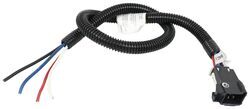
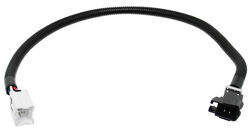
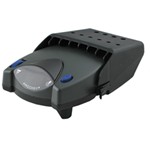
The Tekonsha P2 is a classic brake controller you know you can rely on. It's easy to install, and with the custom harness, it's plug-and-play.
Features:
Specs:
Gain is the maximum amount of power that will be applied to your trailer's brakes. How much braking output you need is determined by the weight of your trailer; a heavier trailer will need more power to bring it to a stop. You want to go as high as you can without the trailer brakes locking up.
You can adjust the gain by turning the thumbwheel on the front of the controller.
The boost setting controls the aggressiveness of your trailer's braking, meaning how quickly the brakes reach the maximum braking level. If your vehicle takes too long to come to a stop, increase the setting. If it stops too abruptly, decrease the setting.
Depending on the level of boost, your trailer brakes can start at either 13 percent or 25 percent of the set gain. So instead of starting at 0, the brakes will start at 25 percent and get to 100 percent sooner. This keeps the trailer from pushing your tow vehicle forward.
Boost Levels:
| Approximate Gross Trailer Weight | Boost Level | Increase in Initial Power Output |
|---|---|---|
| Less than tow vehicle GVW | B1 | 13% |
| Equal to tow vehicle GVW | B1 or B2 | 13% or 25% |
| Up to 25% more than tow vehicle GVW | B2 or B3* | 25% |
| Up to 40% more than tow vehicle GVW | B3* | 25% |
*Both B2 and B3 offer a 25-percent boost in initial power. But the braking curve for B3 is more aggressive than that of B2. This means that, even though you will start out with the same intensity when using these boost levels, you will get an overall more aggressive braking experience with the higher level. So if you use B3, you will reach maximum braking sooner than if you use B2.
To engage the manual override, twist the rotary-style lever from right to left. This will activate the trailer's brakes and brake lights independently of your vehicle, great for stopping sway or controlling your trailer's momentum in an emergency.
The Prodigy P2 offers key safety features to prevent damage to your towing setup:
- Integrated reverse battery protection shields the brake controller and your trailer's breakaway system from shorts.
- When the P2 is not in use, it draws only 3.6 milliamps to minimize the drain on your vehicle's battery.
- Any time your vehicle and trailer are at a standstill with the brakes applied for more than 5 seconds, the hold feature will kick on and reduce power to just 25 percent. This will keep your trailer in place without your brakes overheating.
The Prodigy P2 also runs continuous diagnostics to check for problems as they come up, including:
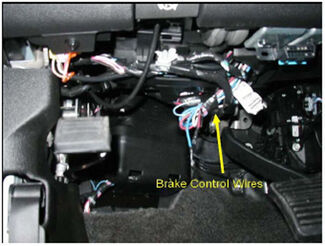
Installing the P2 is incredibly simple. You'll mount the bracket to your dashboard then mount the unit to the bracket. Plug the custom harness into your vehicle and into the unit. Done!
Keep in mind that the P2 must be horizontally level and parallel with the direction of travel to work correctly.
With a replacement wiring harness (sold separately) and replacement bracket (P7685 - sold separately), you can even transfer the Prodigy P2 to another vehicle.
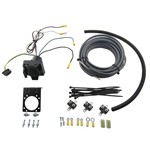
Note: If you don't already have a 7-way plug at the back of your vehicle, take a look at our exclusive 7- and 4-way brake controller installation kit (ETBC7 - sold separately).
Proportional braking means that your trailer brakes mimic your tow vehicle's brakes. If you slam on the brakes, your trailer brakes will activate with the same intensity; if you brake lightly, your trailer brakes lightly too. The trailer's braking is in proportion to your vehicle's braking. This saves wear and tear on the tires and the brakes on both your vehicle and trailer.
The Prodigy P2 uses an internal inertia sensor to detect how your vehicle is braking so it can send the right amount of braking power to your trailer. It measures the inertia of your tow vehicle and activates the trailer's brakes to slow at the same rate. The result is uniform braking across your towing setup. No push-pull action - just smooth, proportional braking every time.
California residents: click here
Videos are provided as a guide only. Refer to manufacturer installation instructions and specs for complete information.
Today on our 2011 Ford Escape we're going to install part number 90885. This is the Tekonsha Prodigy P2 Trailer Brake Controller. Now to help us with our install we're using a couple other parts. We're using the ETBC7 Brake Controller install kit as well as a long bracket from from Tow Ready part number 18136. We'll start off with that part first. This is our bracket we're going to install first.
We need to attach our bracket for our 7 pole connector. This will just slide over the hitch and a clamp to hold it in place. We're going run in through the bracket around the hitch and the clamp vector itself. Start through the opening and then we can go ahead and thread it through using the fastener. We'll get started and adjust the bracket where you wanted. I guess we're enlarge, matter personal preference.
I take my excess tab and just fold it and then it back up into itself so I don't have a sharp edge. Now this is the hardware that comes with our bracket. We'll use this to attach our 7 pole connector that comes with each of these seven kit. Now to keep things from sticking out as far as possible we're going to take a bracket and reverse it. Now, we'll take assemble connector and attach to your bracket using the hardware that comes with the kit.
With the bracket in place, let's go ahead and take a moment using an electrical tape to help contain all the wiring. With our wires bundled up we'll go ahead and take the 4 pole and start in previously installed on our vehicle and we'll connect to this 4 pole coming from 7 pole connector. We also use some dielectric grease to help make this a semi-permanent connection. The dielectric grease we're using is part number 11755. We'll go ahead and push the two halves together and then we'll use some electric tape to help secure it. We'll use a short bit of length of our wire that comes with the kit.
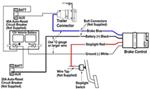
We didn't use all of it, we'll use that to dress that we can see. Next, we'll go ahead and put our gray cable to these two wires here. As gray cable comes with the ETBC7 kit and we're going to hook it up black to black and white to blue. Our black wire eventually will be 12-volt power supply coming from the battery. The white wire will be our output from Brake Controller which eventually go back to blue. We'll go ahead and strip the wires and make our connection to the black connectors. We'll go ahead and protect these connections with some electrical tape too. We'll go ahead and use it to secure the rest of the wire to our cable. Still working with gray cable, we'll go ahead and start running it up towards the front. We're going to scale a little far enough just to help hold it up. We'll run all the way through the front yet. Now, we'll go ahead and take some of the wire and we'll go ahead and start zip tying to make sure it's secure and up and all the way. Next, we'll go ahead and take a moment to deal for our white wire to ring terminal, that'll be your ground screw, so we'll go around directly to the frame underneath the vehicle. Now we'll use a large self-tapping screw that comes with the kit. You need a driver for three eighths thick. Now, our purple wire is designed for reverse light circuit or an auxiliary circuit. Now this will not be using this installed. We can go ahead and continue running our gray cable up towards the front of the vehicle. In this case we're going to run it over to the rear sub-frame like we started, then we'll go ahead and follow the parking gray cable for a little bit, then follow some brake lines just going up towards the front of the vehicle. Then we'll go ahead and run it up against the firewall and then we'll go ahead and pull it up out of the hood. The pull up wire from the bottom, we use this piece of old air line inaudible 00:04:04 to help pull it up. We run it from the top down and we kept it along to the side of the vehicle in this side towards underneath and we went ahead and tape the two gray cable. We use that to pull it back up. We'll go ahead and take up all our slack. We'll go ahead and zip tie our wires, just leave the wire alone for now and we'll go ahead and mount our circuit breakers that come with the ETBC7 kit. There's three of them but we'll only use two of the three. We'll use our 40 amp circuit breaker for our 12-volt power supply going out to our 7 pole connector using the black wire. Now, our 20 amp circuit breaker will then should be used to derive power for our brake controller. Next, we'll go ahead and cut our gray cable to length. Now eventually we're going to need to go to the positive side of our battery. However, our white wiring side here needs to go eventually to the inside, so we're going bark off enough length for our gray wire to do both. It maybe a good idea to go ahead and kind of pull it outside of the vehicle about where you think it's going to be when we use our mark. Now our leftover wire we want to keep because eventually this will go between your brake controller and our battery. Let's go ahead and remove the sheet on our gray cable so we can get access to our wires. Let's take our white wire and we'll go ahead and just push it off to the side for now. Let's run our black wire and we run it down to our 40-amp circuit breaker. We cut it in half, put a ring terminal on both sides, then we'll go ahead and continue to get it ready for our battery. We'll take our in that goes out to our 7 pole connector and we'll connect it to the silver post. Our wire going to our battery always uses the cap that goes. We'll go ahead and tightened down our wires going to our circuit breaker and then we'll go ahead and run it through our battery. We'll go ahead and cut it to length using this post right here. Strip that wire back, use one of the larger ring terminals on it. This connection to our battery is one of the last things that we do. We'll just set that aside for now. Now we're going to find an entry point for our white wire to eventually go into our brake controller. To do that, there's a ground right here that we'll go ahead and cut with a knife, and we'll go ahead and poke a wire through. There's a small plug on the inside of the vehicle that's just cut off for the installation maybe already removed, if not just push it out of the way once you put the wire through. While we're still under the hood, we'll go ahead and take some time and work with the rest of our gray cable. We'll go ahead and push that through as well. We probably will need all the extra length but we'll go ahead and cut off our excess on the other side. We want to go ahead and route a wire where we have enough to go through our circuit and through our positive side of our battery. Also we want to use the ground as well because our black wire will be for power for our brake controller, once again. Our white this time will be our ground. Once again we'll use some more zip ties to secure our wires. Now you probably know as I went through a lot of zip ties by now, so it's always a good idea to get extra zip ties before you do a wiring install. Because I use a lot and you may have to redo so. Let's go ahead and remove our sheet for our wires. Now going onto our brake controller, just like before, we'll go ahead and cut our black wire in half, the half going to the brake controller, will go to the silver side, and then not going to power for our battery, we'll go to the inaudible 00:08:38 side. Once again we'll go ahead and use the small terminals going through our circuit breaker. We'll go ahead and add our large ring terminal here. Just like our other wire, we'll go ahead and leave that connection to the battery last. Now, let's go ahead and work for our white wire. Please stack your grounds right here and we'll use, luckily, our last large ring terminal. We'll go ahead and install our white wire for ground. We're underneath the hood for now, let's go ahead and work for our wires underneath the dash. Now we're underneath our dash, let's go ahead and pull out our wires. We'll go ahead and cut it to length. We'll leave these wire alone for now. Now, we're going to work for our wire harness for our brake controller. Now, we take the rest of our loop material and apply it to the wires. We can go ahead and start making some of the connections, we'll go ahead and start with our red wire for our brake controller harness. This need the brake signal off the brake switch. Wherever the brake pad gets pushed down, it's going to signal out. We cut off the end and we're going to use a quick splice connector to connect it to our wire. We'll go ahead and test our wire, the sheet now behind the brake pedal make a good ground and we'll test our wire. We found out that our purple wire with white stripe is our brake signal, so that's where we work. We take a quick splice connector, throw over the wire we're going to use and right next to it, we'll go ahead and put our red wire to it, that'll make our connection. Next, we'll go ahead and work for our blue wire. Remember this is going to connect before first white wire. This is the white wire that went back to the blue wire on our 7 pole connector. Our last two hours will be pretty easy, color for color. Now we'll go ahead and take a moment to zip tie some of our wires. Now our brake controller is roughly going to sit about right here, so we'll make sure it has an excess leftover. Let's go and keep our wire out of the way for now, we'll go ahead and install our pocket our brake controller. We use a sheet metal screws that come with the brake controller and we're going to use to go into the plastic. Put one screw to set it in place, and then we'll make our adjustments on our pocket. Our brake controller has to sit in a straight line with the vehicle and not on an angle like this. We take a wire harness and run it through the back side of the pocket, and then we'll go ahead and plug it to the back of our brake controller, then let's put into our pocket. All right, maybe one more zip tie in the back here to help support the wire but enough where you can move it if you ever want to take the brake controller out. We're done inside of the vehicle for now. Let's go ahead and make a final connections to the battery. We'll go ahead and loosen up our terminal here on a positive side of our battery. We don't take it all the way off because the threads are kind of messed up anyway, we'll go ahead and make a small cut in our ring terminals just enough to over the bolt. Basically, just stack them on top of each other and then tighten up the knot. We'll go ahead and put our cover back into place. Let's go ahead and check our brake controller. All right, we got two dots in the brake controller, so that's good. It shows we have power going to it. We hit the manual override, it is NC for no connection. We'll go ahead and check our foot brake. It won't do anything because we don't have trailer hooked up. Let's go ahead and hook up our trailer. When our trailer plugged in, we can see a C for connection. We move the manual override and we're going to see how it scrolls through the numbers, so we know we're good there. Let's go ahead and try out the brake pedal, and we should have just a small amount of numbers show up. At this point, everything is good to go. All that's left is go ahead and take your trailer out onto a parking lot or low traffic road and go ahead and adjust the brake controller the way you like it. With that, that'll finished up your install of the Tekonsha Prodigy P2 Trailer Brake Controller, part number 90885. Along with the ETBC7 kit on our 2011 Ford Escape. .
Do you have a question about this Trailer Brake Controller?
Info for this part was:
At etrailer.com we provide the best information available about the products we sell. We take the quality of our information seriously so that you can get the right part the first time. Let us know if anything is missing or if you have any questions.


Thank you! Your comment has been submitted successfully. You should be able to view your question/comment here within a few days.
Error submitting comment. Please try again momentarily.