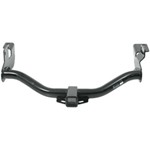
Curt 13703 Hitch Dimensions from Frame Bracket to Hitch Opening
Published 08/26/2016
Products Featured in This Question
Question:
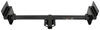
I am trying to determine if this hitch receiver will work for mounting my bike rack on my camping trailer, and it appears it will fit the trailer frame. However, because of the location of the stabilizers, I cant mount it at the very rear of the trailer frame, and it will have to be mounted about 4-6 inches forward of the rear of the trailer frame. This leads to a couple of additional questions. First, Id like to know the relationship of the end of the hitch receiver tube to the back of the hitch frame bracket. If you can give me the distance from the back of the hitch frame bracket to the hitch main body tube, and the distance from the hitch main body tube to the end of the hitch receiver tube, I will be able to determine this dimension. That will allow me to determine the length of extender I would need for my bike rack, which leads to my second question. I know that a general rule of thumb is that an extender tube reduces the allowable load by 1/2. However, I also know that in actuality the amount of reduction is dependent on actual the moment arm versus the design moment arm used to determine the allowable load for the receiver. My concern is that my bike rack weighs 135 lbs fully loaded bikes and rack, and the center of the load is 19 inches back from the receiver, without an extender, so I’m not sure that a ½ reduction will be sufficient. My question is, do you have any idea of the design moment arm the manufacturers use to determine the allowable load for the receiver. For example, if its 15 inches, then I have already reduced the allowable load to about 275 lbs, without the extender, and if I have to use an 18 inch extender then I would be right at the allowable load about 140 lbs, and, since I have no idea of the factor of safety used by the manufacturer in determining the allowable load, Im not sure how comfortable I would be that close to allowable. If the design moment arm is only 12 inches, then I would definitely be over the limit, but if it were 18, then I should be around the ½ number and be OK. As you can see, the design moment arm is pretty crucial in my decision. I appreciate very much any info you can give me regarding the location of the end of the receiver tube to the frame bracket and the design moment arm for the hitch. Thanks!
asked by: Mike R
Expert Reply:
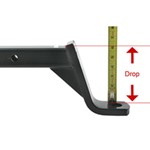
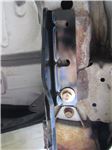
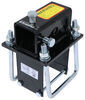
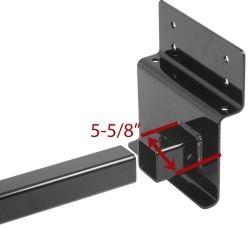
I attached two pictures that detail where the hitch tube and opening are in relation to the bracket for you to check out.
Hitch manufacturers basically refuse to get into the specifics of the hitch extender capacity reduction for fear of people assuming they can carry more than they should based on hypothetical math problems. Hitch extenders though are even more hard on hitches when installed at the back of an RV because trailers have much rougher ride qualities than vehicles. I really wouldn't recommend you use a hitch extender. Especially one as long as you would need. Is there a 4 inch bumper at the rear of your trailer that you could mount bumper hitch to like part # UF35-946401?



Product Page this Question was Asked From
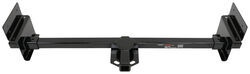
Adjustable Width Trailer Hitch Receiver for RVs, 22" to 72" Wide

- RV and Camper Hitch
- Frame Mount Hitch
- 350 lbs TW
- 3500 lbs GTW
- 22 - 72 Inch Wide Frames
- Towing and Cargo
- Bolt-On
- Weld-On
- CURT
more information >
Featured Help Information
Instructions

Continue Researching
- Search Results: trailer bumper hitch
- Search Results: trailer hitch
- Q&A: What Determines Cargo Weight Limit for Hitch Carrier Installed on RV Bumper Hitch
- Shop: Trailer Wiring
- Shop: Trailer Hitch
- Shop: Blue Ox Trailer Hitch Receiver - Custom Fit - Class III - 2"
- Shop: Trailer Mate Trailer Hitch Receiver - Custom Fit - Class III - 2"
- Shop: Curt Trailer Hitch Receiver - Custom Fit - Class III - 2"
- Shop: Ultra-Fab 2" Motor Home Trailer Hitch Receiver for 4" x 4" Bumpers
- Shop: Curt Trailer Hitch Receiver - Custom Fit - Class III - 2"
- Shop: Curt Trailer Hitch Receiver - Custom Fit - Class III - 2"
- Shop: Curt Trailer Hitch Receiver - Custom Fit - Class III - 2"
- Q&A: What is the Difference Between a Class II and a Class III Hitch?
- Article: Trailer Wiring Diagrams
- Video: Curt T-Connector Vehicle Wiring Harness Review C56040
- Search Results: trailer wiring
- Video: The Low-Down on the Curt Powered Tail Light Converter with 4-Pole Flat Trailer Connector
- Article: Brake Controller 7- and 4-Way Installation Kit (ETBC7)
- Q&A: What is the Difference Between a 4-Way and 7-Way Trailer Connector
- Article: How to Choose the Right Trailer Hitch Class
- Search Results: trailer tires and wheels
- Q&A: Lug Nut Torque Chart for Trailer Wheels
- Video: Clean Up Your Trailer Wiring
- Article: How to Measure for Trailer Hitch Drop
- Video: How to Choose a Trailer Brake Controller
- Shop: Brake Controller
- Search Results: trailer jack
- Q&A: Recommended Bike Rack and Dual Hitch Adapter for Carrying E-Bikes While Flat Towing
- Q&A: Comparing the Curt Hitch C13416 and EcoHitch Hitch 306-X7396 for a 2019 Toyota RAV4
- Article: Wiring Trailer Lights with a 7-Way Plug (It's Easier Than You Think)

on RV and Camper Hitch