Hey Rob! The pin for the Ultimate Trailer Jack #322-RDJ-2K sits 3/4" above the mounting plate, is 1" thick, and sticks out 3" from the body of the jack (see attached photo). The bolt pattern for the mounting plate is symmetrical so you…
Good question! Can you close the hatch of the vehicle the CVT Timber Creek Annex #RG35ZV is attached to? Yes. However, it should be noted that the hatch is actually acting as a roof support, so some of the roof will not necessarily cave in, but it…
It might be Dan but I wasn't able to pull any specific information off of the UFP 13674 part number you gave me. What you'll need to do is pull one of the hubs and read the part numbers stamped into the sides of the bearings. This information…
There is a kit for a 5th wheel trailer, gooseneck trailer, horse trailer or any other RV that is similar to air bags, the Lippert Components Center Point by Trailair Air-Ride Suspension Upgrade - Tandem Axle #LC1565391 or Triple Axle #LC1565401. Like…
The Buyers Products 1/4" Zinc Plated Safety Pin w/ Lanyard #3373004987 is designed to fit something like their 30 Ton Heavy-Duty Swivel Type Pintle Hook #337BP760A. This has a split tab that is specifically for this application (I included a…
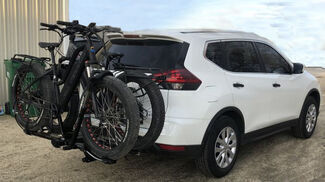
For carrying e-bikes at the rear of an RV like your 2021 Nucamp Tab 400 you'll need an e-bike approved for RV use like the Lets Go Aero V-Lectric FAT PRO Bike Rack for 2 Electric Bikes #LGA77FR that you referenced. This rack has a 75 lb per bike…
We have exactly what you need! For your 2018 Subaru Outback with 225/60-18 tires, I recommend the Glacier Cable Snow Tire Chains #PW1046. They use cables or "spring" style rollers that wrap around wire cross cables which provide the…
I have a clevis hook that may work with your 5,000 lb trailer. Take a look at part #6495-401-04. This hook has a working load limit up to 5,400 lbs and the pin that connects through the chain is 7/16 of an inch in diameter. We have heavy-duty clevis…
I reached out to the manufacturer he Deluxe Compartment Door Thumb Latch - 1-3/8" part #37200145 is designed to work with 3/4" holes the locking blades are 1 1/2" long and can be set to depths of 1 1/4", 1 3/8" and 1…
I can certainly point you in the right direction. We do have the #e22YR which is a 26" long 2,000 lb leaf spring. We also have the #e44SR which is a 25-1/4" long 2,500 lb spring. When replacing old leaf springs, it is critical that the…
It sounds like you're referring to the pitch arm for your awning. If that's the case then you'll need to measure your support arm, the wall mount portion in particular. The Replacement Pitch Arm for Solera XL Flat RV Awnings part #LC67VR…
WOW! I am impressed! I called to place my order and real person answered, spoke perfect English, albeit a slight southern accent, and my order was sent within a day, shipped quickly and I had it a few days later. I saved over a hundred dollars over local and installed it my self. I cant imagine how that they could do any better. THANKS!
Eric
Cedar Springs, MI
Essential Ropes for Every Camping Adventure
Ropes are a versatile and essential tool for any camping trip. Whether you're setting up a tent, securing gear, or creating a makeshift clothesline, having the right rope can make all the difference. Look for durability, strength, and weather resistance to ensure your rope meets all your camping needs.
For camping, consider ropes like paracord for its strength and versatility, or nylon ropes for their durability and resistance to weather. Climbing ropes are great for more demanding tasks, while polypropylene ropes are lightweight and float, making them ideal for water-related activities.
The right rope length depends on your specific needs. For general use, a 50-foot rope is versatile enough for most tasks like setting up tarps or securing gear. If you're planning more specialized activities, like climbing or creating a zip line, you might need longer lengths.
Rope material affects durability, weight, and weather resistance. Nylon is strong and elastic, ideal for dynamic loads. Polypropylene is lightweight and floats, perfect for water activities. Paracord is versatile and compact, great for emergency situations. Choose based on your specific camping needs.
To maintain ropes, keep them clean and dry. After use, shake off dirt and debris, and if necessary, wash with mild soap and water. Store them coiled in a cool, dry place away from direct sunlight to prevent degradation. Regularly inspect for wear and tear to ensure safety.
Always check ropes for damage before use. Use appropriate knots for the task to ensure security. Avoid overloading ropes beyond their weight capacity. When climbing, ensure ropes are properly anchored. Keep ropes away from sharp edges and heat sources to prevent damage.


 Filters