To see if this custom-fit item will work for you please tell us what vehicle you'll use it with.
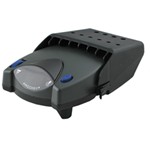
The Tekonsha P3 is a brake controller beloved for its reliability and useability. You're able to save your settings and multiple profiles. It's easy to install, and with the custom harness, it's plug-and-play.
Features:
Specs:
Braking output is the maximum amount of power that will be applied to your trailer's brakes. How much braking output you need is determined by the weight of your trailer; a heavier trailer will need more power to bring it to a stop. You want to go as high as you can without the trailer brakes locking up.
Use the arrow buttons on the front of the module to set the output.
The boost setting controls the aggressiveness of your trailer's braking, meaning how quickly the brakes reach the maximum braking level. If your vehicle takes too long to come to a stop, increase the setting. If it stops too abruptly, decrease the setting.
Depending on the level of boost, your trailer brakes can start at either 13 percent or 25 percent of the set braking output. So instead of starting at 0, the brakes will start at 25 percent and get to 100 percent sooner. This keeps the trailer from pushing your tow vehicle forward.
Boost Levels:
| Approximate Gross Trailer Weight | Boost Level | Increase in Initial Power Output |
|---|---|---|
| Less than tow vehicle GVW | B1 | 13% |
| Equal to tow vehicle GVW | B1 or B2 | 13% or 25% |
| Up to 25% more than tow vehicle GVW | B2 or B3* | 25% |
| Up to 40% more than tow vehicle GVW | B3* | 25% |
*Both B2 and B3 offer a 25-percent boost in initial power. But the braking curve for B3 is more aggressive than that of B2. This means that, even though you will start out with the same intensity when using these boost levels, you will get an overall more aggressive braking experience with the higher level. So if you use B3, you will reach maximum braking sooner than if you use B2.
To engage the manual override, twist the rotary-style lever from right to left. This will activate the trailer's brakes and brake lights independently of your vehicle, great for stopping sway or controlling your trailer's momentum in an emergency.
The P3 is able to store your settings in multiple profiles so that you can have them ready to go for different trailers and drivers. Even the display is super customizable: you can change the screen color, brightness, and language to make it easy to use.
The P3 makes it easy to troubleshoot problems as they come up, with comprehensible and detailed diagnostics displayed on the screen.
Diagnostic troubleshooting messages include:
Diagnostic warning signs include:
The Prodigy P3 offers advanced safety features to prevent damage to various components of your towing setup.
-Integrated reverse battery protection shields the brake controller and your trailer's breakaway system from shorts.
-When the P3 is not in use, it draws only 3.6 milliamps, minimizing drain on your vehicle's battery.
-Any time your vehicle and trailer are at a standstill with the brakes applied for more than 5 seconds, the hold feature will kick on and reduce power to just 25 percent. This will keep your trailer in place without your brakes overheating.
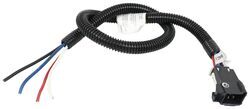
Installing the P3 is incredibly simple. You'll mount the bracket to your dashboard then mount the unit to the bracket. Plug the custom harness into your vehicle and into the unit. Done!
Keep in mind that the P3 must be horizontally level and parallel with the direction of travel to work correctly.
With a replacement wiring harness (sold separately) and replacement bracket (TK5906 - sold separately), you can even transfer the Prodigy P3 to another vehicle.
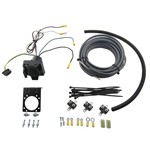
Note: If you don't already have a 7-way plug at the back of your vehicle, take a look at our exclusive 7- and 4-way brake controller installation kit (ETBC7 - sold separately).
Proportional braking means that your trailer brakes mimic your tow vehicle's brakes. If you slam on the brakes, your trailer brakes will activate with the same intensity; if you brake lightly, your trailer brakes lightly too. The trailer's braking is in proportion to your vehicle and trailer.
The Prodigy P3 uses an internal inertia sensor to detect how your vehicle is braking so it can send the right amount of braking power to your trailer. It measures the inertia of your tow vehicle and activates the trailer's brakes to slow at the same rate. The result is uniform braking across your towing setup. No push-pull action - just smooth, proportional braking every time.
California residents: click here
Videos are provided as a guide only. Refer to manufacturer installation instructions and specs for complete information.
Today on our 2009 Cadillac Escalade, we're going to take a look at and show you how to install the Tekonsha Prodigy P3, proportional trailer break controller for 1, up to 4 axles. Part number on it is 90195. Now the P3's proportional setup is really going to help us out in many different situations, whether it's an emergency braking situation where we really need maximum force immediately. The P3 picks up on that and it's going to send that power back to our trailer, right up to whatever level we have it set at. If we're just in stop and go traffic, and we're just lightly applying the brakes here and then, it's also going to sense that so we don't have to worry about the wheels on our trailer lighting up or dragging our truck down a lot when we just want a little bit of braking power to be applied. Now you can see here on the bottom, we've got a manual override lever. This is going to allow us to manually apply our trailer brakes in the events that we need to. Nice thing about is no matter where we've got our output set, when we reach down in the panic situation it's only going to go up to that number for us.
Here we've got our power setting adjustment here. Bring that down or up, just depending on the weight of our trailer and how much braking force we're going to need. Another nice thing about is going to be our boost levels. The boost levels are going to set the initial power and aggressiveness in which our brakes come on. For boost 1, that would be for a lighter trailer.
As we move up through our boost levels, it goes to bigger and bigger trailers. We can even set the boost off if we've got a light unloaded trailer that we won't need that immediate, immediate response from. Other great thing about the Tekonsha is you can see we've got setups for the display, the brake type, and help to help us work through everything. It has 5 store-able settings for different trailers, drivers, or conditions. Now we need to begin our installation by finding our factory wiring that's going to exist underneath the dashboard. Here we've got our on board diagnostic port. We're going to go back from that about 4 inches, just about to the very front of our parking brake here.
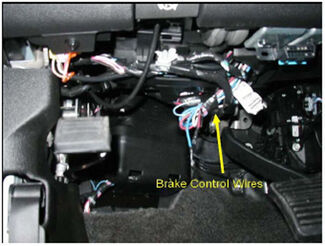
There's going to be a wiring harness that runs right behind this little tab. There's a piece of tape that's holding it on and it's got this piece of white paper on it, that indicates what needs to be connected where. We want to be careful and just lightly trim that tape. Then pull down our harness. You can see we've got a red with black, dark blue, a white, and then a light blue with white. Let's pull off our tag here as well.
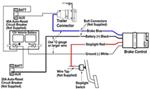
You'll see on here it's going to tell us what we need to connect where. We need to look at our brake controller instructions, it's also going to have instructions for what wire goes to what. We'll start with our ground here, let's strip this off. Use one of the smaller butt connectors, provided with our brake controller. Let's go through and we'll add our connectors to each one of our wires here. The 2 small wires get the blue butt connectors. The 2 larger ones are going to get the yellow. Now we'll bring in the pig tail that's going to come with the brake controller, and we'll use the diagram that we've got here and we'll use the list that we've got here and we're going to match that up to the list that's in our instructions. Let's start hooking up our wires. Our white wire is going to go the white wire. Our black wire is going to be our battery wire, that goes to the red and black. Our red wire is going to go to our stop light wire, which is going to be the light blue and white. Then finally, our darker blue wire that's going to be connected to the darker blue wire from our pig tail. All right, now let's take a second. Just to kind of tape this all up. Make it look a little bit nicer. All right, now with that wrapped up, that will give us a nice clean wiring look so we won't have 4 separate wires hanging out. We're just going to set that aside, let's get our brake controller put in. We can mount our brake controller, we can pick any spot here on or under the dash that we like. I like to use the small screw that's right here, there's already a hole there, it goes into a metal bracket. It's going to give us a lot of support. You can mount up here on the dash if you want, as long as you stay in our angle limitations on it. The one area I would avoid would be over here on this left side. You might bump your knee when you're getting in and out of the car. Just anywhere over on this side should be fine, or right down here where we're going to go. I'll just pull that Phillips screw out. I'll slide my bracket in right behind that plastic piece. Tighten that down, then we can also use one of the provided self-tapping screws to secure it down on the other side. All right, that is nice and secure. We will slide our pig tail right into the rear. Make sure it's connected nice and tight and then we can use our hole on each side and thread in our machine screws, after we pass them through our bracket. All right, perfect. Now let's secure our excess pig tail. Just going to group that up and we will secure it right off to our vent. Turn off our zip tie, now we can head under the hood and hookup our 2 wires. Now let's pull the cover off of our fuse box here. We will see 2 studs sticking up here. 1 here and 1 here. Now we need to connect 1 of our wires, that's hanging out right down here. You can see it just underneath that wiring cluster there, that red one with the black stripe. Pull that one up here as well. Now the wire that we've got down here, on that cluster, it's going to go to the smaller stud. The wire that's over here on this main harness is going to go the larger stud. We will need a couple of nuts to help hold these on. To access them we will just pull out on the small tab, and up on the grey lever. Now bring our wires in, place our nuts on, and the other one we're hooking up that's going to be powered back to the trailer connector. Since we're here we might as well get them both taken care of. Now we can put our cover back on after we bend those down. Now we can see there that we've got power coming to our trailer, everything is fine there. Now that we know it's recognizing the trailer, let's unhook and make sure it flashes and gives us the signal. It has a constant monitoring for if something happens with our connection it's going to let us know. Now the screen should turn red and it should be flashing "No trailer connected." And give us an indication, just like that. With everything working as it should that's gong to complete today's installation of the Tekonsha Prodigy proportional trailer brake controller. Part number 90195 on our 2009 Cadillac Escalade.
Do you have a question about this Trailer Brake Controller?
Info for this part was:
At etrailer.com we provide the best information available about the products we sell. We take the quality of our information seriously so that you can get the right part the first time. Let us know if anything is missing or if you have any questions.


Thank you! Your comment has been submitted successfully. You should be able to view your question/comment here within a few days.
Error submitting comment. Please try again momentarily.