Charging Trailer Batteries While Towing Using the Alternator in a 2016 Ford F-150
Updated 05/02/2018 | Published 05/01/2018
Products Featured in This Question

Question:
We have a new RV and our style of travel means we are towing it regularly - averaging a couple hours per day - and then boondocking off grid. This feels like ample opportunity to charge our onboard batteries 2x 250Ah 6V using the alternator of the truck - a 2016 Ford F-150 with, I think, a 220A alternator. By my calculations, if we had drawn the batteries all the way down to 50, that would be 125Ah @ 12V which, if I could take even just 30A off the alternator, would take a little over 4 hours to charge. In reality, adding for the charge profile and loss, I’d hope 6-8 hours would be sufficient. I have a few questions I’m hoping you can help with: 1 How can I determine the available “capacity” of my alternator? Run it at idle with everything turned on and put an amp clamp over the cable to the battery post? 2 30A feels very conservative - I’d love to pull more, say 80A. How high would you recommend I go? 3 To get this to the trailer, my thinking is hard wiring an inverter near the truck battery and running 120VAC to the RV charger to avoid heavy gauage cables for high current DC. Does this make sense, and do you sell a higher rated pure sine inverter than this 200W one? 4 What’s the best type of connector to use on the truck bumper to plug the trailer in with? Should be durable, locking and waterproof. 5 Am I crazy and is there a better way to charge the RV battery from the truck? Seems like too good an opportunity to miss out on. Thanks!
asked by: Matt
Expert Reply:
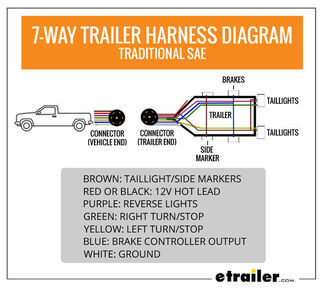
The problem with charging trailer mounted batteries is that vehicle alternators and the wiring going through, say, a 7-Way trailer connector cannot push back the amperage required to charge up the batteries (or it would take an extremely long time). At best they can maintain the charge level in most cases.
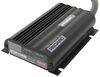
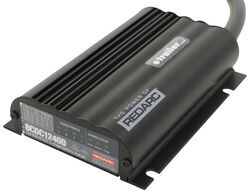
But there is a solution to that issue and it is actually similar to what you have suggested. What you need is a DC to DC charger. We do have one rated at 40 amps, # 331-BCDC1240D, which is compatible with 12 volt systems. So if your batteries are connected to each other to put out 12 volts then this system can be used to charge both batteries as if they were 1 but if it were me I would just go with a regular 12 volt battery instead of two 6 volt batteries. It will charge faster that way.
As far as figuring out the capacity of the alternator it is possible, even likely, that Ford has that data. Otherwise you could use a meter to test for amperage on the output side of the alternator to see what it is putting out.
In the universe of battery chargers 80 amps would be very high. Our highest rated DC to DC charger is the 40 amp one mentioned above which is as high as I would go.
Using an inverter could work but they aren't really consistent as far as output and they aren't really designed for this type of application so there is no telling how well it would work.
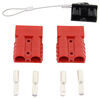
No connectors are completely waterproof so in that regard there isn't one that is better than another. What I recommend are winch quick connects # BDW20047 which can accept 6 to 10 gauge wire. Then you could use dielectric grease, # LT37534, at the electrical connections and wrap everything up in electrical tape to keep moisture at bay.
You aren't crazy but going with a DC to DC charger is the best way to go.

Product Page this Question was Asked From
Redarc In-Vehicle BCDC Battery Charger - Dual Input - DC to DC - 12V/24V - 40 Amp

- Battery Charger
- Battery Charger
- RV/Camper
- Trailer
- 12V
- Charges and Maintains
- AGM
- Calcium
- Gel
- Lead Acid
- Lithium
- Solar Panels to Auxiliary Battery
- Vehicle Battery to Auxiliary Battery
- Smart Charge
- Trickle Charge
- Redarc
more information >
Featured Help Information
Instructions
Miscellaneous Media

Continue Researching
- Shop: Suspension Enhancement
- Shop: Weigh Safe 180 Hitch 2-Ball Mount for 3" Hitch - 6" Drop/7" Rise - 21K - Cerakote
- Shop: Weigh Safe Ball Mount w/ Built-In Scale for 2" Hitches - 2" Drop - 10,000 lbs - Aluminum
- Q&A: What is the Difference Between a Class II and a Class III Hitch?
- Shop: Curt Powered Tail Light Converter with 4-Pole Flat Trailer Connector
- Search Results: trailer hitch
- Shop: Trailer Hitch
- Article: Trailer Wiring Diagrams
- Shop: etrailer Anti-Rattle Hitch Collar for 2" Hitch Receivers
- Search Results: trailer tires and wheels
- Video: Choosing the Right Vehicle Suspension Upgrades
- Shop: Trailer Wiring
- Q&A: Lug Nut Torque Chart for Trailer Wheels
- Article: Brake Controller 7- and 4-Way Installation Kit (ETBC7)
- Q&A: What is the Difference Between Load Range C and D ST175/80D13 Trailer Tires
- Search Results: trailer wiring
- Shop: Power Mountain Tallboy Off-Road Bottle Jack - 8-1/2" to 37-3/4" Lift - 6 Tons
- Article: How to Measure for Trailer Hitch Drop
- Q&A: What is the Difference Between a 4-Way and 7-Way Trailer Connector
- Shop: Brake Controller
- Article: 5 Things to Know About Weight Distribution Hitches
- Shop: Universal Installation Kit for Trailer Brake Controller - 7-Way RV and 4-Way Flat - 10 Gauge Wires
- Search Results: suspension enhancement
- Article: The 5 Best Trailer Drop Hitches You Can Buy
- Q&A: Installation Time for Blue Ox BX1128 Flat Tow Base Plate Kit for 2016 Jeep Grand Cherokee
- Shop: Gooseneck Hitch
- Shop: Blue Ox Patriot Portable Flat Tow Brake System - Proportional
- Search Results: trailer jack
- Article: Wiring Trailer Lights with a 7-Way Plug (It's Easier Than You Think)
- Q&A: Should I Get Loadlifter 5000 Or 7500 For Towing A 15K Fifth Wheel

on Battery Charger