

Ballmounts

Rise, Drop and Length

Ballmount Length

Length: Is the distance from the center of the ball hole to the center of the pin hole. The length will determine how much clearance will be available between the vehicle and the trailer, and can be used to get past a spare tire or tailgate.


Ballmount Rise

Rise Is the distance from the top of the shank to the top of the ball platform.


Ballmount Drop

Drop: Is the distance from the top of the shank to the top of the ball platform.


Choosing the Correct Ballmount

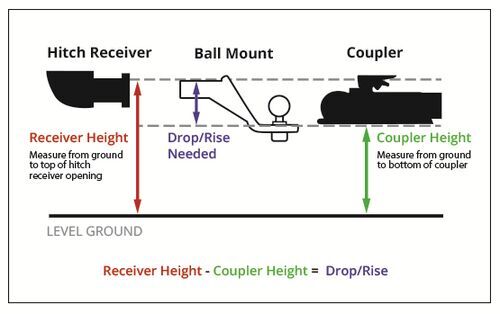
For safe and comfortable towing, the trailer should always be as level as possible. A level trailer will put less strain on the connection between the trailer and hitch. It will also help the trailer stay in line behind the vehicle. Because trailer and vehicle heights often differ, a ballmount with a Rise or a Drop may be needed. To determine how much of a rise or drop you need, follow the simple steps below.

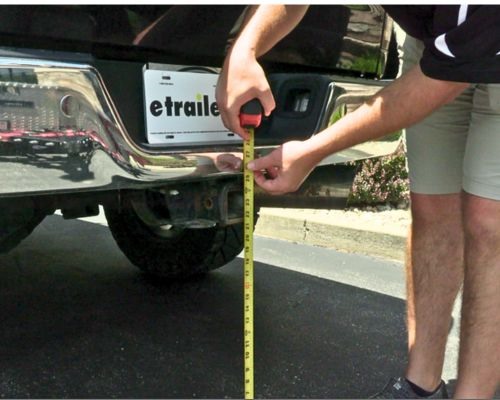
Hitch Height Measurment

Step 1: Measure the hitch height - from the ground to the top of the receiver opening on the trailer hitch. With the vehicle parked on level ground, measure to the top of the 2" hole on class III and IV hitches, and 2-1/2" hole on class V hitches.


Coupler Height Measurment

Step 2: Measure the Coupler Height - from the ground to the bottom of the trailer's coupler. Make sure the trailer is level, and on level ground.


Step 3: Compute the difference between the hitch height and the coupler height. If the hitch height is greater than the coupler height, the difference is the drop that is required. If the coupler height is greater, the difference is the rise that is required. The ballmount with the rise or drop closest to the difference should then be chosen. For example, if the hitch height equals 24-3/4" and the coupler height equals 17". Because the hitch height is greater, a ballmount with a drop of 7-3/4" would be required for a level trailer. The ballmount with an 8" drop is the closest one offered and would therefore be chosen.

  • If the hitch height is greater than the trailer height then
    • Hitch height - trailer height = DROP
  • If the trailer height is greater than the hitch height then
    • Trailer height - hitch height = RISE


Class I & II Ballmounts

When towing with a class I or class II trailer hitch, the ballmount that is recommended by the manufacturer should be used. All class I and class II trailer hitches are tested and rated with the specific ballmount for that hitch. Using a ballmount that is not recommended by the manufacture will void the warranty.

  • All 1-1/4" x 1-1/4" ballmount are held in place with a 1/2" pin.
  • All 1-1/4" x 1-1/4" ballmounts use a ball with a 3/4" shank diameter.
  • Class I ballmounts are rated at 2,000 lbs GTW
  • Class II ballmounts are rated at 3,500 lbs GTW
    • Class II ballmounts will not fit on Class I trailer hitches
  • 1-7/8" or 2" hitch balls can be used.
    • 2-5/16" balls can not be used on any class I or II ballmounts.


Class III & IV Ballmounts

Class III & IV hitches and ballmounts are rated to tow 5,000 to 12,000 GTW, depending on the rating of the receiver hitch. Class III & IV ballmounts will work with trailer hitches with a 2" x 2" opening. When towing with class III & IV receiver hitches, the GTW and TW of the ballmount should match or exceed the trailer hitch.

  • All 2" x 2" ballmount are held in place with a 5/8" pin.
  • All 2" x 2" ballmounts use a ball with a 1" or 1-1/4" shank diameter.
  • Class III ballmounts are rated at 5,000 lbs GTW
    • Ballmounts rated at 10,000 lbs or greater will use a ball with a 1-1/4" shank.
  • Can use a 1-7/8", 2", or 2-5/16" hitch ball.


Class V Ballmounts

Class V hitches and ballmounts are typically rated to tow 12,000 GTW. Class V ballmounts will work with trailer hitches with a 2-1/2" x 2-1/2" opening. When towing with class V receiver hitches, the GTW and TW of the ballmount should match or exceed the receiver hitch.

  • All 2-1/2" x 2-1/2" ballmount are held in place with a 5/8" pin.
  • All 2-1/2" x 2-1/2" ballmounts use a ball with a 1-1/4" shank diameter.
  • Class V ballmounts are rated at 12,000 lbs. GTW and 1,200 lbs. TW.
  • Can use a 1-7/8", 2", or 2-5/16" ball.
  • A weight distribution system can allow for more weight to be towed.

Ask the Experts

Do you have a question about an installation, a product, or how something works? With thousands of product installations and troubleshoots under our belts, we don't just sell this stuff, we know how to install and use it. Just type your question in the box below.

It may be helpful to include the year, make, and model of your vehicle and the product part number if you have a question about a specific product application.

Name:


Contact email:


How can our experts help?


Related Videos

Video showing how to lower the exhaust for a typical hitch installation.Lowering the exhaust for a typical hitch install

Video showing how to use fish wire for the installation of a trailer hitch.Fish Wire for a trailer hitch installation

Video showing minor drilling needed for a hitch installation.Minor Drilling for a trailer hitch installation

Video showing how to enlarge an existing hole for a trailer hitch installation.Enlarge an existing frame hole for a trailer hitch install

Video showing a typical installation of a fifth wheel trailer hitch.Fifth wheel hitch installation - 2008 Ford F-250

Video showing the installation of a trailer brake controller.Brake controller installation

etrailer.com TVetrailer.com TV


Satisfaction Guarantee
Great to do business with,,,fastest turn around time I've ever experienced!!
Delores, Warner Robins, GA