


Is it Normal to Have Play on Your Coupler?
Updated 02/10/2026 | Published 01/29/2026
Question:
I have a Big Tex 60EC with this style coupler. It has a significant amount of play in the upper side components when its in the locked position lever, piece that s over the front of the coupler. That play doesnt seem to significantly impact the actual clamping mechanism on the ball and there is virtually no play once you install the safety pin. This may be normal and it may have always been like this - I just cant remember and paranoia started setting in today. Is this typical of these yoke style couplers or should it be replaced?
asked by: Joe

(click to enlarge)
Expert Reply:
Hey, Joe.
I just want to make sure I'm understanding what you're saying. When you hitch up your trailer and close the latch there is some play, but when you put the pin through the latch on the coupler there is next to no play? Are you referring to play on the latch or play between the coupler and ball?
If the latch is really easy to unlatch it would be worn. There should be some sort of resistance to unlatch it. Coupler play is normal. The coupler needs to be able to glide on the hitch ball.
Let me know If I'm on the right track or if I need to switch gears for you. You can leave a comment below.

Marcia
2/10/2026
Hey Joe, I have this style of coupler and is is working well for me and have hauled dozens of 2 ton+ loads of road base last year without experiencing any kind of play like you are describing. I believe most of these hitch mechs do have a threaded adjuster to take up some slack as the mechanisms were down and you might want lay on your back to see if you can tighten this up. Or better yet, have mechanic or trailer rep do this for you to get it right. I drove for 5 years 350 style trucks with trailers and oversized loads with total lengths over 70 ft long,... truck, trailer and overhanging huge river rafts and dories all in excess of what the vehicles and trailers were designed for TBH. I had some scary moments when guides did not secures the loads right and the winch straps disconnected, but always I always added back up straps and was able to not loose gear or have any incidents. But in the back of my mind was the reality that trailer hitches were the weakest link of the chain and how important it was to make sure to have the ball totally down, the lock mech/pin in right, safety chains in place and make sure the slop with the ball and hitch was not excessive. And then, to drive defensively and slow to minimize stress to these components as they all have engineering limits on how much load and stress they can bear. So if it is tight with the pin in place, probably OK, but check the adjuster is my feel??
Product Page this Question was Asked From
A-Frame Trailer Coupler - Yoke Latch - Black - 2" Ball - Weld On - 8,000 lbs
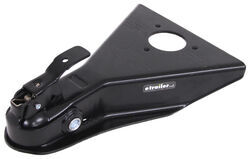

- A-Frame Trailer Coupler
- Standard Coupler
- 50-Degree Frame
- Weld-On
- 8000 lbs GTW
- 2 Inch Ball Coupler
- Yoke Latch
- 2-1/4 Inch Hole
- Standard Grade
- etrailer
more information >

Continue Researching
- Video: Complete Breakdown of the A-Frame Trailer Coupler
- Video: A Closer Look at the etrailer A-Frame Trailer Coupler
- Q&A: Looking For Brake Assemblies And Hubs For Dexter 4,400 lb EZ-Lube Axles
- Q&A: Replacing the Drop Leg Spring Loaded Pull Pin on a Bulldog 180 Series Square Jack
- Q&A: Replacement Gear Kit Instructions and Diagram for Ram 12,000 Series
- Q&A: Approximate Price of PingMaster 5000 Wireless Trailer GPS Tracker Per Month
- Q&A: Looking for Replacement Breakaway Battery for Old Battery Break Way Corp 081020FHon Battery
- Q&A: Solution for A-Frame Trailer Coupler Yoke Latch Repair Kit
- Q&A: How To Find Correct Replacement Electric Braking Assembly Parts for a Trailer
- Article: Most Popular Wheel Bearings
- Article: How to Measure for Travel Trailer and Fifth Wheel Steps
- Article: 5 Things to Know About Weight Distribution Hitches
- Article: How to Measure for Trailer Hitch Drop
- Article: Types of Trailer Hitches: How and Why to Use Each
- Article: How to Measure Your Trailer Wheel Bolt Pattern
- Article: How to Measure a Trailer Axle
Joe
2/9/2026
Thanks for the response. There's play on the latch in that it can be rocked back and forth while in the locked position. When the pin is through, that disappears. When rocking the latch back and forth, it remains in the locked position and that rocking doesn't seem to actually move the coupler any meaningful amount. There is definitely still resistance to unlatch it even with this play since you need to lift it up and back. It doesn't feel like it would unlatch on its own if a pin weren't through it or anything like that.