bing tracking image

Man Hooking Up Travel Trailer to Truck
Written by: Amber S. & Jacob J.
Last Updated: 9/16/24
Time to read: 7 mins.

What Kind of Hitch Do I Need for a Travel Trailer?

Chances are you’re here because you’re gearing up for some really awesome camping trips (and I'm so excited for you). But before you get to kicking back with a cold one or huddling up around the bonfire with family and friends, you need a hitch. None of this happens without one! At least, not if you want your travel trailer to come with you. I’m going to make this as easy as possible, so you can get hitched up and get to the fun parts faster:Put simply, for a travel trailer, you need a Class III, IV, or V trailer receiver hitch that’s compatible with your vehicle and strong enough to haul your camper. How do you pick the right class? How do you know if it's strong enough or if it works with your vehicle? We'll get into that below.
Note: Remember, you're always limited by your lowest-rated component, whether it's your vehicle, hitch, or some other component!

How Do I Know What Trailer Hitch I Need?

I said above that your hitch should fulfill 2 criteria:
  • It must be compatible with your vehicle
  • It must be strong enough to haul your camper
Finding a hitch compatible with your vehicle is easy with our fitguide—just enter your year, make, and model, and we'll show you hitches that fit. As for a hitch strong enough to haul your camper, you'll want to look at two numbers: the towing capacity and tongue weight capacity.
Towing CapacityThis is the weight the hitch can handle when towing. It's best to choose a hitch with a little "wiggle room"—that is, you want your hitch capacity to be at least 20% greater than the heaviest thing you're towing. Err on the side of caution here.When you're trailer shopping (or if you already have a trailer), you should be looking at its maximum weight when loaded with gear, water, etc. You might see this listed as the trailer's GVWR (Gross Vehicle Weight Rating), or you might have to add up its Dry Weight and Cargo Capacity to get that number. Your hitch should be able to handle this weight, plus about 20% or more.
Towing Capacity
Look for the towing capacity on your trailer hitch and make sure it's about 20% higher than your trailer's GVWR.
Tongue WeightTongue weight (TW) is the constant downward force a trailer tongue applies to your hitch. It should be about 10 to 15 percent of your loaded trailer weight. So if your trailer's GVWR is 8,000 lbs, your maximum TW should be about 800-1,200 lbs. Your trailer hitch's TW capacity should be able to support this, plus at least 20% (again, it's best to err on the side of having TOO much capacity).
Towing Capacity
To learn more about tongue weight, check out a more in-depth explanation and learn how to measure it.Now that we know what we're looking for, let's go over our potential options.
Trailer dry weight (or curb weight) + Cargo Capacity = GVWR (Gross Vehicle Weight Rating) or (GTW) Gross Trailer Weight
Tongue Weight on Hitch

A Brief Note on Weight Distribution:

Despite which class of hitch you end up with, there is always the possibility that you will require a weight distribution hitch. A weight distribution hitch is an additional component you will add to your towing setup to allow more even weight distribution (wild right?) To find out whether or not you'll need a weight distribution hitch, consult your owner's manual. For example, your vehicle's owner's manual may say that when towing anything above 5,000 lbs, a weight distribution hitch is necessary. For obvious safety and warranty-compliance reasons, we suggest abiding by these manufacturer recommendations. We would also suggest a weight distribution hitch if your trailer's weight is more than 50% of your towing vehicle's weight. There is quite a bit more to learn about weight distribution though, and we're happy to help! For more information, or to just see how deep the towing rabbit-hole goes, check out some of our other articles on the subject!
weight distribution correction
Improper weight distribution causes your vehicle to sag, which can negatively affect your vehicles performance in a number of ways. If you find your setup looking like the top image here, maybe it's time to upgrade your setup to something a bit more stable.

Class III Hitches

Class III hitches are the most common hitch class installed on pickup trucks and SUVs. This is largely because of their versatility. With some class III hitch receivers offering capacities up to 8,000 lbs., many towers find they never need more than this. These hitches are generally quite capable of towing small-to-mid-sized campers. Pro Tip: If you drive a vehicle that can't tow beyond the capacity of a Class III hitch, then your decision is made easy, as no hitch will increase your towing capacity. But if you have a full-size truck or larger SUV with more capacity, it may be a good idea to size up to a class IV, even if you don't need it for what you're towing today. If you ever want to upgrade your camper/boat/haul you'll be grateful that you already have a hitch that can handle the additional weight.
Class III hitch
A class III hitch is perfect for smaller campers, boats, or bikes/luggage racks! There's a reason they're so common.

Class IV Hitches

If a Class III hitch just won't cut it, or if you have a beast of a vehicle that hauls 8,000 lbs. like it's nothing, then let me introduce you to your new best friend. A Class IV hitch is one of the largest you will see on the market for non-commercial use, and it's perfect if you are hauling a particularly large travel trailer.A Class IV hitch will also have a 2" receiver opening, so there shouldn't be many compatibility issues if you tow a variety of trailers or want to swap out the camper for a bike rack. If you need a little more power than the Class III can provide, but still want the flexibility to tow with the most common receiver size, then the Class IV hitch is just what the doctor ordered.
class IV
Large travel trailers are no match for the increased towing capacity that comes standard with a class IV hitch

Class V Hitches

Here we are, the top of the mountaintop, the heaviest of duty, the class V hitch. The majority of class V hitches on the road will be for commercial use. Hauling heavy equipment, livestock, etc. However you will see these on occasion hauling the biggest of the toys. I'm talking about the heaviest towable trailers on the market. These hitches can also be equipped with a 2" receiver opening, however where they really see their strength shine is with a 2 1/2" or 3" receiver. This will maximize the towing strength and make sure you have the capacity for literally anything you may want to tow in a rear receiver hitch.
There are hitch styles with larger capacities than the rear receiver hitch (regardless of class). For example the gooseneck or fifth wheel hitch will both generally sport more pulling power than a rear receiver, but will require a pickup truck to operate. To find out more about all of the various hitch types, click here.
big tow
You're most likely to find a class V hitch in a commercial setting like this one.
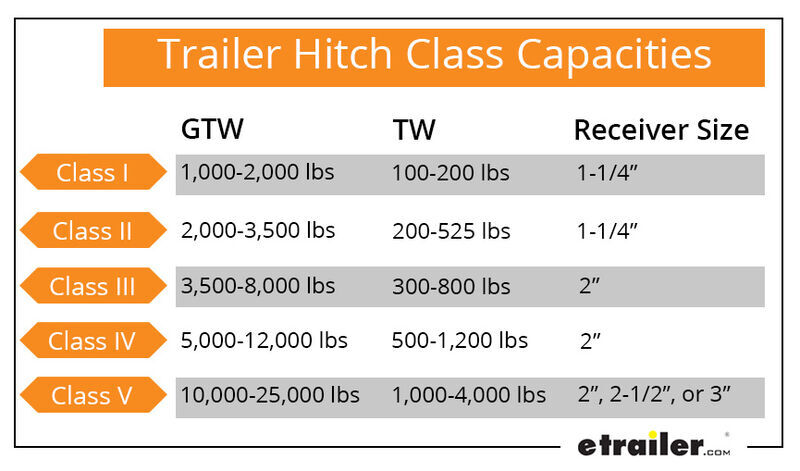
Trailer Hitch Class Capacities
Here's a "cheat sheet" of the approximate weight classes of each rear receiver hitch. Again it's important to read your owner's manual for specific numbers, and to leave yourself plenty of wiggle room for the safest towing experience possible.
The Takeaway
To the naïve onlooker, all hitches seem very similar. However we know, and now you know too, that there's a significant amount of nuance to choosing which is right for you and your setup. Remember to always consult the owner's manual for your vehicle before you decide on a hitch, as you will always be limited by your lowest rated component. A quick and dirty rule if you're unsure is to always get a hitch that's rated for the most your vehicle can tow, that way you're not going to run into capacity issues with your hitch.So go ahead and pull the trigger on that hitch you've been eyeing (provided it meets all the criteria for your trailer), get it installed (using our handy-dandy installer locator), and get to adventuring (it's a pretty good time, and I really wanted something in parenthesis here).
Related Articles
trailer maintenance checklist
ball mount guide
steel vs aluminum ball mount
amber s
About Amber SAs a content writer for etrailer, I might spend my morning loading and unloading a bike on five different bike racks to figure out which is easiest to use. I might be in the parking lot, taking pictures of an impressive RV battery setup our techs came across in the shop and discussing the benefits of the setup with the owner. I might spend an afternoon in a manufacturer training classes for some hands-on experience with new products, and then sit down to assemble all this information into a coherent article. At etrailer, one of our core values is that we are always learning, and I learn something new every day. I start each morning with the goal in mind of taking all of this information and figuring out the best way to answer the questions people ask us (and the ones they don’t know to ask yet), and helping people get the solutions they need to make their lives easier, safer, and more fun. I’m a DIYer at heart, so it brings me great joy to help a fellow DIYer find what they’re looking for, whether that’s a product, an answer, or a community.


Departments

Towing

Sports and Recreation

Trailer Parts

Vehicle

What our customers are saying:

"WOW! I am impressed! I called to place my order and real person answered, spoke perfect English, albeit a slight southern accent, and my order was sent within a day, shipped quickly and I had it a few days later. I saved over a hundred dollars over local and installed it my self. I cant imagine how that they could do any better. THANKS!"

Eric
Cedar Springs, MI