


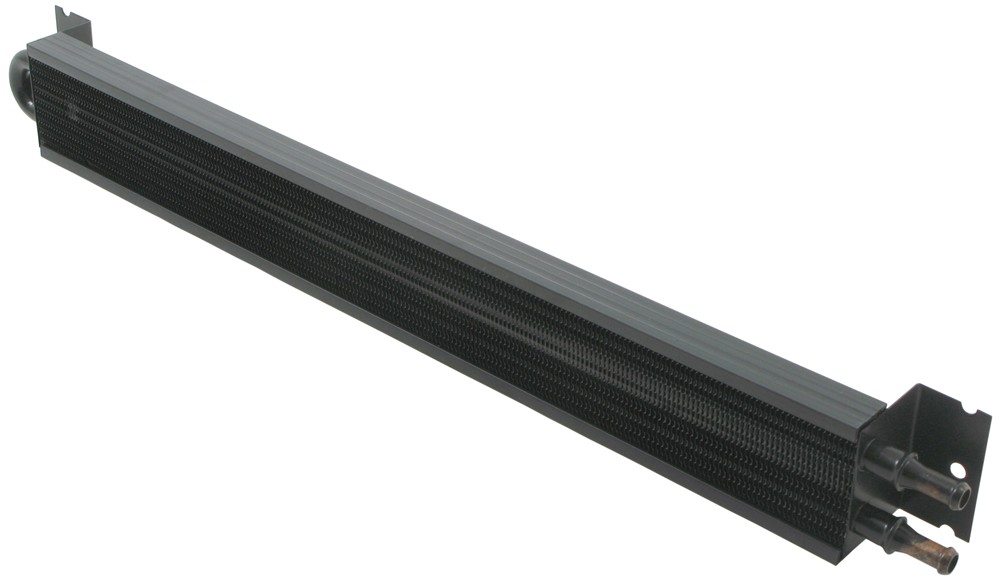



23-3/4" Long x 1-3/4" wide x 2-1/2" deep, heat exchanger mounts on your vehicle's chassis to provide additional cooling to increase the life of your transmission and improve overall functioning. Great for hot rods and muscle cars.
Features:
Specs:
Note: The Derale Insta-dapt radiator adapter fits most vehicles with 5/16" transmission lines, but not all. In some cases, additional fittings or alteration of the OEM lines or hoses may be required for installation.
Perhaps the simplest type of heat exchanger, the tube-fin effectively cools a variety of automotive systems. The concept is simple: Fluid cools as it travels through the core by transferring heat out to the fins. The fins then provide the surface area necessary for sufficient heat exchange to take place, allowing the heat pulled from the fluid to dissipate into the surrounding air. And to think - all this cooling power is compact enough to fit on your vehicle's frame rail! Easy, efficient and convenient.

Videos are provided as a guide only. Refer to manufacturer installation instructions and specs for complete information.
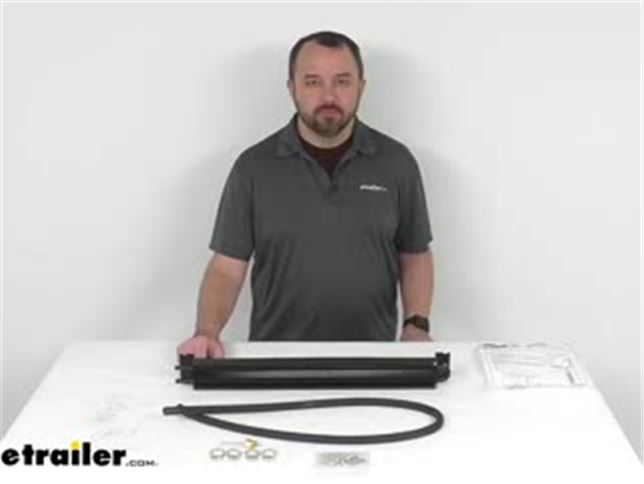
Hi, everybody, Andy here with etrailer.com. And today, we're gonna take a brief look at this Derale Frame Rail Transmission Cooler. This heat exchanger is going to mount on your vehicle's chassis to provide additional cooling to increase the life of your transmission and improve overall functioning and performance. This is going to be great for vehicles such as your hot rods and muscle cars. And this has built-in turbulators that are going to agitate the fluid for more efficient cooling. This is made here in the USA.
And it's designed with copper tubing. And the copper tubing is expanded into the aluminum fins for maximum heat transfer. And as you probably know, copper is the best material for conducting the heat out of the fluid, while aluminum is going to be ideal for transferring and dissipating that heat. So this includes everything that you see here on the table before me. You're going to get an inch offset bracket here that's going to provide increased airflow.
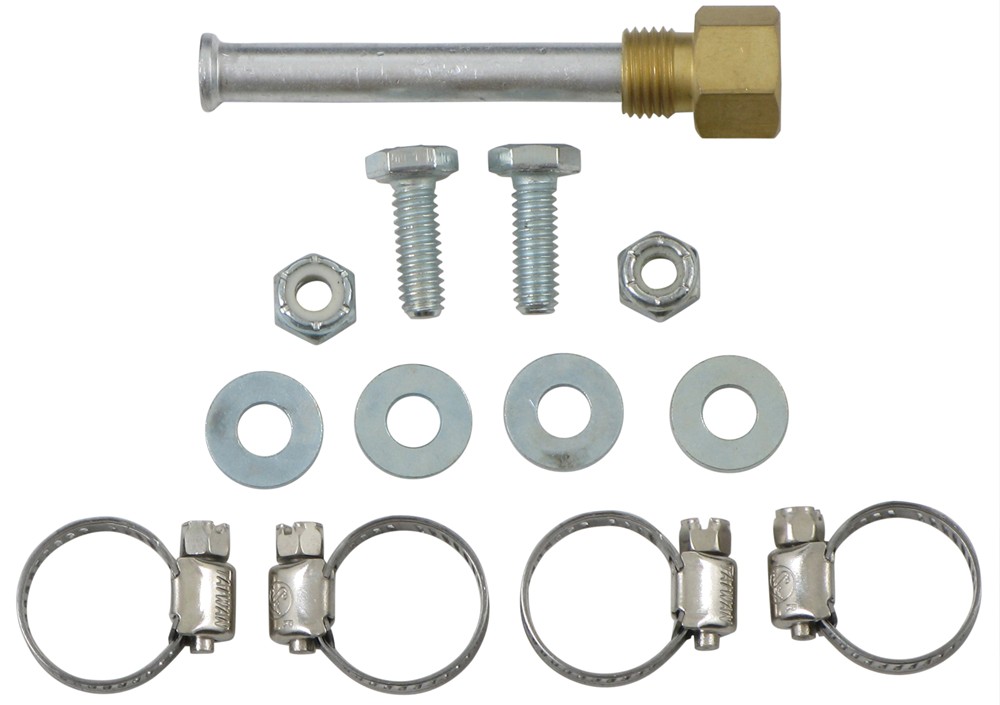
And then here on the table, we have a four-foot long, 11/32 of an inch rubber hose. And this also includes stainless steel clamps and then all of the necessary mounting hardware and then this Insta-dapt radiator adapter. Just a quick note on this, this Insta-dapt radiator adapter is going to fit most vehicles with 5/16 of an inch transmission lines, but not all. In some cases, additional fittings or alterations of the OEM lines or hoses may be required for installation. So the inlets are gonna be 11/32 of an inch hose barb.
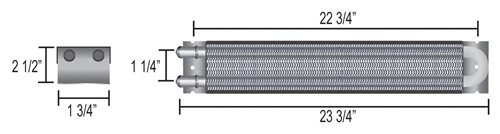
And then I do have a diagram there that I'm gonna put there on your screen to show you the overall dimensions. As you can see there, it's 23 3/4" long by an inch and 3/4 wide and 2 1/2" deep. And then the distance between the mounting holes is 22 3/4", center to center. And then the distance between the inlets is 1 1/4". And this diagram is also on our product page.
And then you will get an instruction sheet to walk you through the installation. Well, that's gonna conclude our brief look today. I do hope that it was helpful for you. Again, my name is Andy. Thank you for joining me..
Ratings & Reviews

Here are some comments and photos regarding the above-referenced order.
The D 13220 Derale transmission cooler was purchased as a replacement cooler
for the primary-transmission cooler for a 2005 Nissan Frontier LE 4WD. This
was done to prevent cross contamination of transmission fluid with engine
coolant caused by a possible rupture of the primary-transmission-cooler core
located in the radiator. Due to numerous consumer complaints regarding this
issue, I decided to take preemptive action and avoid expensive transmission
and radiator repairs. This Nissan also has an auxiliary transmission cooler
located in upper front of the radiator on the passenger's side of the truck.
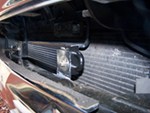
The Derale cooler was installed on the center of the bumper frame about 2
3/4 inches in front of the air-conditioning condenser. In order to install
the Derale cooler, two strips of steel 7 inches long, 2 inches wide and an
eighth of an inch thick were attached to the bumper frame, see photos
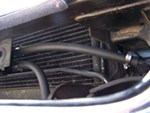
attached. Since the factory-installed auxiliary cooler's outbound hose barb
is just to the left and above the Derale cooler's top/inbound hose barb,
connecting the outbound and inbound hose lines of the two coolers was fairly
easy. The return line hose barb to transmission is just to the left and
almost parallel with bottom/outbound hose barb on the Derale cooler, see
photos attached. Thus, connecting the Derale cooler's outbound line to the
line that returns cooled fluid back to the transmission was also easy.
The primary cooler was by-passed by cutting the outbound line from the
transmission before the connection to the radiator and splicing it to the
inbound line of the auxiliary cooler. The two lines were connected via a
metal tube purchased from a Nissan dealer.
The most difficult part of the installation was attaching the steel mounting
strips to the front bumper frame. Since I do not have an electric welder, I
used liquid steel to make the bonds.
The next step in this process will be to replace the transmission fluid and
filter. The transmission was last serviced at 81k and the vehicle's current
odometer reading is 114k, so it's time for a routine fluid and filter
change. Neither the transmission fluid nor the engine coolant shows any
sign of cross contamination. After 33k, the transmission fluid still has a
red color consistent with replacement fluid I've purchased.
Ideally, in order to insure that the both coolers provide adequate cooling
for the transmission, it would be a good idea to install a transmission
temperature gauge. I understand that most automatic transmissions are
designed to operate at approximately 175 degrees Fahrenheit. However, in
lieu of a temperature gauge, I will monitor the transmission fluid's color
and smell. If the fluid changes color from red to brown or has a burnt
smell, the next step will be to install a transmission pan with added fluid
capacity or replace the factory radiator with one that has dependable
transmission cooling core and connect it as the primary transmission cooler
and have it cool in conjunction the auxiliary and the Derale coolers.
The attached photos were made with the skid plate, spoiler and lower grill
removed. In the photograph labeled Bottom View of Cooler Mount, you may
notice a second hole in the mounting bracket, which is 3 1/4 inches lower
than the actual mounting hole used. A second mounting location was added so
the Derale cooler could be lowered in the event it impeded air flow to air
to the air-conditioning condenser or radiator in a manner that reduces their
operating efficiency. However, so far, the current location of the cooler
has caused no issues.
Please keep in mind that the foregoing comments were made by a retired
accountant - not a mechanic by any stretch of the imagination.
Info for this part was:
At etrailer we provide the best information available about the products we sell. We take the quality of our information seriously so that you can get the right part the first time. Let us know if anything is missing or if you have any questions.



















Thank you! Your comment has been submitted successfully. You should be able to view your question/comment here within a few days.
Error submitting comment. Please try again momentarily.