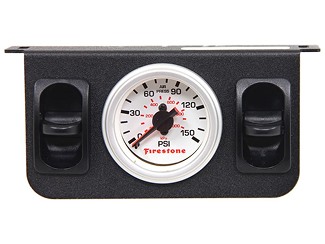
Firestone Air Command systems are built around three key components: control panels, air compressors, and air tanks. Together, they give you precise, in-cab control over your air springs, whether you're towing a camper, hauling equipment, or leveling out a daily work truck.
At etrailer, we install and test Firestone systems every day on real trucks, RVs, and commercial rigs. This guide explains how each part works, how they work together, and how to choose the right combination for your needs.
A Firestone onboard air system is designed to work as a complete system, not just a collection of parts. The compressor supplies airflow, the air tank (if included) stores that air for quicker response, and the control panel lets you adjust pressure from the cab as your load changes.
When these components are matched correctly, the system responds faster and stays more stable under load, giving you:
Faster air-spring adjustments
More consistent ride height
Better control when towing or hauling
The ability to power accessories like tire inflators or small air tools
CONTROL PANELS
Control panels are the in-cab interface for adjusting and monitoring your air springs. The right panel makes it easier to fine-tune pressure while driving, respond quickly to load changes, and keep installation as simple or as clean as you want it to be.Why it matters: The control panel determines how air is delivered to your springs, how pressure is displayed, and whether the system relies on air lines, wiring, or a combination of both inside the cab.
Control Panel StylesSingle control panels adjust one pair of air springs together. They’re a solid choice for basic rear air-spring setups where loads stay fairly consistent and independent adjustment isn’t needed.
Dual control panels let you adjust left and right springs, or front and rear, independently. This is the most popular option for uneven loads, 5th wheels, slide-in campers, and RV setups where balance matters.
Types of Control Panels
Electric ActivationSimple and tank-free.
Uses an analog needle gauge
Switch powers the compressor directly
Does not require an air tank
Requires air line to cab
Slightly slower inflation compared to tanked systems
Pneumatic ActivationFast and tank-driven.
Analog gauge
Switch releases stored air from the tank into the springs
Compressor automatically refills the tank
Ideal for faster response and heavier loads
Requires tank + cab air line
Digital Activation
Cleanest install + easiest to read.
The air compressor supplies the airflow that inflates your air springs and refills the air tank (if equipped), directly affecting how quickly the system responds and how well it keeps up with changing loads.
Why it matters: If you change air pressure frequently, or your load varies day to day, you need a compressor that can keep up.
Compressor Options & Choosing the Right One
Standard-duty compressors operate in the 120–130 psi range and move a lower volume of air. They’re a good fit for weekend towing or occasional hauling where air-spring pressure is set once and rarely adjusted, and where onboard air accessories aren’t needed.
Heavy-duty compressors run at higher pressures (typically 145–150 psi) and use larger cylinders to move more air. They’re better suited for weekly towing, work trucks, or setups with uneven or shifting loads where faster response and more frequent pressure adjustments are needed.
Extreme-duty compressors offer the highest output and fastest recovery times. These are designed for onboard air systems that power tire inflation or air tools, as well as larger air tanks and commercial or full-time use where the system needs to keep up with constant demand.
AIR TANKS
Air tanks store compressed air so your system has immediate access to airflow when adjustments are needed, rather than waiting on the compressor to build pressure.
Why it matters: A tank reduces wait time when inflating or deflating your air springs, helps maintain more consistent ride height under load, and allows you to power air-driven accessories like tire inflators or small air tools.
Choosing the Right Air Tank (and Compressor)
Small Tanks (1/2 - 1 Gallon)
Faster air-spring response
Compact and easy to install
Best for quicker adjustments without running accessories
Compressor pairing: Standard-duty works
Medium Tanks (1 Gallon - 3 Gallons)
Faster overall system performance
Supports occasional tire inflation
Most common choice for towing setups
Compressor pairing: Heavy-duty recommended
Large Tanks (3 - 5+ gallons)
Stores the most compressed air
Designed for onboard air use (tires, small air tools)
Best for full-time towing, RV, or work use
Compressor pairing: Ultimate-duty required
REAL-WORLD USE CASES
Travel Trailer or 5th Wheel Towing
Dual control + heavy-duty compressor + 1–2 gallon tank
Why: Independent left/right adjustment and faster response under changing tongue or pin weight.
Slide-In CamperDual control + heavy-duty or ultimate-duty compressor
Why: Slide-in campers often cause side-to-side lean, making independent control essential for proper leveling.
Work Truck / Changing Jobsite LoadsHeavy-duty or ultimate-duty compressor + mid- or large-size tank
Why: Supports frequent pressure adjustments and provides stored air for inflating tires or running small air tools, not just carrying heavy equipment.
Full RV or Commercial RigDigital control + ultimate-duty compressor + 3–5 gallon tankWhy: Delivers the fastest response times, precise pressure control, and onboard air capability for tires or accessories.
PUTTING IT ALL TOGETHER
Choosing the right Firestone air suspension setup isn’t about picking the biggest compressor or the largest tank. It’s about matching each component to how you actually use your vehicle. When the control panel, compressor, and air tank are selected with your load, towing frequency, and adjustment needs in mind, the system responds faster, stays more stable, and works the way it should.At etrailer, we see the best results when customers focus on fit and function first, then build their system around real-world use. Whether you’re leveling a travel trailer, managing a slide-in camper, or setting up onboard air for work or RV travel, a properly matched Firestone system delivers consistent performance and fewer headaches down the road.If you’re not sure which components make the most sense for your setup, our team is here to help you dial it in—so you end up with a system that works as hard as your truck does.
About Nicki B.I’ve always loved learning and teaching. Every day I get the chance to help a neighbor pick up something new, whether it’s understanding how to tow with more confidence, setting up camp a little easier, or just finding the right gear for their next trip. For me, the real joy comes from turning those little “aha” moments into solutions that make life safer, smoother, and more fun.Outside of work, you’ll usually find me outdoors. I love fishing, camping, and hiking the trails with my family and our golden retriever (who insists on carrying the biggest stick he can find). I spent years as a Cubmaster and scout leader, and now I get to put those skills to good use running our team campouts. My favorite part is dreaming up fun games and activities that get everyone laughing.When I’m not outside, I’m probably curled up with a book or unwinding with some old Top Gear reruns. At the end of the day, I just like finding ways to make things a little easier and more enjoyable, on the road, at camp, or at home.