


Thank you! Your comment has been submitted successfully. You should be able to view your question/comment here within a few days.
Error submitting comment. Please try again momentarily.

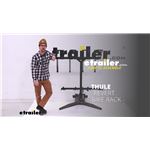
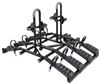
When you’ve got a full group ride planned, the ReVert handles it. This vertical rack carries up to 6 bikes, each up to 55 lbs, and mounts into a 2" hitch receiver. The mast uses a built-in gas shock that tilts down so you can roll bikes into place instead of lifting them. Once they’re set, a simple nudge raises the rack back up—no strain needed.
No one likes a rack that rattles on rough roads. The ReVert’s hand-tightening lever expands inside the hitch to lock the rack solidly in place, keeping movement and noise to a minimum. A powder-coated steel frame gives it the kind of stiffness that stays true even when fully loaded, so your bikes ride steady mile after mile.
Getting to your cargo shouldn’t mean unloading bikes. The ReVert tilts away with just a tap of its lever, giving quick access to gear behind the rack. The gas-assist mast makes it easy to move even when the rack is full, and the lift-back motion is smooth and balanced.
From trail bikes to longer setups, the ReVert adapts. It fits wheelbases up to 53" and tires up to 3.0" wide, with 11" spacing between bikes to keep them separate and stable. Adjustable height settings let you fine-tune the fit for each bike, so everything lines up just right.
Built-in security keeps your bikes where you left them. The ReVert includes a One-Key System lock that deters theft by securing the rack and bikes together. For even more protection, it’s ready for an ABUS cable lock (sold separately). Whether you’re parked at the trailhead or loading up in the driveway, your setup stays locked down and ready to roll.


Customer Satisfaction Score:
97% were satisfied with this product
3% of customers were not satisfied
Ratings & Reviews

I watched the e trailer video on assembly which made putting it together a breeze. The rack does all the things I was hoping for. It has all the little niceties dialed so raising, lowering, loading, and unloading my heavy eMTBs is no problem. A very well built rack!
solid rack at a good price. I bought this instead of a 4 bike platform rack to minimize the torque on my car. E trailers shipping was fast and free.
This is the Rack to get if you want a verticals bike rack. There are several other racks on the market that have similar functionality. I would say what sets this apart is as follows.
1- packaging. Thule does the best Job packaging their items, I had recently purchased another vertical rack and it was slightly damaged because a large heavy metal rack can bang around if not packed correctly. This Rack had come packed very well and no damage to any items, as you would want it when purchasing a new item that is being shipped to you.
2- assist function both up and down. Other racks have assisted function down or none at all. This rack has assistance both ways and if you have 3 bikes on the rack, one pull on the lever and the rack pull it up for you.
3- ease of assembly. Assembly of this rack was probably one of the easiest things out there. Just watch the assembly video and you should be done with in an hour with absolutely no rush.
4- hitch stability. The rack comes with an adjustable hitch wedge built in and it makes a huge difference. No need for a hitch stabilizer to be bolted on. The attached hitch pin and adjustable wedge make this very solid and stable when transporting your bikes.
Lastly, honestly think about the cost in comparison to other racks. It may cost just a few hundred more, but the assurance that you have thousands of dollars of bikes on the rack that are safe is well worth it.
This is a fantastic rack. Look up on YouTube for other people comparing other racks like the Velocirack or JB Rack (I bought the JB one and it was a mistake, thin steel and not even close to as stable. Steel bent with assembly and flexed when transporting bikes). When I purchased the Thule revert the comparison to the other vertical rack was night and day. Expensive mistake but at least now you know.
Easy to load and haul 4 full sized bikes. Rack does not rattle or move around even on the bumpy roads of the north east.
This rack is strong but there are a few problems. 1) It doesn't tilt down far enough to load my bike without lifting the bike. If you have a heavy e-bike, this is a problem. 2) The rack itself is heavy and an awkward lift so it's difficult to put on my truck when I'm doing it alone. 3) It's difficult to find a bike cover that keeps the bike clean while being transported on the rack.
Nice rack, taller than I was expecting, so we can't leave it on the vehicle when pulling into the garage. But it's much lighter than the T2 so it's easier to pull off & put on. Used 4 hooks to hang it on the wall, makes it easy to work with. Bikes are well hung, they don't touch and the rack is very stable. Really like the tool-less design and the lift/lower assist.
Ordered for a friend. So far, they love it!
Useful rack, easy to tilt up and down.
I'm using a Hollywood rack valet to hold it when off the vehicle with a motorcycle cover.
We previously owned a Thule XTR 4-bike platform rack and thought it was the fastest to load and unload compared to other 4+ bike racks. This is from seeing other folks loading their bikes on trails. Not until we got Thule Revert, which is by far the easiest and fastest to load and unload. The assist is a game changer, even though it makes it hard to lower an empty rack to access the rear hatch. The angled stem helps avoid hitting rockes and clear uneven terrain on a lower clearance vehicle. The thick rubber bands are super fast to put on and off. The height is just right to simply roll bikes into baskets without lifting. Make sure to get a torque wrench and follow correct torque specifications.
Expensive but totally worth it. Easy enough for my wife to load bikes on the rack.
Do you have a question about this Hitch Bike Rack?
Info for this part was:
At etrailer we provide the best information available about the products we sell. We take the quality of our information seriously so that you can get the right part the first time. Let us know if anything is missing or if you have any questions.























Brooke M.
3/31/2025
We'd love to see a photo of you whole set up if you ever feel like sending one in the next time you're geared up to hit the road :)