Replacing the Bearing, Races and Seals on a Trailer Hub
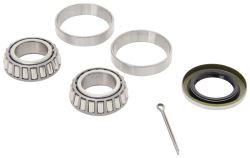
No parts are more critical for the dependable performance of your trailer than the bearings, races, and seals. To ensure that your trailer performs reliably, you should inspect the
bearings, races, and seals and repack the bearings every 12 months or 12,000 miles.
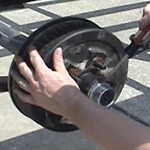
After the grease cap on the spindle is removed, the castle nut should be visible. The castle nut holds the hub and bearings in place.
You will then see one of three devices that lock the nut onto the spindle. The most common is a cotter pin. Just bend it straight and pull it out.
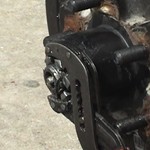
Then you may see what is called a "tang washer."
Wipe the extra grease off the nut and look for a "tab" that is in one of the notches of the castle nut.
With your screwdriver, push the tab back toward the spindle. Spindles with a flat spot on the threads are a dead giveaway that the spindle will use the tang washer.
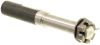
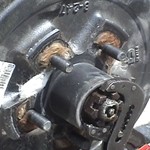
(These EZ lube spindles are "D-shaped" at the end and have a zerk fitting to transport grease to the bearing location.)
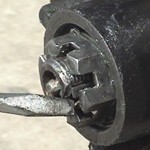
Finally, you may see a type of "cage" surrounding the nut. This is also on an EZ lube spindle and will just snap off the nut.
Use your screwdriver to gently pry off the cage in a circular motion around the nut.
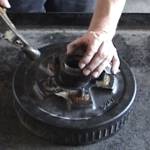
Remove the Hub:
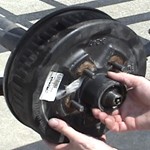
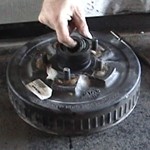
If the hub is in good condition, it should slide right off the spindle.
Use a paper towel to hold in the outer bearing as you pull off the hub.
If the hub is stuck, rock it in a circular motion to help slide it off.
If that does not work, use a mallet to tap the back side of the hub in a few places.
If the bearing is frozen to the spindle, you will have to knock off the hub with some force.
When this happens, often the hub will come off but the bearing and seal will stay on the spindle.
In this case you will have to work off the frozen bearing by using a chisel to break it loose.
If you chisel the bearing, be very careful not to hit the surface of the spindle, especially where the seal rides.
Even the smallest of nicks can wear out the bearings and seals very quickly.
If there are any nicks in the spindle where the bearings or seal sit, then you will want to replace the spindle or the entire trailer axle.
If you run into a frozen bearing you may want to consider taking the axle to a local garage.
Disassemble the Hub
Remove Outer Bearing:
Pull out the outer bearing and spindle washer.
The outer bearing is closest to the outside of the hub.
It is the one that hit the ground if you did not catch it when you were pulling off the hub.
Set the bearing aside.
Remove Inner Bearing and Seal:
Now you will need to remove the inner bearing and seal. (With luck it was not stuck on the spindle).
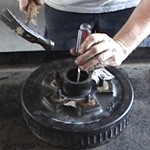
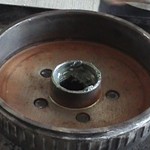
Place the hub, with the wheel studs facing up on a hollow cinder block or on a couple of 2x4s.
Then use a 1" wood dowel rod or scrap lumber that will fit into the center of the hub.
Place the dowel rod against the inner bearing and knock out the bearing with the mallet.
Do this in a circular motion.
The reason for wood is that it will transmit the force of the hammer but will not nick the bearing or race.
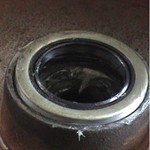
The grease seal will be pushed out by the bearing.
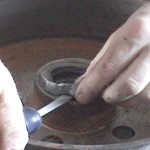
If you are planning on replacing the seals, another option to remove the inner bearing is to simply punch a hole in the seal and pry it out with a flathead screwdriver.
Be careful not to damage the hub and race when prying.
Clean and Inspect Bearings:
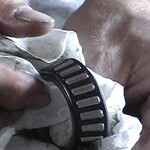
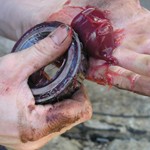
Wipe down the bearings and check their condition.
Look for nicks in the roller and dents in the roller cage.
If you see any of these problems or if you see lines, spots, or discoloration of the metal, discard the bearings.
If everything passes inspection, clean out the bearings and allow them to dry.
The best way to clean out the bearings is by using a heavy-duty degreaser and a paper towel.
Make sure to wipe down the bearing after it has been cleaned.
In a pinch, you can use a low-suds dish detergent such as Dawn to help cut through the grease.
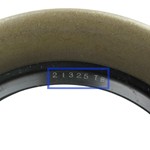
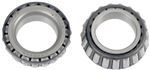
If the bearings have to be replaced, look for the number stamped on the ends or side of the bearing.
If the hub slid right off you should be in good shape, but you will still want to double-check the area where the bearing and the seal sit on the spindle.
Again, use the fingernail test. Simply run a fingernail across the spindle; if it catches, you will want to replace the spindle.
Spend some extra time on the spindle where the seal rides.
The smallest nick will wear out the seal very quickly.
If there is a sizable nick or gouge, you may need to install a new spindle.
Be careful when using bearing protectors not to overfill the hub with grease because too much grease can blow out through the grease seal. This can be especially messy on drums with brakes.
Repack the Trailer Bearings
Pack the Bearings:
The next step is to pack the bearings with grease.
You need to fill every space of the bearing with grease.
You can use a bearing packer, or the bearings can be repacked by hand.
If you are going to do it by hand, start with a gob of grease in your palm and then press the bearing into the grease with some force.
Do this one section at a time and overlap the sections. Start on the front and then move to the back side of the bearing.
The dust cap will install directly over the castle nut. You should be able to start installation of the dust cap with your hands by pressing it into the center of the hub. After it has been started, use a piece of wood to tap it in the rest of the way. Make sure the outer lip on the dust cap is tight against the hub or drum. The wood will help you to avoid damaging the dust cap.
The main purpose of bearing protectors is to keep out water. A grease-filled hub will have some pressure built up inside, and this is what prevents water from seeping in. When filling the bearing protectors with grease, be careful not to overfill them. To help prevent overfilling, the bearing protector will have a small hole that allows the excess grease to spill out the side.
It is not a good idea to fill the hub with grease on every trip. If the release valve is clogged, or the hub runs out of room, the grease will probably blow out through the grease seal. If you have brakes on the trailer and the seal fails, the brake shoes will be contaminated and will need to be replaced.
It is good practice to fill the hub until grease starts to move the pressure spring on the bearing protector. Check it to see whether the spring has gone down then add a little more. Bearing protectors come with bras (or covers) that are designed to keep the excess grease from flinging out of the release valve and help to keep your wheel clean.
I have an older boat trailer, 1984, and would like a clarification on the bearings placement. Should the cones be positioned so that the narrow ends are facing each other on the spindle?
Best trailer bearing advice I've seen. It could be improved by adding advice about removing and re-installing trailer wheels, and pictures that are larger and less dark. I know that's tough with black hubs and drums, maybe paint one white just for pics ?
Other wise excellent info. I'm about to repack my boat trailer wheels and haven't looked at a wheel bearing for many years. I especially appreciate the description of the fine art of adjusting the spindle nut. I've heard of people actually ramming the nuts on with an air wrench, then wondering why the wheel won't turn!
@Leroy The bearings are selected by their spindle diameters. You can get this information by either taking the hub assembly off and measuring the spindle at each of 4 points for inner bearing, outer bearing, grease seal, and race. Another (preferred) way is to take the bearings out and record the number imprinted on them for cross reference. With that information we can provide you the part numbers you will need to replace them. I have attached a page with information you will need.
Liked article. I bought boat trailer hub and bearings all done. Rear bearing seal in place and no taper to axle. My kit has the outer bearing seal. Inner was already on. If I put outer bearing seal in there won’t be enough room for caps to be put in. I read 5 or 6 articles making sure I didn’t need that outer seal. None of them mention the outer bearing seal. Must be for different application ?? I slid it on placed outer bearing, washer, castle nut, cotter pin and cap. Bugs the ....! Out of me with that extra part.
How old is your boat trailer? I've never heard of putting a grease seal on both ends of the hub. Normally you have one on the inside (closest to the center of the trailer) and then you have the grease cap at the very end of the hub.
I have a 2015 enclosed 6x12 Spartan trailer with tandem wheels. The owners manual does not give me any information about the brand or pn of the wheel bearings. There is a small amount of play in the wheels. Do you know what the pn for this bearing would be and do you stock a kit for this? I would like to make sure I have access to the parts before tearing it down.
I can help you out but unfortunately we don't have a list of replacement parts for various trailers. If you can let me know what your axle weight rating is that can help me narrow it down a bit. You should also be able to reach out to your trailer manufacturer and they generally have the replacement part numbers.
I have a 2011 Coachmen Apex 17FB camper trailer that I just bought. I believe the wheel bearing need to get repacked at least every 12,000 miles. I know that some (or all) Class A, B and C Rv's use what's called "sealed bearings". These types of bearings use a rolled element rather than balls and are designed to keep dirt and grease out. Boat trailers also use sealed bearings since they are made to be submerged in water.
Is it possible for me to replace my wheel bearings on my trailer with sealed bearings or somehow provide for a grease fitting to avoid having to remove the wheel for repacking the bearings so often..?
Are you referring to Nev-R-Lube Bearings like # 31-71-3? These are unique bearings that are specific to certain hub assemblies - not something you could switch out using existing hubs. Other bearing types might offer more protection but you'll still want to re-pack them at least every 12,000 miles or 1 year.
Even though I cannot comment specifically on the grease you used because I am not familiar with it, I can tell you the best grease for trailer bearings is a a grease with a rating of GC-LB, which just means it is made to withstand very high…
After you've packed the bearings and assembled everything, carefully slide the hub assembly onto the spindle and install the outer bearing. Install the spindle and tang washer and run the spindle nut down finger tight, then rotate the hub back…
You can check the condition of your hub's races by carefully removing all bearing grease with a rag to expose the actual surface of the races. When they are completely free of grease, etc., inspect them for any signs of scoring (very slight…
Hi Bill! The Dexter 023-105-00 brakes are going to be for a 6k axle, and we do have them as a right and left kit, listed below: Dexter Electric Trailer Brakes - 12" - Left/Right Hand Assemblies - 6,000 lbs #23-105-106 The etrailer Electric…
Hey Shane, so the Timken bearing kits are made in the USA so what would be perfect for you would be the part #TMK52VR is a USA made 3,500 lb axle trailer bearing kit. Have you had bearing problems in past?
Hey Jason, thanks for reaching out! We have the Bearing Kit #BK3-100 which comes with everything you're needing, but these are made overseas. In order to get a set of Timken you'll need to order the following: - 25580 #TMK44FR - 25520…
To determine the size of the brake assemblies you need you have to measure the depth and width of the hub drum on the axle like what you see in the picture I attached. The most common size is 2-1/4 inch wide like the #T4071600-500 that you…
Hello Curtis, thanks for reaching out. We do carry some screw on oil bath caps, but nothing in the size you mentioned. The closest we have would be the Oil Cap #RG04-260 which is a 2.563" ID. From there the next closest thing would be a…
Hi Jackie! A 3,500 pound axle should use the #L68149 inner bearing, #L44649 outer bearing, and #58846 grease seal, which the Terran Axle Trailer Idler Hub Assembly for 3,500 lbs Axle - 5 on 4-1/2 #TX33VJ also uses. Unfortunately, I can't tell if…
Hey Charlie, thanks for reaching out! For that exact brake assembly you'll need part #23-105. The Kit #23-105-106 you found has both the Left #23-105 and the Right #23-106 brake assemblies. Usually when you replace something on one side of the…
Hello Jim, The Fulton Boat Trailer Jack w/ Wheel - Sidewind - Swivel - 10" Lift - Zinc - 1.2K #FTJ120W0301 is rated for 1,200 pounds. Keep in mind that this rating applies to the tongue weight of the trailer, not the overall trailer weight. For…
Hello Robert, thanks for reaching out. If you have grease zerks on your spindles, you would want to slowly add grease until it starts coming out of the spindle or the front of the hub. Do not force too much grease in and overfill or you can blow out…






 Shop for spindle nuts, washers, and retainers
 Shop for grease caps and bearing protectors








 Shop for spindles
 Shop for bearing packers












Dave
8/23/2023
I have an older boat trailer, 1984, and would like a clarification on the bearings placement. Should the cones be positioned so that the narrow ends are facing each other on the spindle?