RV electrical setups look scary until you realize it’s just two small systems playing together. Once you know which plug to grab, what runs off shore power vs. battery, and when to stop pretending you’re an electrician, you’ll spend less time swearing at breakers and more time camping.At etrailer, we’ve heard (and fixed) just about every electrical mistake RVers can make—so here’s the no-nonsense guide you wish came with your rig.
What kind of power hookups will I find at a campground pedestal?
Every good (or bad) camping trip starts at the pedestal. If you don’t know what you’re plugging into, you’re already halfway to warm beer and a dead fridge. A campground pedestal usually gives you three choices, and picking the right one is the difference between a cold A/C and a sweaty night.
20 Amp GFI
Same outlet you’ve got in your garage. Runs separate from the RV hookups. Handy for lights, a coffee pot, or an air pump. That’s it—it won’t run your rig.30 Amp Hookup
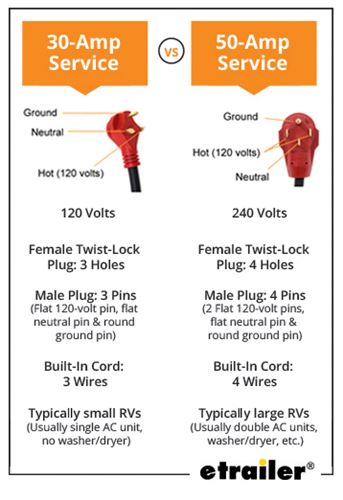
The workhorse for most travel trailers and mid-size RVs. Enough for the basics, but don’t try to run the A/C, microwave, and hair dryer at the same time unless you enjoy flipping breakers.50 Amp Hookup
For the big dogs. And no, it’s not “just 20 amps more.” A 30 amp has one hot wire. A 50 amp has two—that’s why the breaker has two handles tied together. The result? Up to 100 amps of usable juice. Translation: a 70-amp jump, not 20. That’s why big Class As can run multiple A/Cs, a full-size fridge, and still pop popcorn in the microwave without blacking out half the rig.
etrailer Pro Tip:
Don’t assume every campground has 50 amp service. And if they do, don’t be surprised if they charge extra just because they can.
2. How to Hook Up Without Looking Like A Rookie
What’s the correct order to hook up my RV to shore power?There is a correct order. Get it wrong, and you’ll be “that neighbor” in flip-flops running to the pedestal every 5 minutes.
Kill your RV breakers (and yes, turn off the A/C and microwave).
Make sure the pedestal breaker is off.
Plug in your cord—pedestal end first, RV end second.
Flip the pedestal breaker on.
Go inside and turn on your breakers one at a time.
Why the fuss? Because if your A/C, fridge, and microwave all slam on at once, the surge will trip the breaker faster than you can say “whoops.”
Do You Really Need a Surge Protector?
Yes. And not just for lightning strikes. The real win is circuit testing. Good surge protectors light up to tell you the pedestal’s wired correctly. No guesswork, no praying. And when a surge does hit, the protector sacrifices itself instead of your RV. Cheap ones die, pricier ones let you swap parts. Either way, it just saved your weekend.
3. Inside Your RV: Two Electrical Worlds
What’s the difference between RV 12V battery power and 110V shore power?
Your RV doesn’t run on one magic wire—it speaks two completely different electrical languages, and the converter is the translator that keeps them playing nice.110V AC (Shore Power)
This is just like the power in your house. It feeds the hogs: air conditioners, microwaves, coffee pots, residential fridges—basically anything that heats, cools, or hums loud enough to annoy the neighbors.
12V DC (Battery Power)This is the car-battery side of things. It runs the essentials: lights, water pump, fans, roof vents, slide-outs. The stuff that keeps you from being stranded or sitting in the dark.The Converter = The TranslatorEvery RV has one, and it does two jobs:
Takes 110V AC from the pedestal and converts it to 12V DC to run your low-power stuff.
Charges your RV battery at the same time.
It’s the traffic cop for everything electrical—if something dies, this is the first place you’ll be poking around.
110V vs. 115V vs. 120V — What’s the Difference?
None. They’re the same thing in practice. The grid actually swings between about 103V and 133V depending on where you are. Appliance makers just slap different numbers on the label. Don’t lose sleep over it.
etrailer Pro Tip:
The Refrigerator Nightmare: A lot of modern RVs come with full residential-style refrigerators. They’re great…until one fails. Here’s the catch: most of them won’t fit through your RV door. Manufacturers often slide them in before the slide-out walls are installed. Replacing one can mean hours of disassembly and creative cursing.
4. Common Problems (and How They Bite You)
What are the most common RV electrical system failures?
RV electrical systems are pretty reliable, but when they fail, they fail loud. Here are the greatest hits:
Burnt Plug EndsThe undisputed champ. Nine times out of ten, it’s a loose connection. Picture this: kids trip on the cord, bend a prong, and now it won’t seat all the way in. That tiny gap creates electrical arcing—little sparks that make massive heat. Result? Melted plastic, damaged outlets, and in a worst-case scenario, a fireHere’s the non-negotiable: if your plug or cord looks burnt, melted, or blackened, stop using it. Don’t just cut the end off and slap on a new one. The heat usually cooks the copper wire a foot or two back. The whole cord needs to be replaced or inspected by someone who knows what they’re doing.
12V Dead, 110V Still Works
Classic failed converter. Your outlets, microwave, and A/C keep humming along, but your lights, water pump, and fans are dead. That’s the converter’s job—to turn 110V shore power into 12V DC. When it gives up, all the “essential stuff” goes dark. Congratulations, it’s new converter time.
Running a 50 Amp RV on 30 Amp Power
Yes, you can use a dogbone adapter. No, it’s not just “less power.” Here’s what actually happens: a 50 amp panel has two separate power bars. A 30 amp pedestal only feeds one of them. That means half your RV is completely dead, and the half that does work is capped at 30 amps.
You don’t get to pick which half—it’s wired into the rig. So don’t make the rookie mistake of thinking you’re “just losing 20 amps.” You’re really losing half your circuits and squeezing the rest through a smaller straw.
5. Upgrades, Replacements, and When to Call a Pro
When should I upgrade my RV electrical system, and when do I need a professional?
Working on the 12V side of your RV? That’s usually fair DIY game. Worst case, you blow a fuse and mutter about it. Working on the 110V side? That’s a whole different animal. Done wrong, it doesn’t just trip a breaker—it can literally electrify the metal frame of your RV. Touch the door barefoot, and you’ve just turned yourself into the ground wire.
Here’s how the common upgrades and repairs break down:Lithium Battery UpgradesIf you boondock or camp off-grid, upgrading to lithium is one of the smartest moves you can make. They’re lighter, last longer, and you can actually use most of the power you store. But here’s the catch: your converter has to be lithium-ready.
If your converter is older than about 4–5 years, odds are it won’t charge lithium correctly.
Check the sticker. If it doesn’t explicitly say “Lithium/Lead Acid,” it’s not going to work.
In that case, you’ll need to swap the converter section—or sometimes the entire power distribution panel—to take full advantage of the new battery.
Replacing the Power Distribution Panel
This is almost never a simple one-for-one swap. Even if a new panel “cross-references” as compatible, it’s usually a different size. Which means:
Cutting a new, properly sized hole in your cabinetry
Sometimes adding a plywood cover to hide the old opening
Most importantly, tracing, testing, and labeling every single wire before you disconnect it
Skip that last step, and what should’ve been a 20-minute swap can spiral into an all-day troubleshooting nightmare.
When to Call a ProHere’s the blunt rule:
12V stuff (lights, fuses, batteries) ? Safe to tackle yourself. Worst case, it just won’t work.
110V stuff (shore power wiring, converter swaps, breaker panels) ? Call an electrician. The risk isn’t “it might not work right”—the risk is death.
A few things to keep in mind:
Lethal Danger: As the saying goes, “12-volt stuff you can get hurt. 110-volt stuff you can die.”
Manufacturer Support: Don’t expect companies to walk you through 110V installs on the phone. Liability rules. They’ll only deal with certified techs.
Hidden Dangers: You can wire 110V wrong in a way that “seems fine,” but in a fault, the entire RV frame could become hot. And since RVs aren’t inspected like houses, even brand-new rigs can have sketchy wiring from the factory.
Cost Reality: It’s always cheaper to hire a pro from the start than to pay one to undo your DIY experiment. Every electrician has the same story: fixing someone else’s mess costs double.
Do you need a special “RV electrician”?
Nope. The principles are the same as in your house. Any licensed residential electrician is qualified to work on your RV’s 110V system.
Conclusion: Don't Overthink It
What are the key things to remember about my RV electrical system?
Your RV’s electrical system isn’t out to ruin your trip—it just punishes shortcuts. Stick to the basics:
Know your pedestal (20, 30, 50 amps).
Kill breakers before plugging in.
Use a surge protector (cheap insurance + tester).
110V = big stuff. 12V = essentials.
Converter = the lifeline.
Burnt cords = replace, don’t patch.
Lithium upgrades need lithium-ready converters.
Leave 110V rewiring to the pros.
Get these right, and your time at camp is about cold drinks and working A/C—not barefoot breaker runs in the rain. Need help? etrailer has the parts and straight answers to keep your rig powered the right way.
About Sam C.Here at etrailer I spend my day working on trailers, fixing RV's, and building training aids/displays to keep all of employees up to speed on how things in an RV work! I'm also responsible for training all of our Customer Service/Content teams, so it's important I'm out doing things keeping up with changes in the RV industry. In my personal time I stay in my camper up at a large fishing lake here in Missouri with my wife, and am always doing something to it. It's a 2005, and I'm cheap, so I will keep it for as long as possible!