
 Product Experts Available Now!
Call 1-800-940-8924


Cold weather can make a generator or work engine harder to start when you need it. This 1,000-watt tank heater circulates warmed coolant through the engine, with a thermostat that cycles from 80F to 100F to help it start easier.
A standby generator may sit for days before it's needed, while a compressor or piece of agricultural equipment may spend winter nights in an unheated building. Cold engines take more effort to start, especially when temperatures stay below freezing. This 1,000-watt tank heater warms coolant and moves it through the engine before startup, helping reduce cold-start difficulty. It's designed for gas and diesel engines in generators, compressors, and agricultural equipment.
This tank heater uses a process called thermosiphon circulation. Cooler coolant enters the bottom of the tank, gets heated, and rises through the outlet hose toward the engine. As that warmed coolant moves upward, cooler coolant takes its place. There's no mechanical pump involved. The heater must be mounted low in the cooling system, with the outlet pointing up and a clear rising hose path, so the coolant can continue moving through the engine.
The built-in regulating thermostat switches the heater on when the sensed temperature drops to 80°F (27°C) and off at 100°F (38°C). That helps manage coolant preheating without continuous full-power operation. A separate safety thermostat with automatic reset provides additional protection against overheating. These settings control the heater's operation, not an exact temperature throughout every part of the cooling system.
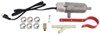
The tank has 5/8" inlet and outlet hose connections and comes with mounting brackets and hardware. The bracket arrangement allows mounting from the top or bottom of the unit, but the tank itself must stay upright with its outlet pointing upward. Mount it below the engine's coolant connections, away from engine vibration, and allow at least 12" of upward rise in the outlet hose. Check your equipment's cooling-system layout before choosing an installation location.
Zerostart is a Phillips & Temro brand, from a manufacturer that develops engine and equipment heaters. This model uses a one-piece, die-cast aluminum housing that resists corrosion and impact, along with a water-resistant terminal end cap and permanently attached 5' power cord. These details help make it suitable for installation in protected equipment compartments where winter conditions and regular equipment use are part of the job.
Install the heater as low as practical, preferably below the lowest point of the engine cooling system, with the outlet pointing upward as indicated by the arrow on the housing. Mount it to a suitable frame, firewall, or fender location rather than directly to the engine, where vibration can shorten heater life. Maintain at least 3" of clearance from nearby engine components.
Use appropriate 5/8" coolant hose and fittings. Connect the lower inlet to a low point in the cooling system and the upper outlet to a suitable higher point in the engine. Keep the outlet hose as short as practical while maintaining at least 12" of upward rise. Avoid loops, sharp bends, and routing over the top of the engine, which can restrict flow or trap air.
A 50/50 mixture of ethylene glycol antifreeze and water is recommended for proper heat transfer. Do not exceed 60-percent glycol concentration or use cooling-system stop-leak additives. Never energize the heater without the heating element fully immersed in coolant, as this can damage the element.
Allow the engine to cool before opening the cooling system. Follow the manufacturer's installation procedure for connecting the hoses, refilling the system, and removing trapped air. With the heater unplugged, run the engine as directed to check for leaks and verify coolant level. Trapped air can prevent circulation and contribute to heater failure.
The heater requires a properly grounded 120V power source and draws 8.3 amps. Use a suitable grounded, GFCI-protected connection and keep plugs dry and off the ground. Install the heater in a weather-protected location and route the permanently attached cord away from hot surfaces, sharp edges, and moving parts.
Do not start or run the engine while the tank heater is plugged in. Engine operation can introduce air into the heater, exposing the heating element and causing damage. Disconnect power before starting, operating, or moving the equipment.
 Alternate Instructions
Videos are provided as a guide only. Refer to manufacturer installation instructions and specs for complete information.
Hi everybody, Andy here with etrailer.com. Let's take a quick look at the Zerostart thermostatically controlled circulating tank heater. Now, when the temperature drops and the air gets really chilly, the last thing that you want is an engine that's going to struggle to turn over. This circulating heater is designed to make those cold starts effortless by keeping your coolant warm and moving. So when you're ready to work, your engine will be ready to work as well. On those bitter mornings, thick oil and cold metal can make starting your engine a chore.
But with this heater, the coolant is going to stay warm and circulating, helping your engine fire up quickly and run smoothly. So whether it's for your generator, compressor, or farm equipment, you're gonna be able to save your starter the strain, and skip the slow cranking altogether. You're gonna be able to plug this in and basically forget it, this is gonna plug into your standard three-prong household plug. It is grounded, of course. And this does have a built-in thermostat that automatically cycles the heat between 80 and 100 degrees Fahrenheit and a secondary safety thermostat with an automatic reset.
This is gonna give you an extra peace of mind, ensuring consistent warmth without overheating or wasting energy. Now this heater just isn't tough, it is made for real world use. It is one piece die cast aluminum, so it's gonna resist vibration and moisture, making it perfect for rugged job sites or long standby periods. And with the CSA and UL certification, you can count on reliable performance season after season. Installation should be pretty straightforward as well.
You get the hardware that you see along with the bracket and instructions to guide you through that installation process. And let me see if I can try to give you some measurements here. By the way, the wattage is gonna be up to 1,000 watts of heating power. So looking at the overall length, I'm gonna say that we're sitting pretty close to about 6 1/4 inches there. Kinda hard to see with that black against my shirt.
But yeah, about 6 1/4 inches. And then let's go for the height, bottom to top, about 7 1/2 inches or so on the height. Then the width, I'd say about 2 5/8 inches wide. Our cord is five feet long. The inlet outlet size is 5/8 of an inch. If you happen to have any other questions about this heater or anything else that we carry, don't hesitate to reach back out to us. We want to make sure that you're getting exactly what you want and need. Well, again, my name's Andy, thanks for joining me.
Ratings & Reviews

Info for this part was:
At etrailer we provide the best information available about the products we sell. We take the quality of our information seriously so that you can get the right part the first time. Let us know if anything is missing or if you have any questions.




















Thank you! Your comment has been submitted successfully. You should be able to view your question/comment here within a few days.
Error submitting comment. Please try again momentarily.