


What Can be Done to Prevent a 2000 Jeep Grand Cherokee from Overheating when Towing a Boat
Updated 08/02/2010 | Published 08/01/2010
Question:
Hi, I have a 2000 V8 4.7L Grand Cherokee Jeep.It has a factory installed class four hitch/towing package. Recently replaced radiator. I bought a new boat and now truck almost overheated going over local mountain pass-needle wnet into the red and I had to stop for 1 hr to let the engine cool down I see you guys sell a transmission cooler kit-D13504. Is this something I can add to my truck to help keep the engine cool/prolong my engine -I dont want to buy a new truck just to go over the mountain 2 x/yr Thanks
asked by: Antony E
Expert Reply:
A transmission cooler will not help your engine run cooler. A transmission cooler is a fraction of the size of an engine radiator. I would first check the vehicle owner manual to see what the towing capacity of the vehicle is. Make sure you do not exceed that figure with your boat. Doing so could damage any number of components on the vehicle such as the engine, transmission, suspension, rear-end etc.
There are some aftermarket parts available that can help so long as you are within the weight capacity of the vehicle. You can use a larger aftermarket all-aluminum radiator. Aluminum dissipates heat very quickly and a larger cooler with more surface area will allow more heat to dissipate off the engine coolant. You can also go with larger or dual electric fans that will pull more air through the radiator, again removing more heat from the engine coolant. I have added a link to our electric fan department below. CFM stands for cubic feet per minute. The higher this number, the more air the fan moves. Look for the fan or fans with the highest CFM rating that will fit your vehicle. You will need to measure the space on the back side of the radiator.
There is one more trick you can use to help the engine cool more efficiently. The coolant that flows through your engine block and the radiator is a mix, usually 50-50, of water and antifreeze. Water is what absorbs heat from the block, transfers it to the radiator, and the air moving over the radiator pulls the heat off. Antifreeze does not hold any heat. The only purpose of antifreeze is to keep the water from freezing in the winter.
In the summer, you can thin the mixture and use more water, say 80-20 water to antifreeze. This will provide more heat transfer from the block to the radiator. Make sure, especially if you are in an area that gets very cold in the winter, to return the mix to 50-50 or whatever is appropriate for your climate.


Product Page this Question was Asked From
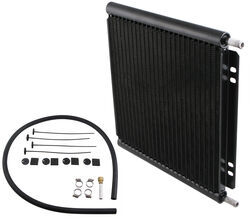
Derale Series 8000 Plate-Fin Transmission Cooler Kit w/Barb Inlets - Class IV - Efficient

- Transmission Coolers
- Plate-Fin Cooler
- Full-Size Truck
- SUV
- Standard Mount
- 11W x 12T x 7/8D Inch
- With 11/32 Inch Hose Barb Inlets
- Derale
more information >
Featured Help Information
Instructions
Miscellaneous Media

Continue Researching
- Q&A: Does Derale Series 8000 Require Additional Adapters for 2017 Chevy Silverado 1500
- Q&A: 2001 F350 7.3 Powerstroke Best Auxiliary Transmission Cooler D13105 vs D13504
- Q&A: Recommended Transmission Cooler for a 2014 Chevy Silverado 1500 with the 4.3L V6 Engine
- Q&A: Installing a Transmission Cooler on a 2010 Chevy Avalanche
- Q&A: Trailer Hitch Option For Motorhome With 39-1/2 Inch Frame Width
- Q&A: Best Way to Prevent Sagging Suspension When Towing a Trailer
- Q&A: What is the Difference Between Class IV and V Transmission Coolers
- Article: How to Measure for Trailer Hitch Drop
- Article: Brake Controller 7- and 4-Way Installation Kit (ETBC7)
- Article: Transmission Cooler
- Article: Brake Controller Installation: Starting from Scratch
- Article: Frequently Asked Questions About Transmission Coolers
- Article: 2 Steps for Finding the Right Weight Distribution Hitch Size
- Article: Breakaway Kit Installation for Single and Dual Brake Axle Trailers