Review the instruction sheet provided with the hitch.
Check the hitch attachment area of the vehicle. Do not attach a hitch to a vehicle which shows excessive corrosion or damage in the hitch attachment areas.
Take the appropriate safety precautions. When elevating the vehicle on a hoist or ramps, ensure that the vehicle is properly secured and blocked such that it will
not fall or roll off its supports.
Use the appropriate tools and wear safety glasses when drilling holes.
Prior to installation, it is a good practice to loosely assemble the hitch, install the
drawbar,
pin and clip, and hold the hitch up into position. This will allow identification of any
obstructions to the installation and verification of drawbar position on the vehicle and give an idea of how the hitch is to be installed.
Installation Steps:
In some cases, it may be necessary to temporarily loosen the
exhaust system and/or slightly reposition it to clear the hitch during installation, particularly on exhaust systems that have been replaced prior to installing the hitch, as all
hitches are designed using vehicle original equipment.
In a few cases, it may be necessary to adjust the bumper on a vehicle, or the brackets which mount to the bumper, in order to install the hitch.
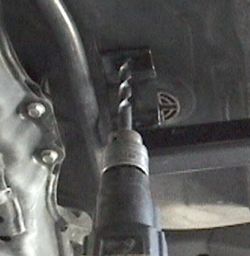
Hitches are designed to use existing holes. In cases where appropriate holes are not available, holes must be drilled in the frame. Holes can be drilled in the
appropriate places using the holes in the hitch as a guide.
When drilling, always center punch the hole positions and drill a pilot hole. This can then be followed with the appropriate drill size for the hole required.
When installing the hitch, be sure to use the reinforcing plates supplied with the hitch where appropriate in order to reinforce the frame and spread the load to the
frame edges.
All hardware, with the exception of handle or tab nuts and U-bolts is grade 5 or 8.8 (metric). Tighten all bolts to the torque levels specified in the instructions.
Before torqueing all of the bolts in place, make sure the trailer hitch is mounted symetrically to the vehicle.
Installation Tips:
A scissors jack or floor jack can be very useful in holding the hitch up in place. In many
cases C-clamps can be used to clamp the hitch to the frame during installation.
Clean out bolt holes. We recommend soaking the bolt holes on your frame with WD-40.
Then take a wire brush, and scrub out the holes to free the opening of road debris and grime. This should allow the bolts to fit more easily. Because the manufacturer of the
hitch will use the diameter required for your vehicle, the correct bolts should be included in the hardware kit.
Drill holes that are either the same size as the bolt or at the most 1/16" larger.
When drilling, be extremely careful to avoid drilling into vehicle components which are located behind where the hole is being drilled.
The hitch must have solid metal-to-metal contact with the vehicle attachment points. Excessive undercoating or weld on the vehicle should be removed.
Never modify the hitch in any way. Do not drill holes into the hitch to mount accessories, etc. Never cut holes or modify the assembly using a torch. This weakens the metal, produces a ragged hole, and presents an unnecessary fire hazard. Never weld a hitch to the vehicle frame.
Welding on the frame of the vehicle can weaken the frame.
Helpful Hints
Lowering the Exhaust:
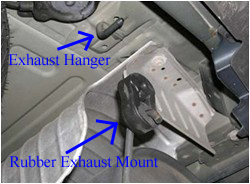
If WD-40 is applied to the rubber exhaust mounts prior to lowering the exhaust, the mounts will slide off the bracket more easily.
A flat screwdriver or pliers can also be used to pry the rubber mount off of bracket.
It is only necessary to remove the rubber mount from the vehicle frame. There is no need to remove it from both brackets.
Lower the exhaust when the vehicle is cold; otherwise the exhaust will be hot and can cause burning when lowering.
Do not apply too much pressure to the exhaust once it has been lowered.
If the vehicle has a custom exhaust system, the instructions to lower the exhaust might not apply to the vehicle.
Do not drill extra holes into the frame. This could weaken the frame of the vehicle.
Lift the hitch into place before drilling to ensure that the holes will be drilled in the appropriate place. The hitch can often be used as a template.
Use a drill bit that is the correct size for the hole. A drill bit that is too big will create a loose mounting point.
Do not drill into the hitch.
Make sure the drill bit is designed to drill into metal.
Avoid hidden vehicle components when drilling into the frame.
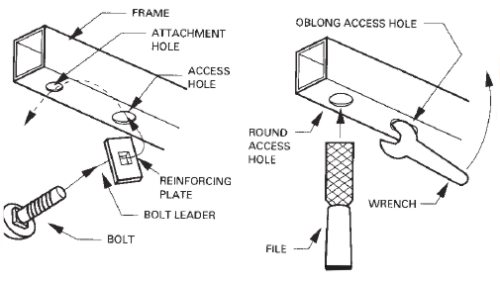
You can also use a drill to enlarge the access hole. This will allow for easier access for the bolt leader, spacer block, and bolt.
It is a good idea to fish the bolt leader through once before installation. This will let you know
how much clearance is available inside the frame rail.
Check the instructions to make sure the correct parts go on each specific lead.
Do not countinually pull on the wire if it gets stuck. If the wire is pulled too much the bolt will strip out of the bolt leader and can get lost in the frame.
If the wire gets stuck in the frame, lightly tap the frame with a hammer. This will help loosen the wire lead and bolt if it gets into a tight spot.
Once the bolts are in place, leave the bolt leader attached until the hitch is in place. Once you are ready to place the washer and nut in place, remove the
bolt leader.
This will prevent you from pushing the bolt back into the hole; or, if you do push the bolt into the frame, you can easily pull it back down.
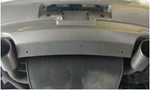
Before cutting fascia, mark where you plan to cut prior to actually cutting.
Use a new sharp pair of tin snips or a utility knife to cut the fascia
If you use a utility knife, do a series of light cuts first.
Make long cuts to lessen the amount of jagged edges from the cut.
Use 220-grit sand paper to smooth the edges.
Trailer Hitch Maintenance
Trailer hitches are powder coated; the way the manufacturer ships the products on pallets,
the hitches can get scratched because they are stacked on top of each other. Also, due to the nature of a trailer hitch, being exposed to the elements and constant road
travel, the hitch will have a tendency to rust. It is a good idea to periodically check a trailer hitch after it has been installed for any signs of rust. If the paint seems
discolored or looks like it has begun to rust, it is a good idea to repaint the rust spots on the hitch to help protect it. Any black spray paint will help to protect your
hitch.
Hitch Hardware
Carriage Bolts and Wrench Washers (Reinforcing Plates):
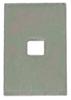
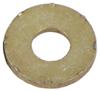
Many hitches use carriage bolts and special washer blocks or plates, which act as a wrench inside a boxed-in section of the frame to hold the bolt
during tightening. The plates also help reinforce the frame by spreading the load to the frame edges.
U-Bolts for Boxed in Sections:
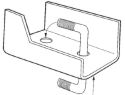
Another method used for boxed-in or enclosed sections of the frame is to use U-bolts. Make sure that the two nuts are drawn up evenly on the U-bolt
during installation. If one nut is installed at a time, the U-bolt may bend and break.
Handle Nuts:
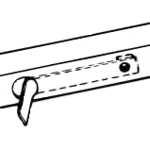
Some attachments to boxed-in areas are made with
"handle nuts." Inserted through an access hole, the handle locates the nut over the
hitch attachment hole and prevents the nut from turning when the bolt is tightened. Do not forget to trim off the excess handle or to bend it away from other wiring or other
components.
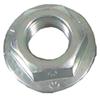
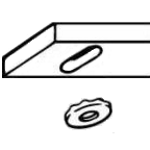
Prevailing-torque locknuts are used for certain critical attachments. These will not spin on freely, but will resist turning all the way on. Do not substitute a free-spinning nut where a locknut has been provided. Hardened washers with peripheral teeth are used on certain slotted
attachments. The toothed side should go against the slotted member as shown below.
Galvanic Isolators:
Prevent corrosive action between steel hitch components and aluminum attachment areas. Remove the paper backing and adhere the isolator to the hitch where indicated in the
instructions. Pierce the isolator with a screwdriver to allow a bolt to slide through.
Terri
5/2/2025
I added a tow package onto the rear of a minibus conversion, can you recommend which parts?
I have a NX300 Lexus and I want to add a tow hitch. Do I absolutely have to drill a hole? Is there another solution. And if not, will that make my car considered frame damaged. Because of the drilling of the hole.
I watched all the hitch videos. I have a 2023 equinox. In some pictures of the hitch (online not etrailer), it is mounted in the bumper space with a bezel. I do not see any videos installing it in the bumper space. Must it be installed under the bumper as all the videos show?
Unfortunately, at this time none of our hitch vendors offer a hitch fit that would place the receiver behind the bumper (like earlier Equinox models). Beginning with the 2022 model year, Chevy changed the rear bumper. The Curt # C98CR class III hitch is a fit, but the receiver would sit up against the underside of the bumper.
I got the etrailer trailer hitch Class 3 with 2" reciever. Item #e98849. If I get the bolts lined up under the bumper, the ones on the chassis is just off. If I get the ones on the chassis lined up, the others are off. I don't know how to adjust the bumper, tried but couldn't get it to move. The only thing I can see is to notch the holes on the hitch itself to make it fit. Any guidance would be appreciated.
@DwayneH, What is the year, brand, and model number of the vehicle you want to install on. Is this the stock bumber from the factory? Is any part of the hitch touching the spare tire?
@LesD I finally got it Les, but thanks for responding. The hitch had a flex in it, once I was able to get one side tightened up, I used a crowbar to get the other side close enough to start the bolts. Its all good now. Thanks for taking time to respond.
You'll need to check the instructions that came with the hitch. There are some general torque specs when it comes to bolts sizes and grades but the torque specs that came in the instructions for your hitch will be your best bet to make sure you're using it exactly how it was tested.
I have the Curt class 3 hitch (13591) and a 2011 chevy equinox. In one installation video they use the carriage bolts, square hole spacers & the fishwire technique when installing the center part. In the other video, they don't use these at all, just the same M12 bolts that are used on the sides.
Can you tell me the particular videos you're seeing. I linked the only install video we have below that we have for the Curt # 13591 on your 2011 Chevy Equinox, in which they simply use the M12 bolts on the frame rails.
The difference between the Class II and Class III hitches has to do with their Gross Trailer Weight (GTW), their Tongue Weight (TW), and their Hitch Receiver Size. Class II trailer hitch receivers have a 1-1/4 inch receiver and can be rated up to…
Hi Stephanie! Great question and you’re totally right to ask, because most hitches for the 2024 RAV4 do require a bit of bumper trimming. That includes the Oris Detachable Hitch #TS66VR, since it uses a hidden design that needs a hole cut in the…
Hey Frank! I'm not sure why it isn't showing up, we definitely still have the EcoHitch Hidden Trailer Hitch Receiver #EH92KR for your 2025 Kia Carnival Hybrid. This must be the one you were quoted since they only make the hidden with the…
Hey Barry congrats on the new SUV! The hitches for the 2025 Infiniti QX60 like item #C46DR are going to block the range of the sensors around the center of your bumper where the 2" receiver sits. You'll need to kick to the left and right to…
Hello Greg, I have an excellent option for you, but I’m afraid you’re right—the B&W Continuum Weight Distribution System w/ Sway Control #BW53FR is designed for a loaded tongue weight of 600-1,600 pounds. Even if you are only slightly over this…
Hey Roy, the EcoHitch part #EH35VR is a fit for your 2024 Toyota Highlander Hybrid and would be a great option. It's got plenty of towing capacity and also is mostly hidden so it looks nicer as well. For trailer wiring you'd then want the…
No, I am sorry we do not have any pictures or instructions of the Oris Hitches Detachable Hitch item #TS76VR installed on a 2024 Volvo XC60 Recharge. We haven't had an opportunity to install this hitch yet. What I do have, that I hope helps, is…
The Outpace 2 Bike Rack for 1-1/4" and 2" hitches #TH39SA is rock-solid, Chris. It uses a hand-tightened locking wedge inside the hitch, which tightens the shank directly to your receiver, no tools, no rattle. This is much better than a…
Hello Josh, thanks for reaching out. Yes, the Curt Class 3 Hitch #C22ZV will indeed fit your 2025 Toyota Tacoma. It is a no drill install and easily bolts on using the included hardware. It will be very easy to put on. Just 3 bolts on each side and…
Hi Eric! The Curt Trailer Hitch Receiver - Custom Fit - Class III - 2" #C77MJ will definitely fit your 2025 Toyota RAV4 Hybrid. I included a picture of it on a 2025 RAV4 Hybrid to 100% cement that absolutely certain fact. : ) For the wiring, I…
Hey Jason! We have a one option to add a class IV hitch to your 2023 Ford F-150. It is the Curt item #C26HR. This mounts below your factory hitch and will give you a 10,000 lbs towing capacity. The main draw back of this hitch is you won't be…
There is only one difference between the Curt Trailer Hitch Receiver #C13176 and etrailer Trailer Hitch Receiver #e98909 that fit your 2020 Chevrolet Colorado, which is the finish. The Curt trailer hitch has a glossy black finish while the etrailer…





















Terri
5/2/2025
I added a tow package onto the rear of a minibus conversion, can you recommend which parts?