


How to Find Your Tire Size if the You Can't Read the Sidewall Numbers
Updated 01/07/2021 | Published 01/04/2021
Question:
Hello, Im trying to replace a trailer tire. However the only information on the good tire the one we are replacing got shredded when it blew says Trailer Use Only. Not sure if this is just a really old tire, or if something else is up. How do I take measurements to get a replacement. I read through the information on your site and it looks like it should be simple, but either we have weird sized tires, or we are doing something wrong. Im guessing the latter. Overall diameter = rim + rubber Yes?
asked by: Bernadette S
Expert Reply:
In order to determine the sidewall numbers (your tire size), there are a couple of measurements and equations that need to be made, which could become a little complicated. I've linked to a help article that explains what each number/letter represents, but I will break down how we can get to that number.
Taking a number like ST175/80-R13, we can look at each piece to find out what to measure.
The ST is a letter that represents what a tire is used for (standard trailer, passenger, etc.), so yours will be ST.
The 175 above refers to the width of the tire (in millimeters) at the widest section. You will need to measure from inner sidewall to outer sidewall for this measurement, not counting raised letters ("Trailer Use Only" in your case).
The next number (80 above) is where things get complicated. This is a percentage that's used to get the height of your sidewall (from the top of tire to the rim). In this example, it's stating the height is 80% of 175, so the formula is Width (175) x Percentage (.80) = Height (140).
Since you don't know the percentage, you will need to work backwards after measuring the height. So, your equation would look like Height (140) / Width (175) = Percentage (.80).
Things get a little more complicated here because you won't be able to get the exact measurement of the height since some of it will be covered by the rim. There is a workaround for that, though, which I'll go into shortly.
The next letter in the example above (R) simply states if the tire is radial, bias, etc. You don't need to really worry about that for this. It's nice to make sure that matches the other tire, but it's not absolutely necessary.
Finally, the last number is your rim diameter (13 above). I've linked to a video of part # AM20750 that explains how to measure this, but you don't measure fully from the outside edge to outside edge since the tire doesn't "sit" there. Instead, you measure the inside edge (bead seat) to inside edge (bead seat).
Knowing about the bead seat now, you can add the width of the outer edge of your rim to the bead seat and find out how much of the tire height from above you weren't able to measure before. Add that to your height measurement and you should have almost exactly what the height is. For example, if you measured 3.5 inches from the top of your tire to the rim, and measure the outer rim to bead seat at .5 inch, you know that your tire height is actually 4 inches.
I know it can be confusing putting all of this together, so if you'd rather just measure and send them to me, I can get you the tire size you're looking for.


Product Page this Question was Asked From
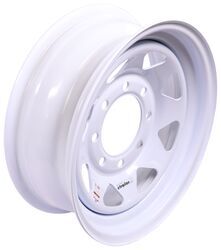
Dexstar Steel Spoke Trailer Wheel - 16" x 6" Rim - 8 on 6-1/2 - White Powder Coat

- Trailer Tires and Wheels
- Wheel Only
- 16 Inch
- 8 on 6-1/2 Inch
- Steel Wheels - Powder Coat
- Dexstar
more information >
Featured Help Information
Miscellaneous Media

Continue Researching
- Q&A: Need Spare Rim For Sailun S637 235/85-16 Tires On 2018 Forest River Cedar Creek Hathaway Edition 34R
- Q&A: Will 16 inch Aluminum Trailer Wheel have 110 PSI Rating
- Q&A: Correct Torque Rating for a Trailer Wheel Spindle Nut
- Q&A: What is the Offset of a Trailer Wheel
- Article: Best Air Bag Suspension 2025
- Article: Most Popular Wheel Bearings
- Q&A: Replacing Trailer Buddy 32220 Reverse Solenoid on Ranger Boat Trailer
- Q&A: What Size Lug Nuts Does Trailer Hub with 6 Lug Bolt Pattern Use
- Q&A: Troubleshooting Dexter Brake Actuator K71-651 Keeping Brakes On
- Article: Where to Position the Trailer Axle?
- Article: Trailer Wiring Diagrams
- Article: Brake Controller 7- and 4-Way Installation Kit (ETBC7)
- Article: Holiday 2025 | Best Gifts for Towers
- Article: How to Measure Your Trailer Wheel Bolt Pattern