


Recommended Safety Cable Quick Connect Links for 7000-lbs Trailer
Updated 05/23/2024 | Published 08/12/2020
Question:
My trailers safety chain hooks have a difficult time connecting to my hitch. The spots where the hooks couldnt connect easily. So I added the 5K links to the hitch and I connect my travel trailer hooks to the quick links. But since the trailer is about 7K in weight, is using the links a good idea?
asked by: Guy
Expert Reply:
You can use quick connect links, but the Tow Ready # 348749M aren't the best choice since they have a 5000-lbs break strength. Since you're likely using 10k chains, I recommend using the Blue Ox 1/2" Quick Link for Safety Chains # BX229-0512 which are rated for 10k and will provide you with a solution that you don't have to sweat being close to capacity on.


Product Page this Question was Asked From
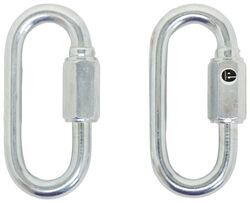
TowSmart Threaded Quick Links for Safety Chains - Qty 2

- Accessories and Parts
- Safety Cables
- Tow Bar
- Trailer Safety Chains
- Safety Cable Parts
- Safety Chain Parts
- Quick Links
- TowSmart
more information >

Continue Researching
- Search Results: tongue weight scale
- Shop: Suspension Enhancement
- Search Results: hitch anti~rattle
- Shop: Weigh Safe True Tow Weight Distribution Hitch - 2.5" Shank - 6" Drop - 18.5K GTW, 1.8K TW
- Search Results: 1/2 inch diameter trailer safety chains
- Shop: Brophy Figure Eight Coupling Link for 1/2" Chain - 11,900 lbs - Qty 1
- Q&A: Best Weight Distribution Hitch For 2026 Brinkley Z Air 297 Travel Trailer With 980 lb Tongue Weight
- Search Results: safety hook
- Search Results: shock absorbing trailer hitch ball mount
- Search Results: firestone 2709
- Search Results: ratchet straps
- Shop: Durabilt Safety Chain Connectors for 1/2" Chain - 12,000 lbs - Qty 2
- Shop: Curt Threaded Quick Link - 1/2" Diameter - 3,300 lbs
- Shop: etrailer Anti-Rattle Hitch Collar for 2" Hitch Receivers
- Shop: Replacement Roadmaster Quick Links for Safety Cables - 10,000 lbs Capacity - Qty 2
- Q&A: Best Weight Distribution with Sway Control for 2025 Brinkley Z Air 297
- Video: The Low-Down on the Replacement Roadmaster Quick Links for Safety Cables
- Shop: SumoSprings Rebel Custom Helper Springs - 2 Piece - Rear Axle
- Video: Comprehensive Review: Durabilt Safety Chain Connectors for 3/8" Chain
- Video: Weigh Safe True Tow Weight Distribution Hitch Detailed Breakdown
- Video: Installation of the B&W Continuum Weight Distribution System on a 2020 Ford F-150
- Video: Review of Brophy Trailer Safety Chains - Figure Eight Coupling Link - BR48MJ
- Video: How to Install: Durabilt Safety Chain Connectors for 1/2" Chain on your 2018 Ford F-250 Super Duty
- Q&A: What Weight Safe Weight Distribution to Use for 11,300 lbs GVWR Trailer
- Video: Quick Links Spec Review
- Shop: BOLT brand vehicle and hitch locks
- Q&A: How to Connect Gooseneck Safety Chains to Coupler With D-Rings
- Q&A: Will the Band Style TST TPMS Sensors Work with Factory GM TPMS for Trailers
- Q&A: How To Wire In 4-Wire Furrion Side Marker Cameras With Only Two Running Light Wires
- Shop: Gooseneck Hitch
Bob
5/23/2024
Eric, The Breaking Strength of chains, links, rope, etc. is inappropriate to use to determine suitability for a given application. It is the Working Load Limit, which is about 1/3 of the Breaking Strength, that should be used to determine suitability. If you are going to list the Breaking Strength at all, then you must always list the Working Load Limit next to it. To avoid safety mistakes it would be best to never even mention Breaking Strength. For example, etrailer lists the "weight capacity" (not an official term used to identify a load standard) for the Buyers Products 3/8" x 35" Class 4 Trailer Safety Chain w/ 1 Clevis Hook - 43 Proof Item # 337BSC3835 as 15,000 pounds. This is the Breaking Strength. A 3/8" Proof 43 chain has an industry standard Working Load Limit of 5,400 pounds that should not be exceeded in any application. Two of these chains would be safe to use with trailers up to 10,800 lbs NOT 30,000 lbs as stated in the product video! (At 4:47 the video incorrectly identifies the 15,000 lb Breaking Strength of these chains as their Working Load Limit). This confusion of Breaking Strength and Working Load Limit is likely causing many people to use your products in an unsafe manner. I don't know if etrailer could be held liable, but etrailer should err on the safe side for their customers regardless. Best Regards, Bob