


Thank you! Your comment has been submitted successfully. You should be able to view your question/comment here within a few days.
Error submitting comment. Please try again momentarily.


If you’ve ever struggled to get your trailer balanced, the True Tow makes it simple. The hitch has a built-in tongue weight scale that shows whether your trailer’s tongue weight sits in the ideal 10–15% range of your gross towing weight. Pair that with the free companion app, enter your setup details, and it’ll calculate your exact distributed tongue weight. Once you adjust the lead screw until the scale matches that number, you’ll be perfectly balanced and ready to roll—no guessing, no trial and error.


When you’re driving through crosswinds or getting passed by large trucks, trailer sway can make towing stressful. The True Tow’s built-in sway control uses tension and friction points to keep your trailer steady and your steering predictable. You’ll notice the difference right away, especially on long stretches of highway or gusty open roads. It keeps your setup smooth and stable so you can focus on the drive, not the trailer behind you.
This system is made for heavy-duty work. The hitch can handle up to 22,000 lbs of gross towing weight and 2,200 lbs of tongue weight. It’s built from high-strength steel for durability and features a rustproof stainless steel hitch ball that stands up to years of use. Every component is designed to hold up under pressure so you can tow with confidence on any haul.
The True Tow includes a 2" shank with an 8" drop and 8-1/2" rise, giving you plenty of flexibility for different trailer heights. The 1-1/4" height adjustments help you fine-tune the setup, while the sway control brackets mount 27"–32" back from the coupler. The top-mount design keeps the hardware easy to reach during setup. When backing or making tighter turns, keep the spring-arm limits in mind and disconnect them if your maneuver exceeds the system's recommended angle.
The hitch comes with a lock to secure it to your vehicle when you’re on the road or parked. It’s V5 and J684 certified for safety, so you know it meets strict performance standards. Once you’ve set it up, you’ll have the confidence that your load is balanced, secure, and ready for the miles ahead.


Videos are provided as a guide only. Refer to manufacturer installation instructions and specs for complete information.
Hello neighbors, it's Brad here at etrailer, and today, we're taking a look at the Weigh Safe Weight Distribution Hitch. Now this is gonna be available in a bunch of different configurations. The two families are going to be the middleweight and heavyweight, and within that, it's all dependent on the spring bars. There's different options available for your camper combo. Also, you can get a different hitch size. Here we have two inch, but also, if you have a larger truck, it has a two and a half inch, you can also get that.
A weight distribution hitch is using physics to distribute the weight that's normally on the tongue, which that's when you see that trailer weighing down on the vehicle, it's causing sag. And with these bars in place, that takes the tension off and distributes it via the axles and that way you get a nice even tow, but also that's gonna give you more weight capacity and just make that truck do a better job of hauling a somewhat heavy trailer. Another huge added benefit of a weight distribution hitch is going to be the anti-sway. You have friction on the spring bars where it attaches to the bracket on the trailer as well as in the head of the hitch, and that's going to translate to an anti-sway feature to where it's gonna wanna stabilize that trailer, so if you're hitting heavy gusts of wind or large trucks passing you and that trailer is swaying, this is gonna help even that out. Now while having this out on the road and testing it out, it did fantastic, and one of the things that I noticed or didn't notice compared to other weight distribution hitches is noise.
There's minor clunks, obviously, as you pull the trailer, but other weight distribution systems, when friction happens, the noise comes with that. So if you've ever heard someone pull into a gas station with a different style system, sometimes you hear that, "Eh, eh, eh," and it's not the most comforting sound, it's a lot of tension going on and it's perfectly normal, but that sure makes for it an annoying drive, a lot of noise. This one doesn't have that, this was beautifully quiet and overall just performed fantastic. Now most weight distribution heads are rather large, and a lot of times, I'll find that the ball is gonna be somewhere in this area where this one sits a little bit further back and I think that's a cool benefit because in our instance, with this truck and trailer combo, I'm still able to lower down our tailgate super close and you may not have that same instance with your combo, but the fact that we do have it is really nice, whereas normally that would never be the case. Now when towing, tongue weight is very important and a lot of people just don't have a way to measure it, there are tongue weight gauges out there, and in fact, if you've heard of Weigh Safe, a lot of times it's gonna be from their ball mounts that have that built in tongue weight gauge to make sure that you stay safe, and this one is no different.
This will actually tell you your tongue weight as well as your DTW, that way you can fine tune exactly where it needs to be, which is a really cool benefit when it comes to the install. A lot of the other weight distribution hitches are very simple and have a washer stacked up to get the proper adjustment, and unfortunately, if you set it up and it's a little bit off, you're gonna be taking that apart. Whereas this one, you're dialing it in and you have a visual representation to get it perfectly set up. So while we have this loaded, we have our DTW or distributed tongue weight and you'll see that it's at 1550, which we we inchesre able to determine based on using the app, which takes quite a bit of measurement here and there, but at the end of the day, it's going to perfectly fine tune it. Now if you need to know your tongue weight, you can just simply undo the bars and it's going to account for that as well.
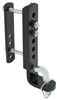
Now as far as our shank goes, when mounting up to our head, you can set this up either in a rise or drop configuration. So depending on your truck and trailer combo, you can get it all dialed in and you have a number of holes here in one inch increments to be able to adjust that. Now here we have a two inch shank version. If you have a larger 3/4 ton with the two and a half inch receiver, you can also get that, so that way you can match it up to your truck and it's gonna stay in place with a locking pin and clip that is included, super nice. And these can also be keyed to light so if you have other Weigh Safe, you know, locks, you can get the same key to be able to unlock all of those. Now the two families of the weight distribution hitch from Weigh Safe, we have a middle weight and then a heavy weight, and in between those, there's different spring arms that are gonna allow you to get closest to your max gross trailer weight rating. So today, on our trailer, we have the 8,500 spring arms, you can also get a 12,500, in the heavyweight configuration, you can get either 18.5K or 22K, and again, that's just gonna go with your gross trailer weight rating. And all the tongue weights are going to be that 10% of those, so for our 8,500 pound spring bars, tongue weight's gonna be 850, so on and so forth as those numbers go. Now something you're gonna wanna consider before getting this weight distribution hitch is checking your frame. If your frame is taller than six inches, this is not gonna work for you because our spring arm brackets, the maximum distance is going to be six inches, which we have here. Other things to take in consideration, depending on your trailer and how everything's mounted up, you may have propane tanks or a battery tray or something along those lines. What you're gonna be looking for is from the center of your coupler back on your frame, it should be 32 inches is the max, and that's what we have here, that's the most ideal, and the minimum is 27. So you have a little bit of adjustability, but if you do have anything in this way, you may have to modify and get those moved out of the way to get your brackets properly mounted. It does come with a 2 and 5/16 ball, which seems to be the most common when putting a weight distribution hitch on a trailer. A few more considerations to take into account is if your safety chains or your breakaway switch or electrical connections are pretty tight, this is something because this extends back a little bit further, you may need to get some extensions for those so it doesn't bind up when driving around. Now a downside to some weight distribution hitches in the market is you cannot back up which really cuts down on being able to, you know, get into tight spots or, you know, kind of have to navigate through a parking lot. So that's something that is frustrating, but this one you can back up. It's not highly recommended to do it too often because you wanna make sure, if you are backing up, you're on a nice flat level spot, you know, any massive changes in grade can cause some binding in here and, you know, you got a lot of weight that's suspended due to friction. And so, when you're going into those different grades, that's gonna bind this up a little bit and not be great for it. So you do have the ability to back up, just make sure you're on flat ground, but still a huge benefit to some of the other ones that you cannot back up with. Now a lot of times, people will ask the question, with weight distribution, can you also have airbags on the truck to account for the squat Well, the squat is still going to be there a little bit, it's not gonna completely get rid of it and that's completely normal, but you are getting that tongue weight to be a little bit more supported and our truck today actually has airbags installed on it and I recommend roughly about 10 PSI in the bags just to kind of fill that up to where the suspension's not gonna squat, you don't wanna overinflate that, but these are gonna work well together. Now while using your Weigh Safe, you do wanna periodically do some maintenance and this makes it super easy. You have Zerk fittings at the top, you also have this cap to keep it all pretty well protected, but having Zerk fittings makes it super easy there. And then, on the bottom side, you're gonna wanna put some grease, just know when you are getting this whole head assembly and all the grease is down below where the spring bar's attached, so you may get some grease on your hands in the process, but it does come pre-greased. Just make sure that you're staying on top of the maintenance as you use it. Now as far as the installation goes, compared to a lot of the other weight distribution hitches that I've done, this is one of the easier ones to do. I like the fit and finish and just it's very well thought out, it's actually a good looking system. Some of the other ones are very utilitarian, and overall, I think it's a really easy one to do. I was able to get this set up, you know, being on camera, it does extend the length of it, but you could probably do this in about two hours. Just make sure you have a flat level spot to do it, it's minimal tools required, there's no drilling, it all bolts up and it's just pretty straightforward. Now you are gonna need to download their app to calculate the numbers to be able to dial in your DTW, but it really is a super easy app to use. Some of the things you may wanna take a look at is taking your trailer to maybe a scale to see exactly what it weighs, that we can really get it dialed in. Otherwise you'll get pretty close, but if you're gonna set it up once, you might as well get all those numbers, you know, spot on. As far as the installation goes, follow along, I'll show you how to get this installed on your truck and trailer combo. Now the first thing you're gonna wanna do is scan the QR code to get the app and that way we can dial in all of our measurements that we're gonna be getting. You're also gonna want to get your truck and trailer combo on nice flat level ground and we're gonna get our shank in place. So this is a little bit longer than your traditional ball mount, so you may have to raise this up, decouple, and then give yourself a little bit of extra room to be able to get this ball mount in place. But we'll go ahead and do that and then get it all hooked up. Now we're gonna be installing this just as it came out of the box. So as far as height goes, as long as it's somewhat close, not to worry because we just need the tongue weight and we'll be using that scale. And then, once we get that, we're gonna be adjusting the height. So the main thing is is just get this in place and lined up ready to couple. Regardless of what kit you have, all the installation's gonna be essentially the same. What's really nice, we have our locking pin and clip, and this is really great because you can get this keyed alike with all of the Weigh Safe locks, that way you can use one key to be able to unlock all of those. We have ours securely in place, so with our app open, we're gonna lower this down and take a look at our tongue weight. (machine whirring) And with our jack raised up off the ground, we're gonna take note of where our gauge is. With our tongue weight, we can see on our scale, it's a little over the 600 range, so we're gonna go with 625. So we're gonna put that in and we'll have that noted. Now at this point, we can raise it back up and we're gonna want to get our trailer as level as possible so once we get it raised up, we can measure from the frame. Now while we're measuring and getting our trailer level, it's a good chance to take a look at what the gross trailer weight is gonna be. Now this is something you're gonna wanna check when it's fully loaded, ready to go out on the campsite, exactly how you're gonna have it going down the road. So ours is rated at 7,500, I would imagine we can add a little bit more than that, we'll shoot for about 8,000 and we can plug that into our app. Now once you got your tongue weight rating, we're also gonna be plugging into the app the actual trailer weight. And the way to kind of get a close weigh without going to a scale is take your gross vehicle weight rating, this is gonna be the max that it can hold, which is 7,500 pounds in our case, and then, the weight of the cargo should never exceed 1205. So determining our dry weight is as simple as taking 7,500 minus 1205. So let's put that in the calculator and that puts us at 6295. Now with that being said, normally your tongue weight rating is gonna be 10 to 15% of our actual trailer weight and that could really come down to maybe it's loaded up a little heavier in the back, so really trying to get this dialed in as far as how you store things is gonna be key and also going to a scale is definitely gonna be a more accurate representation. So with that being said, we can put a little bit of extra weight here just to kind of account for anything they've loaded and we'll just say 300 pounds for now. So 6595, we'll go to 6,600, so we'll plug that in. Now we need to get our trailer as level as possible, so using a bubble level on our A-frame here is gonna help us get us pretty dialed in, you can also measure from the ground to the bottom of the frame in the front and back of the trailer to get this dialed in. So I'm gonna do a combination of both, I'll get our bubble level pretty well spot on, and then, double check our measurements. (machine whirring) Now with our trailer all leveled out, we're gonna measure from the ground to the bottom of our coupler, and this is gonna help determine where we need to raise our ball. It's also gonna clearly determine if we need a rise or drop, in our situation here, we're probably gonna stay in a drop, just move up a little bit. But getting our measurement here, we're gonna be right at about 22 and 3/4. With our 22 and 3/4 height, we're going to get our ball set up by adjusting potentially the holes here on our riser drop. So we're obviously in a drop position, this is gonna put us at a good spot and to get our measurement from the ground to the top of the ball, we're gonna want generally about an inch to two inches above the measurement of the coupler height. Another good rule of thumb is for every a hundred pounds of tongue weight, you can add an eighth of an inch. So measuring here, we're coming in right at about 24 and 1/4, so I think that's gonna be a good spot for us. So at this point, we'll get this torqued down, we'll make sure to use our flat washer, our split washer, and then, our nuts. You can find the torque settings located on this sticker. Now with that torqued in place, we can go back to our app, and at the edit tab, we're going to go to our drawbar position, which we have it in a drop. And visible holes, we have one, and well, we'll call that a half, so one and a half, we'll save that and then make sure everything's good there. Now we need to get some measurements for our brackets. We're gonna go from the center of our coupler to 32 inches back. Have a paint marker ready and you can mark your spot. We'll go to 32 inches and we'll mark that with our paint marker. We're gonna be doing that on the other side, now if you're into any issues, whether it be a battery box, propane or something along those lines in that 32 inch mark, you can move it up a little bit. The minimum is gonna be 27 inches, so you may have to get creative and move some things around, but 32 inches is gonna be the standard and the maximum that we're looking for. To get our side brackets installed, you're gonna have the long carriage bolts and we'll have this channel and the flat plate. You'll see at the top, there's a space, this is going to go on the top portion. So we'll just take a split washer and then a nut, and we're just gonna get a few threads started. And when we drop this down, the middle of our bolt should align with that 32 inches. So just drop this. Now when you slide this down, make sure that you're not pinching any wires in the process. We'll then take our other carriage bolt and you're gonna put it to the highest portion that you can go to. So this is gonna be for a minimum of frames that are gonna be, or the max is gonna be six inch frames that you can use this on. So in our case, we really don't have any other options of where we're gonna run this, so we just pass this through and then we'll finish up the backside with the split washer and the nut. Those hand tight, we're just gonna make sure our bracket stays in place and we're gonna snug down the nuts with a 3/4 inch socket, we're gonna be coming back with a torque wrench, so no need to get crazy here, but we wanna make sure that it's holding in place. (wrench clicking) And I would alternate, go top, bottom, and then, top, bottom, just kind of work it back and forth so it evenly gets dispersed. We'll do the same thing with the torque wrench. (tool banging) For our L brackets, we're gonna get these in place, we need to make sure that we're nine inches from the top of this to the top of the coupler. So measuring down nine inches from the top of the coupler height, should put us where the top of our L bracket is, and I've gone ahead and done that and it puts us right here. And once you're at that spot where you're happy with that nine inches, you'll then pass your carriage bolts through (bolt clinking) and then we'll finish it up with split washers and the nuts. And to make it a little bit easier to get that nine inch measurement, generally the top of your coupler is pretty close to the top of the frame, so just kind of account for the difference. Ours is maybe about a 1/4 to 1/2 an inch. So as I measure down here, that's putting us just about perfect. Now we'll just snug down the carriage bolts with the 3/4 inch socket and eventually we'll use our torque wrench and you'll see that they have that torque setting printed on the spring bar bracket. Once we get these torque done, we're just gonna repeat the same steps on the other side. Our next step, we're gonna get our spring bars in place, so keeping the stickers to where they're gonna make sense, reading it from the outside. We'll slide this in and we'll get our pin put in place from the outside in. Now I did struggle to get ours to feed through in the beginning, I think it's just because it's new and there's powder coat. So if you need to, you can run a drill bit through there just to kind of clear out those burrs. And from here, we're gonna take our arms and they're gonna be pretty stiff, but we're gonna get this as perpendicular as possible. And then, we'll just repeat on the other side. Now, if you haven't already used the app to get your gross trailer weight rating, go ahead and do that. But then if you haven't already hooked up your truck, you're gonna back it up, get this lowered down, and we're gonna latch up the coupler. (machine whirring) Now you're gonna want to get your app ready again because we're gonna be doing three measurements, and the first one we'll do is from the front of the bar closest to the vehicle to the center of the axle. So if you use the center cap of the wheel, that's generally gonna be a good spot. And for all of our measurements, we're gonna be measuring on this front side, so just make sure you keep that consistent. We have 57 inches, so I'll input that into our app. Our next measurement is going to be from the front face to our spring bar connection. So we're coming up with right at 30 and 1/8. Our last measurement is gonna be from the front of the spring bar to the center of our trailer axle. Now if you have tandem axles, you're gonna split the difference and go right in between those two wheels. And measuring this up, we're looking at 240 inches. So we'll save this, we'll go back, and at this point, we should be able to calculate. So this is going to give us our target pounds, which is gonna be 1550 in our case, so we'll keep that number handy. Now we'll take our spring bars and we're gonna move these closer to the bracket. We don't wanna make any contact with that. And then, with it coupled, we're gonna raise this up completely. So you'll just kinda get this to where it's gonna raise it up, this is why it's important to make sure that it's coupled properly. And we're gonna see that our spring bars are gonna raise up above those spring bar brackets, which is what we're looking for. (machine whirring) Now, we should be able to just slide these over to where we can get our L brackets in, we may need to lower this down to be able to get this cinched in place. Now if you're struggling to get this in place, there is the pry tool that's gonna allow you to take the hook and pry that in. Obviously, we don't have that issue, but it would be something along these lines to raise that up and get it into place. So I've got both of my bars in place, I'll lower this down and get 'em pinned up. (machine whirring) Take our cotter pin and put that in the bottom of our L hook. (machine whirring) Now we're gonna be adjusting our screw up top with either the 3/4 inch socket or on the end of our assist bar, you can use this, it has the 3/4 inch attachment here, but we're gonna dial this in until we reach the DTW, which is the distributed tongue weight that we found calculated in our app. Now our target is 1550, so I'm gonna turn this, and every couple turns, you're gonna wanna just bounce the trailer around, just kinda getting friction points out to really get a true measurement until we reach our 1550. (wrench clicking) Once we've reached our DTW safe zone, we're gonna torque down our clamp bolt. With that torque down, we've officially set up our trailer to have weight distribution set up safely with our Weigh Safe, all you need to do is get your safety chains hooked up, your electrical connections, bring your jack back up, and then you're ready to hit the road and see the difference that this is gonna make. The great part too is, once you set this up, you know, if you have the same trailer combo and you're not overloading it any different than normal, you're gonna be ready to go. All you'll have to do is hook up the ball and get your spring bars in place each time you use it and then you're ready to go. And that was a look at the Weigh Safe Weight Distribution Hitch.
Customer Satisfaction Score:
88% were satisfied with this product
12% of customers were not satisfied
Ratings & Reviews


Gwendolyn Y.
4/23/2025
Your set up looks great, Justin! I'm happy to hear that Tiffani was there to help you out with everything that you needed. Have you taken your camper to any fun destinations yet with the Weigh Safe system on it now?

Kate F.
4/15/2026
I’m a bit surprised to hear that, Caleb. I’ve personally installed quite a few of these, and I’ve been impressed with how well the Weigh Safe system performs. This makes me think there may be something else going on. Do you know your trailer’s total loaded weight and your loaded tongue weight? Ideally, tongue weight should be around 10–15% of the total trailer weight. If the trailer isn’t loaded correctly, even the best weight distribution hitch won’t be able to fully control sway.

Brooke M.
2/15/2025
Well Im glad to hear that its a so far so good situation. :) If youd like to add photos to your review once you have it installed, wed love to see them! Thanks, Tom.
Tom O.

2/13/2026
I’ve now towed twice across the United Statesin all kinds of wind and weather. I like that I can measure and keep an eye on the rouge weight. We haul a 33’ ORV Blackstone which has a GVWR of 11,000 and we average around 9,840, with a tongue weight of 1500 due to the trailers wheel base design is long being a rear kitchen unit. On my F250 I can have a GCWR of 21,800 and Max Payload of 3,233. The truck handles the trailer quite well. That said the hitch also works well 90 of the time. No problem with hills and backing, or passing Semis. I due wish there was a bit more control in heavy side winds I experience traveling primarily north and south in the fall. We travel from Western NY in September to Michigan, then south to the Carolinas, and across country to Yuma Arizona over a couple months, then North into Montana and then again back to NY. The hitch is a beast and its heaver capacity over my old hitch is a definite improvement. I do recommend the hitch but be totally aware of your vehicles tow capacity and limitations.
Tim
2/10/2026
I like this hitch but it is very heavy, the head weights 70 pounds by itself so if you have a bad weak back, this probably isnt the hitch for you. I do recommend getting a hitch connecting tool, it attaches to the ball and assists ing into the truck receiver.
Ryan
4/14/2026
Weve towed several times now with no issues. App is easy to use to calculate pre-load settings.
Do you have a question about this Weight Distribution Hitch?
Info for this part was:
At etrailer we provide the best information available about the products we sell. We take the quality of our information seriously so that you can get the right part the first time. Let us know if anything is missing or if you have any questions.



















James D.
5/27/2026
Hey George, we definitely understand the frustration with the app compatibility and difficulty reaching support for assistance. The good news is the hitch does not rely on the app to function. The gauge and weight distribution system are mechanical, so you can still set it up correctly without the app. The method to set it up the traditional way: Measure the front wheel well height before hooking up Hook up the trailer Tighten the WDH until the front suspension returns close to unloaded height That restores proper front axle weight and gets the hitch adjusted correctly regardless of what the app says. Let me know if this helps.