


50A to 30A Y-Cord with 30A Pins Wired to Separate 50A Pins
Updated 07/11/2019 | Published 07/10/2019
Question:
Observation: It seems that some 50A male plug to two 2 30A female receptacles Y adapter cords are wired internally using only one hot pin leg of the 50A plug to supply power to both 30A female receptacles. Such a wiring arrangement places all the loads connected to both 30A female receptacles to only one hot leg of the 50A male plug, thus defeating the purpose of the 50A plug to supply 120VAC split phase A and B power to balance and carry more loads. If a voltmeter test lead was placed on the hot leg of one 30A female receptacle and the other test lead on the hot leg of the other 30A female receptacle and zero 0 volts, this would confirm these cords with this type of internal wiring arrangement i.e., wired to only one hot leg on the 50A plug. Ideally, one 30A female receptacle should have its hot pin connected to one hot pin of the 50A plug and the other 30A female receptacle to the other hot pin of the 50A plug. Therefore, if the same voltmeter test was done on this internal wiring arrangement 240VAC should be displayed. Question: Which 50A male plug to two 2 30A female receptacles Y adapter cords are wired internally for the ideal condition, i.e., both hot legs of the 50A plug are used to separately supply phased power to each 30A female receptacle.
asked by: Renee-Nicole D
Helpful Expert Reply:

I reached out to my contact at Mighty Cord and they confirmed that the Mighty Cord RV Power Adapter Y-Cord - 50 Amp to 30 Amp # A10-50X30Y is configured to that both hot legs of the 50A plug separately supply phased power to each 30A female receptacle. This configuration results in one 30A female receptacle hot pin being connected to one 50A hot pin plug and the other 30A female hot pin being connected to the other 50A hot pin plug as the customer requested.
Attached is a review video for you to reference.


Product Page this Question was Asked From
Mighty Cord RV Power Adapter Y-Cord - 50 Amp to 30 Amp
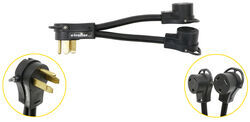

- Generator Plug Adapters
- Y-Adapter
- 30 Amp to 50 Amp
- 1 Foot Long
- 50 Amp Male Plug
- 30 Amp Female Plug
- Mighty Cord
more information >
Featured Help Information
Miscellaneous Media

Continue Researching
- Q&A: Will The Victron SmartShunt Battery Monitor VN43ZR Work On A 24v Lithium Battery?
- Q&A: Is 72" Wide the Bracket or Sofa Measurement on the Thomas Payne RV Jackknife Sofa TP88KR?
- Article: 30-Amp and 50-Amp RV Service: What's the Difference?
- Q&A: Correct Installation Height for B&W Companion BWRVK3700 5th Wheel Hitch
- Q&A: How to Find Best Height Setting for B&W Companion on 2023 GMC Sierra 3500 with OEM Puck System
- Q&A: Adapter For 2025 Chevy 2500HD Pucks To Use B&W Patriot Sliding 5th Wheel Hitch
- Q&A: Can The PowerMax Wireless 50A RV Power Center and Distribution Panel PM77VR Be Mounted On Its Side?
- Q&A: Wiring the Roadmaster InvisiBrake on a 2026 Ford Maverick
- Article: How to Measure for Trailer Hitch Drop
- Article: How Much Solar Power Do I Need For My RV?
- Article: 4 Reasons Not to Use RV Solar Power (And 4 Reasons You Should)
- Article: Aftermarket Brake Control Wiring for 07-13 GM Full-Size Truck with Factory-Integrated Brake Control
- Article: Trailer Wiring Diagrams
- Article: Trailer Lighting Requirements