


How to Prevent Trailer Sway
Updated 06/03/2025 | Published 07/04/2015
Question:
Looking for sway control possibly with weight distribution. It seems to make sense to purchase a product with both systems as a single unit as opposed to purchasing a sway control product separate from a weight distribution product. So I guess that is part of my dilemma as I dont have to much budgeted for a solution. I think the sway control is probably more important. I am trying to stay away from drilling into my frame and I see that I will need a new mount or mount adapter if I use the friction sway control. I am trying to distinguish from all the different products. Can someone whelp me narrow it down? Thanks,
asked by: Peter
Expert Reply:
To fight trailer sway your best defense is proper trailer loading. If you can load your trailer so that 10 to 15 percent of the total weight of the trailer is tongue weight you will be doing well.
Sway control can help with sway from intense wind or from a passing semi-truck, but it will not fix a trailer that wants to sway at a certain speed.
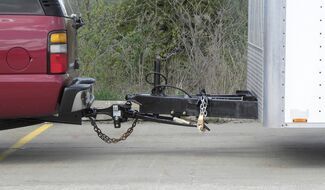
Weight distribution will take some of the tongue weight and actually distribute it back up to the front axle of the trailer which will also help with sway. It will also help with sagging rear suspension and improve handling/braking.
Without knowing what you are trying to accomplish it's hard to say what would be your best bet, but a weight distribution with sway control would be a great option
The best way to pick out a weight distribution system is to base it off of the loaded tongue weight of the setup when it is loaded and ready to tow. This figure also includes the weight of any cargo behind the rear axle of the tow vehicle. I attached a help article on determining tongue weight for you to check out as well. You will want the loaded tongue weight of your setup to fall right in the middle of the tongue weight range of the system you use.
I attached a couple help articles for you to check out. A Strait-Line system like part # RP66083 would be great if your tongue weight fell in it's range of 400 lbs - 800 lbs.


Featured Help Information
Miscellaneous Media

Continue Researching
- Article: How to Measure for Trailer Hitch Drop
- Q&A: When to Replace Trailer Tires Due to Age and Deterioration
- Article: Determining Trailer Tongue Weight
- Shop: Trailer Wiring
- Search Results: trailer tool box
- Article: 5 Tell-Tale Signs It’s Time to Replace Your Trailer’s Leaf Springs
- Shop: Fusion LED Combination Tail Light Bar for Trailers Over 80" Wide - Submersible - Red/Clear Lens
- Video: The Low-Down on the DeeZee Specialty Series Trailer Tongue Tool Box
- Video: The Low-Down on the Buyers Products Trailer Tongue Toolbox
- Video: A Closer Look at the Buyers Products Trailer Tongue Toolbox
- Shop: Buyers Products Trailer Tongue Toolbox - White - 18 x 19 x 36
- Shop: DeeZee Specialty Series Trailer Tongue Tool Box - A-Frame - Aluminum - 3.71 Cu Ft - Silver
- Search Results: rv power inverter
- Shop: etrailer eDream RV Mattress - Innerspring - 80" Long x 72" Wide - King
- Shop: RV Mattress
- Shop: Suspension Enhancement
- Article: 5 Things to Know About Weight Distribution Hitches
- Shop: Universal Installation Kit for Trailer Brake Controller - 7-Way RV and 4-Way Flat - 10 Gauge Wires
- Search Results: truck tool box
- Article: RV Maintenance Checklist
- Search Results: rv awnings
- Search Results: air shocks
- Article: Tire TLC: How & When to Check Your RV/Trailer Tire Pressure
- Video: Comprehensive Review: Optronics Mini LED Trailer License Plate Light w/ Chrome Housing
- Video: An In-Depth Look at the Buyers Products Trailer Tongue Toolbox
- Video: Optronics Mini LED Trailer License Plate Light w/ Chrome Housing Feature Review
- Shop: Optronics Mini LED Trailer License Plate Light w/ Chrome Housing - 2 Diodes - Rectangle - Clear Lens
- Shop: Buyers Products Trailer Tongue Toolbox - Black - 18 x 19 x 36
- Article: Brake Controller 7- and 4-Way Installation Kit (ETBC7)
- Video: Installing the Firestone Ride-Rite Air Helper Springs on a 2025 Chevrolet Silverado 3500
Paul
6/3/2025
One very common fault is to have the hitch ball too high. The trailer should be level or hitch down. Hitch up will cause bump steer in the wrong direction with most suspensions and cause the trailer to weave uncontrollably.