


Camp off grid for a long weekend with this complete solar kit for your RV. Gives you 800 watts of solar power generation with an efficent MPPT solar controller. Includes a powerful, all-in-one pure sine wave inverter charger.
Features:
Individual Component Specs:
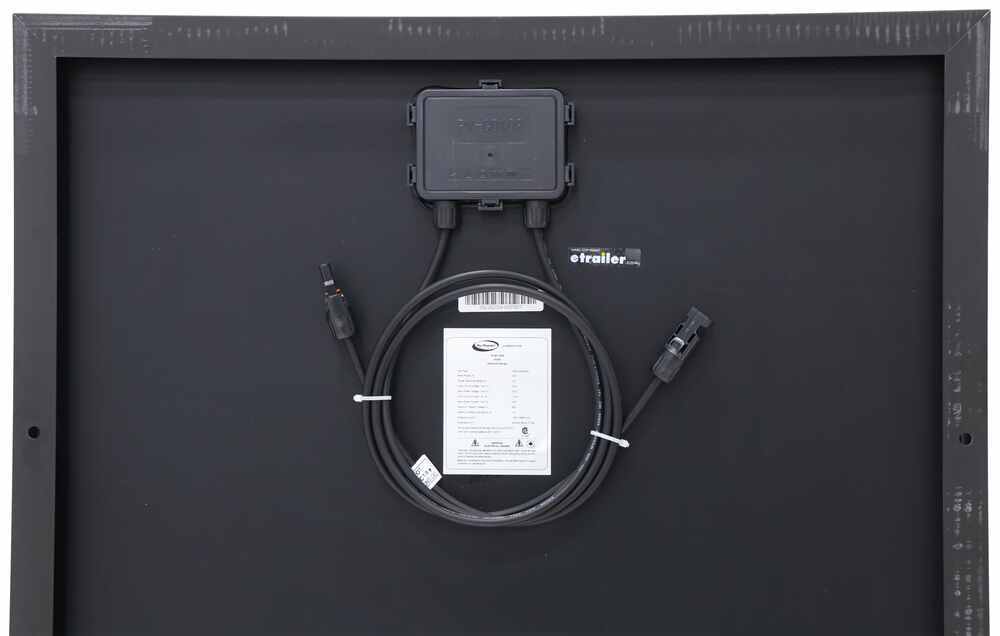
Solar panel
Solar controller
Inverter charger
Fuse block
This kit is perfect if you're looking for a strong foundation to add on to later. That's because the MPPT solar controller functions with greater efficiency than a PWM solar controller. Basically, a MPPT solar controller can convert excess voltage into amps, charging your battery bank faster.
MPPT controllers are great for large solar panel systems, but PWMs are more cost effective and work great for smaller systems. It's not worth investing in MPPT if you have modest energy generation.
Since the Go Power PowerTrack kits come with advanced components, you'll have a lot of room to grow. All you'll need is another Eclipse expansion panel (GP47MR). It includes all the hardware and branch connectors needed to add on another 200 watts of power per panel. With this kit, you can add on 2 more panels to get as much as 1,200 watts of solar capability.
Videos are provided as a guide only. Refer to manufacturer installation instructions and specs for complete information.
Hello, neighbors. It is Brad here from etrailer. And if you've looked at adding solar to your RV or overlanding vehicle or any camper, power becomes super important when on-grid, off-grid. And Colin from Go Power! is gonna walk us through, well, a lot of things to help get you to what you need, all the different parts that go into solar. 'Cause it can be a little bit overwhelming. Collin's made it super easy.
So I'm gonna let 'em take it from here and kind of break it all down for us. Yeah, you bet. Of course. Welcome, everybody. So we're basically gonna go over what a solar system is, what the products that that you need for it are, and kind of how everything works together.
So a really good way to do it is we're gonna start off with this, how does a mobile power system work We're gonna use what's called our gas analogy or our fuel analogy. So everybody knows how a fuel system in a vehicle works. You fill up the gas tank, you press the accelerator, the fuel lines, the gas goes through the fuel lines through the fuel shut-off valve to the engine, and then you're on your way. We're gonna use that 'cause it makes a little more sense to people on how a solar system works. So our gas station and our analogy here is our solar panel.
So this is 100 watt solar panel right here. This is where all the power is gonna come from. That fills up your batteries. So a solar panel is basically made up of silica cells, and those silica cells act as kind of like a, the power for the solar panel. So the Sun has little molecules called, or particles called proton or photons.
They hit the solar panel here. The electrons then come out of the photon, they go into the copper on this wiring here, and then you create power. The power then flows down in through this junction box through the wires, and then that flows down through your system. So you need this sucker right on the top of your RV. We have portable ones as well. But this guy is gonna create all the power that you need. and I call this the cheapest fuel pump in the world because once you buy this, all your energy's free after that. We're gonna flow down right now from our solar panel to what we would call in our analogy here, our fuel shut-off valve or our solar controller. So our solar controller, there's two styles, but we'll just look at this one for now. This is called our PWM solar controller. So this product's only job is to regulate the charge from that solar panel to your battery systems. That's all it does. So if I go over here and I take this solar controller out of the equation here and I've got this solar panel connected directly to your battery bank, what's gonna happen fairly quickly is those batteries are gonna look like a football because they're gonna be overcharged. That solar panel here has no on off switch. So whenever it's in the sun, it is producing energy, it's producing volts and current. You can't shut that off, unless you cover it up. So this is absolutely needed in between the two. So there's two different styles. We've got PWM here, which is a really robust, nice, inexpensive unit. If you've got 600 watts or less, this one is a great one to choose. The other style we have here is called an MPPT. This is a little bit more robust unit here. This is actually installed right by your battery bank. This is a really good unit to use if you've got a large system or if you're running your solar panels in series. PWM cannot do any series install for panels, but this MPPT can. So the good thing about the MPPT, when you've got your panels in series and you've got an MPPT on here is that it's gonna be way more efficient in shade. So if you're in a state where you've got a lot of shade, say, if you're in the northeast, or where I am in, the Pacific Northwest, having an MPPT along with the solar panel here is gonna increase the charge to your batteries by about 20 to 30% because that MPPT is gonna be looking all the time to create efficiencies in your system. And that's basically what it does. So it's gonna charge your batteries much faster than a PWM does for those larger systems. But if you've got a smaller system, PWM works really great. We're gonna flow down now from our fuel shut-off valve, or our solar controller down to our gas tank, which is gonna be our battery systems. So when I talk to folks about getting a solar system in, before I even talk about solar, I talk about batteries first. Batteries I think are one of the most important things because this is all the power that your RV is going to be using. Everything that you're running inside, whether it's your convenience devices, like your microwave or your Keurig coffee maker, or all your DC devices as well, like your lights, propane alarm, water pump, all of this is gonna be running off of your battery systems when you're off-grid. So we've got a few different kinds here. We've got our AGM batteries, which are a very good battery, they've been around for a long time. AGM just stands for absorbent glass mat. It's a little upgrade from your lead acid batteries. Does really well. Two-year warranty on this guy. But if you take care of it, you're gonna get many years out of it. The only caveat with this guy is it's pretty heavy. She's about 70 pounds here. We're gonna go to the next level here, which is our lithium battery. So everybody knows lithium lithium's become a very popular lately. Really good reason why to get lithium is because there's a huge weight savings on this. We're going from 70 pounds from this battery to about 23 pounds for this battery. So very, very lightweight. Also, 10-year warranty on most lithium batteries. 10 years for us, for sure. It'll go probably longer than that. We have a few different kinds, but this one's are advanced right here. So this one has a few more bells and whistles on it. It's got a heater on it, DC heater, it's got RVC, it's got a power button, it can go into sleep mode, you can have a reserve mode on it. So really, really good battery right here. We're gonna flow through right now from our gas tank or our batteries to our engine in this scenario. So in this analogy, our engine is gonna be our inverter. So if you are off-grid and you want to bring things with you like that Keurig or like the margarita mixer, this a must. So you're gonna have to have an inverter in the system. So all an inverter does basically is you're gonna connect this inverter up to the battery systems with a nice, big cable, like we've got right here. So this is your cables. So this is gonna be the ones that's connecting up to the battery systems from your inverter. So an inverter, basically what it does is it inverts. So just, like it says, it takes the 12-volt battery power that you've got in your batteries, it inverts it into your 120 household. So then, this inverter gets connected most of the times to a sub-panel or your distribution panel inside your RV. And then when this inverter is on, then all those plugs that are inside your RV that you can plug anything into, which we call convenience devices, that's gonna be live. And then you're gonna be able to run your Keurig, your microwave, kettle, coffee maker, all of those devices are gonna be able to run through the inverter. There's various different sizes for inverters. So when you're looking at an inverter, the best thing to do is look at the devices that you're going to run and maybe upscale it a little bit. So an example would be, like a hairdryer that's 1,500 watts. I would wouldn't recommend you buy 1500-watt inverter. I would go up to a 2,000. Even though that 1500 is gonna surge, that is only gonna cover one device. So if you've got something else that's running at the same time, you're gonna run into a little bit of an issue if you don't have the right size. So look at what you're using and then bump it up to the next level of your inverter. We've got inverters from 400 watts all the way to 3,000. We have inverters with transfer switches in them. So you're able to transfer, or to switch between two AC sources. So either your inverter or your generator, or, your inverter and shore power. So we've got those options as well. We have regular or inverters as well that don't have any transfer switches in them. And we have our big ones which are, which is our inverter chargers. So the inverter chargers have three devices all in one. So they've got a pure sign wave inverter, they've got a transfer switch in it, and they've got a battery charger in them. So it's all-in-one device in a nice compact package. Fairly easy to install and set up. And so you've got all of those devices all in one. So it's one install instead of three, which is really nice. So, Colin, we have all the different components that feed into it, but a lot of people, when they buy our RVs, they'll hear from the dealer they bought or see the sticker that says, "I'm solar prepped." Yes. Or, "I'm wired for solar or solar." What all does that mean And what all do they need For sure. Yeah. So we can go over that quickly. So we work with a lot of OEMs out of the manufacturing areas like Elkhart, California, Colorado. So we've got a few programs that we work with for those OEMs that go to the dealers where you're gonna see the map. So the first one we have is wired for solar. So when you see an RV or you purchase an RV that says that it's wired for solar, it basically means that it is prepped for solar at the factory level. So in Elkhart, they're gonna put what's called a cable entry plate on the roof, which is the sky right here. It sits on the roof with some 10-gauge wire that's already prepped at the factory. So this goes on the roof, there's some sealant all around it. It goes, the wiring goes in through the walls. You're gonna see a little decal usually on the inside of the RV that says where our solar controller is gonna go. And that's where that will go. Basically you just kind of cut, you jig out where the decal is, there's wiring in behind it, and you just put those wires into your solar controller. It's already connected to the battery. Very, very easy to do. So that's what the pre-wire means for the roof. Pre-wire also means or wired for solar, there's a, there may be a side port on. Almost all RVs now have a side port on it. This is specific for portable solar. So this is gonna be, on the side of your RV, and it's gonna look like that. And it's probably gonna be a little, little sticker on the bottom that says, "Wired for solar," or, "Solar port." This is gonna be connected actually directly to your batteries, right Just like that. And then when you have portable solar panel, you just fold that briefcase, solar out, you connect it right into this solar port, and then you're charging your batteries. Your trickle charging. Solar on board is another one of our programs that we have. So solar on board means that at the factory level, it's gonna come off the line, and it's gonna have a solar panel on the roof already. It may have a solar controller on it as well. So it makes it really easy for the neighbor, for the customers and for the RV owners that they've got something on there already. And that means you can upgrade as well. Because if there's a 200 watt panel on board and it's got a 30-amp controller and you want to expand, easy to do. You just get two expansion panels and then you've got 600 watts on there with your controller. Most of the controllers that ar done at the, the solar onboard level are gonna be a PWM. So this maxes out at 600 watts. If you wanna do anything larger, you're gonna have to go to an MPPT and do a little bit of an upgrade with the dealer. So if maybe they don't have the stickers on there, look for the black box. Exactly. Yeah. Look for the black box. So you can, if you climb up onto the top of your RV, you're gonna see something that looks just like that. It's gonna be a black square It's gonna have some white, probably Dicor Sealants, around it. And these are MC4 connectors is what those are. So these connectors actually connect in right into, if we spin this around, like that, these are MC4 right here. So these just connect directly into this cable entry plate and you just basically have to mount this on the roof with mounting hardware that comes with it. And then you're good to go. It's a very quick and simple install. And you could do it yourself or just take it into a dealer and they could have it done very quickly. Yeah, you're right. If they are prepped, I've done the installs that are prepped ones, and it does kind of make it plug and play to a certain extent. It's much easier, for sure. Yeah, you don't. In the old days we used to have to fish the wires through, these cable wires through fridge vans, and then we'd have to fish them in through the walls, and then put a solar controller inside a cabinet in the kitchen, and then of wire in, and it took a long time. This is a really nice upgrade. If they've got solar prep on it, it's gonna save them a lot of time and money. Yeah, absolutely. So if you're doing it yourself, that'll make it easy. But also if you want someone else to do it, it's also gonna cut down on labor. Exactly. Yeah. So. Cut down on labor by a ton. Yeah, for sure. So going along with that, okay, maybe I'm already got solar on board, and I hear all the time, "I want to go completely, fully off-grid." Yeah. Full solar. Full solar. How realistic is that It's realistic for most folks. Now there's a caveat with that with your air conditioning systems. So air conditioning is a huge power draw. Anything that heats and cools is gonna be a big power draw. Air conditioning is the biggest, for sure. So if you've got dual air conditioners and you've got a residential fridge and you want to go fully off-grid all the time, that's a substantial system. We can work with you on how to size that system. But realistically, having, you know, a large class A with dual air conditioners and a residential fridge, it's gonna be a little bit difficult. But most of the time, especially with the B vans that are really popular now, the sprinter vans, and your overlanding, 100% you can do it, definitely. You can get an inverter in there, you can get your solar systems in there, you can get your solar controller. Everything you need is gonna be on there. And your battery systems are the most important. So don't forget about those. Put as many batteries as you can if you're gonna be going off-grid, for sure, 'cause that is where all your power comes from. If we do it right, you're gonna run out of water before you run out of power when you're outside. Yeah, absolutely. It's definitely doable, for sure. Yeah. Yeah. And a good way to do that too is with a solar calculator. So etrailer does have a solar calculator. On the website as well, we have one too at Go Power! Utilize that, for sure, because it's got everything in there that you're going to be bringing on your camping trip. Your DC and your AC devices. AC just means stuff that you can plug into your plug at home. So that's gonna be your coffee maker, your hair dryer, you know, your microwave's gonna be on that as well. So all that stuff is gonna be there. It's gonna tell you how many and what wattage of solar panel you need. It's gonna tell you what kind and what amperage of the solar controller you need. It's gonna tell you what type and what wattage of inverter that you need. And it's also gonna tell you what type and what it's gonna recommend, types and numbers of batteries that you need to make sure that that system runs properly. So getting the right system to make sure that when you're off-grid or just supplementing any power that you're not getting from shore power, solar is definitely the way to go. And with factory prep, it sure makes it a lot easier. And with that, you know, we're here to help too. So if you still have questions, feel free to reach out to us here at etrailer. We'd be happy to guide you through. And when it comes to the installation, you can use our installer locator if you want someone to get that all installed for you and they can worry about all the guesswork. That way you can have your solar ready. And with that too, if you're looking for solar, Go Powers! in tons of the OEs. So if they're trusting Go Power! to be their source for solar power, you can do the same. So we have tons of different options here from Go Power! at etrailer.com. And with conjunction of the calculator, you'll be figuring out exactly what you need. You got it. Exactly. Colin, thank you so much. Really appreciate it. You got it. No problem. Have a great time outdoors, everybody.
Info for this part was:
At etrailer we provide the best information available about the products we sell. We take the quality of our information seriously so that you can get the right part the first time. Let us know if anything is missing or if you have any questions.













Thank you! Your comment has been submitted successfully. You should be able to view your question/comment here within a few days.
Error submitting comment. Please try again momentarily.