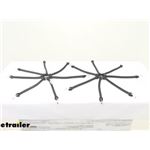
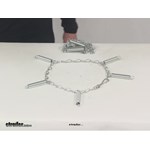
Need serious grip for tractors or skid steers on packed snow and ice? Heavy equipment tire chains with square links dig in to keep you moving and handle tough snow removal work. They're hefty, so expect a bit of wrestling during install; use tensioners for a snug fit and check inside clearance between the tire and frame to avoid contact on tight setups.
Yes. Each chain can be roughly 70 lbs, so expect some wrestling. Use tensioners, zip tie everything tight, and a small bungee across the tread at the closure can help prevent the chain from hitting the frame. Check inside clearance, especially if you don't run wheel spacers.
Yes, square link chains improve traction where R4 tires do poorly on packed snow/ice. Rear square links can get a tractor moving with a rear implement, but adding front chains and 4wd is often necessary for most snow removal. Square alloy links bite well and help with uphill work.
Not if the sizes differ much. A 3" width difference can prevent any one chain from fitting both tires. Match square link chains to the exact size on your sidewall, like 10-16.5, 17.5-24, or 365/70-18. If you change tire size, plan on a different chain.
Ladder pattern works well for general traction and breaking up ice. For mud and dirt, double-spaced cross chains can grip deeper. In severe snow, using square links on both axles or pairing rears with front chains and 4wd can improve control.
Yes, square links are used on skid steers and 9k lb machines with solid longevity. Avoid spinning tires on steeper driveways to help them last, since operator use is key. For commercial work, choose heavy-duty chains intended for skid steers or loaders.


 Filters